1. ArchDaily
  2. Digital Fabrication

Digital Fabrication: The Latest Architecture and News

5 Robots Revolutionizing Architecture's Future

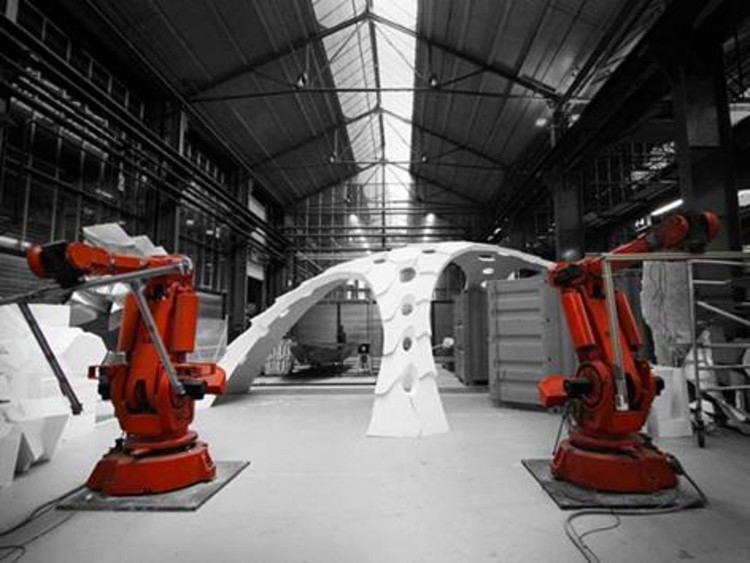
Robots fascinate us. Their ability to move and act autonomously is visually and intellectually seductive. We write about them, put them in movies, and watch them elevate menial tasks like turning a doorknob into an act of technological genius. For years, they have been employed by industrial manufacturers, but until recently, never quite considered seriously by architects. Sure, some architects might have let their imaginations wander, like Archigram did for their "Walking City", but not many thought to actually make architecture with robots. Now, in our age of digitalization, virtualization, and automation, the relationship between architects and robots seems to be blooming...check it out. 

Keep reading to see five new robots making architecture.

5 Robots Revolutionizing Architecture's Future - Image 1 of 45 Robots Revolutionizing Architecture's Future - Image 2 of 45 Robots Revolutionizing Architecture's Future - Image 3 of 45 Robots Revolutionizing Architecture's Future - Image 4 of 45 Robots Revolutionizing Architecture's Future - More Images+ 4

Digital Fabrication / SketchChair

Subscriber Access | 
Digital Fabrication / SketchChair - Featured Image
Diatom Studio, SketchChair Process

Digital fabrication has been a popular discussion among architecture and design professionals. Students are digitally fabricating their models and building their own personalized 3D printers. What was impossible to build by hand is quickly assembled through digital fabrication. As the technology rapidly evolves, larger objects are being fabricated at more affordable prices. Today we may be digitally fabricating furniture and tomorrow we might be 3D printing our house. Architects and designers are jumping on board and exploring the capabilities of this game changing technology.

2011 matR Project: "The Passage"

Subscriber Access | 
2011 matR Project: "The Passage" - Image 9 of 4
© Victoria Capranica

A team of graduate students recently created a temporary installation on the Kent State University, Kent campus in Ohio. The project grew out of an internal challenge in the matR design competition. Designed by graduate students Brian Thoma, Carl, Veith, Victoria, Capranica, Matt Veith, and Griffin Morris, the tunnel-like structure called “The Passage” was a study to support the conceptualization and actualization of innovative and experimental material research. The students created the initial form in Rhinoceros with a couple Grasshopper definitions as a waffle structure of 26 vertical ribs and 24 horizontal struts. More images and information after the break.

Digital Fabrications: Architectural and Material Techniques / Lisa Iwamoto

Subscriber Access | 
Digital Fabrications: Architectural and Material Techniques / Lisa Iwamoto - Featured Image

“Architecture continually informs and is informed by its modes of representation and construction, perhaps never more so than now, when digital media and emerging technologies are rapidly expanding what we conceive to be formally, spatially, and materially possible”

- Lisa Iwamoto

During 2009 I had the chance to visit Iwamoto Scott in San Francisco, a practice lead by Lisa Iwamoto and Craig Scott. At their office I could see first hand the study models for some of the projects the firm has been involved, such as a mockup for their P.S.1 proposal, Coral Reef, or the lightweight wooden pieces that structure the massive Voussoir Cloud installation at SCI Arc. These small pieces had a lot to tell, not only about the specific project they were part of, but also their iterations.

The firm has a recognized expertise in digital fabrication, presented by Lisa Iwamoto at the AIA Convention 2009 during the Emerging Voices forum, and also on her book “Digital Fabrication” edited by Princeton Architectural Press under their Architecture Brief series.

The book presents in a clear way (with very good examples) the methods behind digital fabrication: sectioning, tessellating, folding, contouring, and forming. For most of us these words are pretty much obvious and we often use them as design principles of our projects. But to get the full scope of what they really mean, or for those that want to start understanding -and using- them, this is a recommended reading.