3D Printing has opened up a whole new world for architecture. Technology that was once restricted to fabrication labs is now available to the end user – and at an affordable price. Of course, this new technology has also created the necessity to easily share 3D data over the web.
In the following months, we at ArchDaily will be publishing Nikos Salingaros' book, Unified Architectural Theory, in a series of installments, making it digitally, freely available for students and architects around the world. In the following paragraphs, Salingaros explains why we've decided to impart on this initiative, and also introduces what his book is all about: answering "the old and very disturbing question as to why architects and common people have diametrically opposed preferences for buildings."
ArchDaily and I are initiating a new idea in publishing, one which reflects the revolutionary trends awaiting book publishing's future. At this moment, my book, Unified Architectural Theory, 2013, is available only in the USA. With the cooperation of ArchDaily and its sister sites in Portuguese and Spanish, it will soon be available, in a variety of languages, to anyone with internet access. Being published one chapter at a time, students and practitioners will be able to digest the material at their leisure, to print out the pages and assemble them as a "do-it-yourself" book for reference, or for use in a course. For the first time, students will have access to this material, in their own time, in their own language, and for free!
The book itself arose from a lecture course on architecture theory I taught last year. Students were presented with the latest scientific results showing how human beings respond to different types of architectural forms and spaces. At the end of the course, everyone was sufficiently knowledgeable in the new methods to be able to evaluate for themselves which buildings, urban spaces, and interior settings were better suited for human beings.
This approach is of course totally different from what is now known as “Architectural Theory.”
ArchDaily is looking for some awesome, architecture-obsessed Interns to join our team for Fall 2013 (August 19th – December 6th)! If you want to research/write about the best architecture around the globe – and find out what it takes to work for the world’s most visited architecture website – then read on after the break…
Last year, we spoke at a packed lecture at the Center for Architecture, along with Bjarke Ingels, the Morpholio team and moderator Ned Cramer; we were discussing the impact social media and technology have on our profession and the way in which we design.
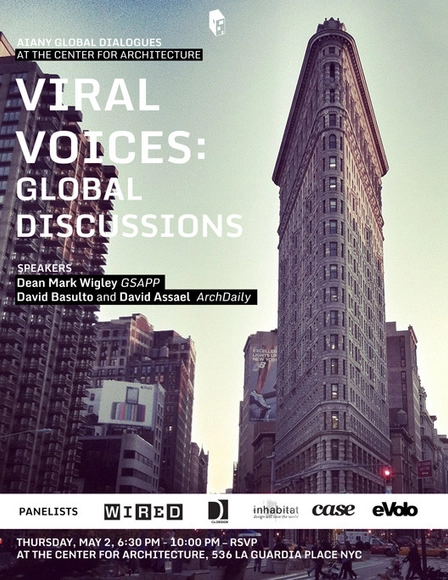
And now, thanks to the AIANY Global Dialogues Committee, we are happy to invite you to a new event taking place at the Center for Architecture on May 2nd, 2013 at 6:30PM, where together with Mark Wigley (Dean Columbia GSAPP) we will address the present and future of architecture education. The lecture will be followed by a panel with our friends Carlo Aiello (eVolo), David Fano (CASE), Jill Fehrenbacher (Inhabitat), Toru Hasegawa (Morpholio), Tim Maly (Wired Magazine ) and Cliff Kuang (Fast Company / Co.Design).
Back in 2006, we saw that there was a very strong generation of young architects that weren't part of the traditional circle of printed publications. So, we had this crazy idea that we could create a platform to give those architects the exposure they deserved, spreading the knowledge and innovations they were producing to the rest of the world. At a time where Web 2.0 shifted how media was produced and consumed, we saw an opportunity to embrace the web for to achieve this goal.
Very soon we realized that we were on the right track: that we were making available to the world a whole new corpus of architecture knowledge, having a positive impact on the speed of innovation in our field, and generating a new, virtuous circle.
Then in 2008, the world entered the urban era with more than 50% of its population living in cities, 3 billion people, a number that is expected to double by the year 2040. This growth is expected to happen particularly in parts of the world where architecture is required the most, and we understood that our global exchange of knowledge was part of that dynamic.
Our mission is to improve the quality of life of the next 3 billion people that will move into cities in the next 40 years, by providing inspiration, knowledge and tools to the architects who will have the challenge to design for them.
In the span of five years, we went from an idea to the world's most visited architecture web site in the world, with over 7 million monthly readers, and a staff of over 50 people working in 9 different countries. This is our story.
"ArchDaily has fed the addiction of architecture to me. The first thing I do in the morning and before I go to sleep, is check from the most interesting and inspiring designs from around the world utilizing the most advanced and socially responsible techniques. Architecture and design choose the user, the user does not choose architecture and design. In this way ArchDaily has allowed the creativity to flow more rapidly throughout my veins and caus[ed] more creativity to flourish. Thank you ArchDaily for aiding in times of frustration and times of designer block. Thank you for the effort you put forth for the architecture and design community, and you are a vital resource." - Chris Siminski, ArchDaily reader and Facebook Fan
Five years ago, ArchDaily was a tiny 5-man operation, spearheaded by two Architecture grads with a very simple dream: to shake-up and democratize traditional architectural media. Fast-forward five years later, and we're the most visited architecture web site in the world, with over 280,000 daily readers and 70 million pageviews every month.
We're celebrating today with a doodle (see above) and lots of fantastic content - keep your eyes peeled for the 20 Most Visited Projects of All Time, the 5 Most Read Posts of All Time, and an ArchDaily original Infographic telling our story.
And of course, we'd like to use this occasion to thank you, ArchDaily readers. You've meant everything to us these past 5 years, and we'd love it if you could tell us what we've meant for you. So please share your thoughts in the comments below! And have a very happy ArchDaily birthday!
Today, ArchDaily turns 5 years old! We've already shared with you our special doodle of the day and the 20 Most Visited Projects of ArchDaily history - now, let's look back at the 5 posts that most caught your attention these past five years. From the ever-pressing topic of work/life balance to an underground Data Center lair, these five posts offer us a snapshot of what's important to architects today. Enjoy!
The 5 Most Read Posts in ArchDaily history, after the break....
As you might have heard, ArchDaily is celebrating our 5th birthday today! We decided it was time to get a bit nostalgic and look back at the projects of yesteryear, the ones that struck a chord with you, our ArchDaily readers, and helped us get to where we are today.
So, with no further ado, the 20 most visited projects in ArchDaily history! Beginning with....
See our 20 most popular projects of all time, after the break...
Over the last year ArchDaily has kept growing, reaching more than 280,000 daily readers and 70 million pageviews per month. But more important than these figures is our mission: to provide inspiration, knowledge and tools for the architects that will face the challenge of improving the quality of life of the next 3 billion people that will live in cities in the next 40 years.
After two intense weeks, with 40,000 nominations, the collective intelligence formed by the readers of ArchDaily has scrutinized close to 3,000 projects, creating the shortlist that now moves into the final voting stage.
As in previous years, we have to congratulate our readers, as the finalists are outstanding. Buildings from all over the world, by firms of all sizes and trajectories, ranging from social buildings with no budget to state of the art buildings. But they all have something in common: good architecture that can improve people’s lives.
The winners of the iPad Minis that we are giving away during the nomination process are: Sunil Bald and Susana Carls (you’ll receive an email shorty). And remember that we are giving away two iPads during the final voting round!
For the 4th consecutive year, we are proud to announce the Building of the Year Awards. During the past year we continued to grow, reaching over 280,000 daily visitors and close to 70 million page views per month. We also expanded our ever-growing network of architects on social media: 640,000 fans on Facebook, 105,000 followers on Twitter, 40,000 followers on Instagram and more than 100,000 photos contributed to our Flickr group.
But ArchDaily is more than numbers. The world faces fundamental problems, related to health, energy, climate, and more. And almost all these problems are related to the built environment.
We launched ArchDaily Mexico this year, which joins ArchDaily, ArchDaily Brasil and Plataforma Arquitectura in our mission to improve the quality of life for the 3 billion people who will live in cities in the next 40 years. How can we do this? By providing the inspiration, tools and knowledge to the architects who will face this challenge. By connecting the traditional hot-spots of architectural production with emerging economies (where a lot of innovation is happening). We believe that, in this way, the constant iteration of architecture will accelerate and result in better and faster solutions to the world’s issues.
That’s why the Building of the Year Awards are so important for us. It is a peer-based award process that identifies and recognizes projects with impact. It will be up to you, the architect, to nominate and choose the winners for each category. It will be up to you to be a part of a collective intelligence that will judge more than 2,700 projects – a scope we think is unprecedented in the world of architecture.
For the next 4 weeks, you’ll be in charge of nominating buildings for the shortlist, and then voting for the winners. We will give away iPad Minis and 4th Generation iPads for voters, and will include amazing plotters (courtesy of our friends from HP) for the firms behind the two projects with the most votes.
Rules at a glance: During the nominating stage, each registered user of the My ArchDaily platform will be able to nominate once per day for their favorite projects (published between Jan 1st 2012 and Dec 31st 2012), the counter resets at midnight EST. This stage starts on Jan 15th and ends on Jan 29th at 11:59PM. After this, five projects per category will move into the voting stage, starting January 30th and ending on February 13th. The winner will be announced on February 14th. Start voting here.
ArchDaily is in need of a select group of awesome, architecture-obsessed Interns to join our team for Spring 2013 (January 14th - May 14th)! If you want to spend your days researching/writing about the best architecture around the globe - and find out what it takes to work for the world's most visited architecture website - then read on after the break...
We know you’ve been anxiously waiting to have ArchDaily with you everywhere you go - whether on the road or on your couch. Well, we’ve listened, and we’re more than proud to announce the launch of our first iPad application!
Our new App will give you in-depth access to the winners and finalists of The Building Of The Year Award, the most important architecture award in the online world (since 2009). It’s an award that recognizes architects - both established heavyweights and emerging talents - as the best and brightest of today, and they’re all chosen by you, our community of ArchDaily readers. While you'll have to wait a bit longer until you can vote for your favorite 2012 projects (TBA early 2013), the App offers the perfect distraction: full access to the 2011 winners.
Find out more about our “Building of the Year” App, after the break...
We at ArchDaily are used to picking the best buildings for you, dear readers, but we felt it was time to turn the tables a bit. The following is the best of you. You didn’t always agree with us, but you opined intelligently, and for that we salute you.
”Imagine if we designed all public space as if we lived in a democracy. Imagine if we treated participation as a right. Imagine if this was part of the core curriculum in architecture schools.”
– Graeme Bristol
Our Number 1 Comment, after the break…
https://www.archdaily.com/222335/the-best-of-you-our-top-3-comments-of-the-monthAmber P
After two weeks and more than 30,000 nominations, we are proud to announce the finalists for the 2011 Building of the Year Award, a selection of the best projects made by our readers.
The shortlist for the awards includes 70 projects in 14 categories, a selection that shows the diversity of projects featured at ArchDaily during the past year. From small interiors to large scale buildings, designed by renowned practices and young architects, in different locations around the world.
I’d like to thank everyone who participated during the nominations round, as the finalists are outstanding.
You can vote for your favorite projects starting today and until March 6th at midnight EST (all the rules here):
During the process we worked very hard to log and flag every attempt to abuse the voting system, removing fake accounts and automated votes, and we wil continue to do so during this stage.


.jpg?1382361160)

.jpg?1373988741&format=webp&width=640&height=580)


.jpg?1362687201)


