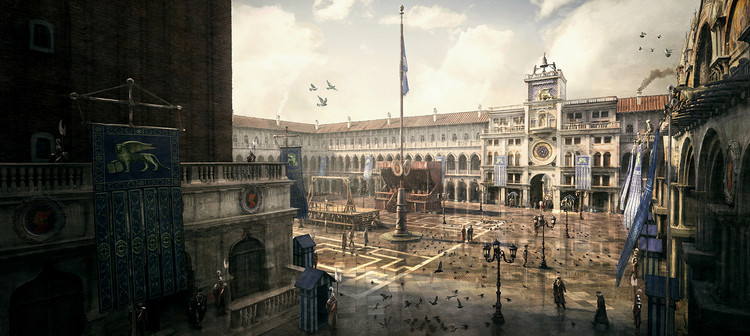
Video games and virtual worlds are jam-packed with imaginative environments to explore, time periods to peruse, and invented architectural styles to thumb through within every reality we choose to engross ourselves into. With recent advancements in technology, greater than ever are we witnessing the latest PC and console generations harboring the ability to produce life-like settings for players to roam around, get lost, and explore all the nuances the seemingly authentic reality holds.
In this new collaboration, originally titled Cartografías del Metaverso (Cartography in the Metaverse), Spanish architects and founders of the blog MetaSpace, Enrique Parra and Manuel Saga, explore the potential of mapping in video games. Mapping can sometimes go beyond the mere role of orientation, as in the Diablo sequel, and become a very important element of the game, as in Civilization and World of Warcraft.
The cartographic and planimetric language of architecture is also common to the world of video games. Many video games base much of their experience on interaction with one or more maps, through which users orient themselves to find out where they are and where they are supposed to be.
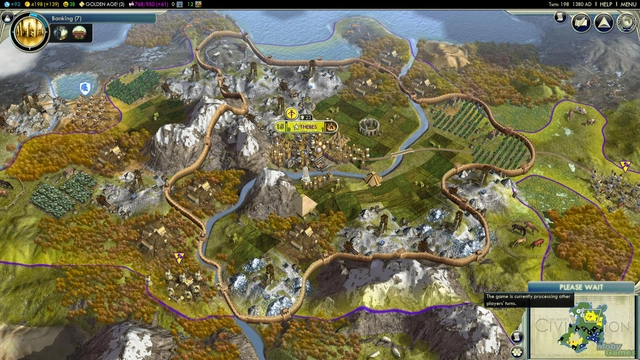
One example is the Civilization saga, a series of empire management games created from 1991 to date. All versions are played on a map, a geographical view of the world that represents different areas, available resources, geopolitical balance, and other factors. These variants are the rules of the game, the situation the player faces; the map becomes a dynamic fabric, ie, the interface that makes up the game.
https://www.archdaily.com/782818/cartography-in-the-metaverse-the-power-of-mapping-in-video-gamesEnrique Parra y Manuel Saga
We’ve asked our ArchDaily readers about which video game has impressed them most in terms of architectural visualization, and why. Hundreds of various answers later, it became evident that there isn’t one element that makes a video game stand out, but the virtually-built environment is almost always a key factor in how the game is experienced.
In video games, architecture plays a much bigger role than just being a backdrop of a virtual city or an authentic render of an existing one, it is, in fact, a fundamental component of transcending gamers into a virtual world that feels just as authentic as the real world does, but with extra adrenaline.
(WARNING: the videos and images featured in this article may potentially trigger seizures for people with photosensitive epilepsy)
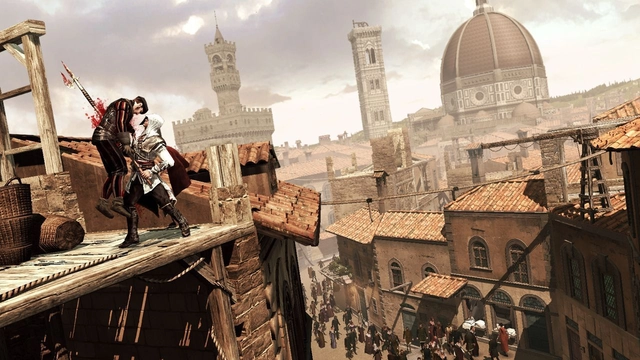
In the following article, originally published in Spanish on MetaSpace as "Assassin's Creed 2 - Arquitectos que hacen videojuegos"(Architects Who Make Video Games), Spanish architect Manuel Saga interviews María Elisa Navarro, a Professor of Architectural History and Theory, who worked with Ubisoft Montreal as a historical consultant on the design team for the video game Assassin's Creed II, from the first rough drafts up to its launch in November of 2009.
While getting her PhD at McGill, María Elisa Navarro was a consultant for the entire development process of the game as part of a research project between the university and Ubisoft Montreal. She worked on the project in complete secrecy with "a small team of 20 people and then later more than 400 in a huge basement in Montreal." Navarro worked on everything from late 15th century wardrobes to the correction of architectural errors in the recreated cities, going over the look and ornamental details of the buildings.
"Sometimes, for gameplay purposes, they needed to have walls with a lot of texture so that Ezio could climb them, but when the time came to lay those parts out, there were some inaccuracies. For example, I remember a balcony with a wrought iron railing that couldn't have existed in that time period. I was responsible for detecting those issues," Navarro noted in her conversation with MetaSpace.
Read the full interview with Navarro after the break.