Giorgi Khmaladze

BROWSE ALL FROM THIS PHOTOGRAPHER HERE

The Evolution of Gas Stations: From Roadside Stops to Architectural Landmarks

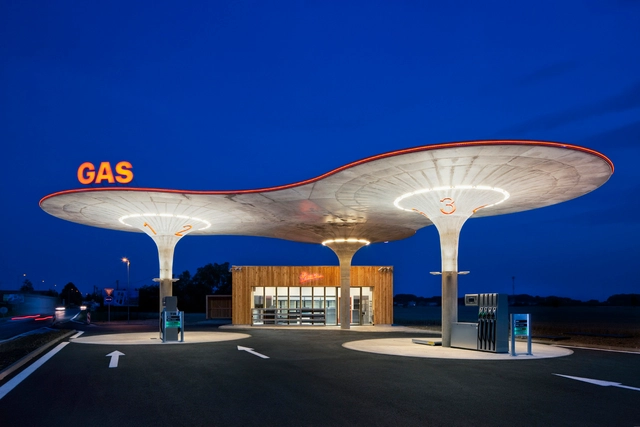
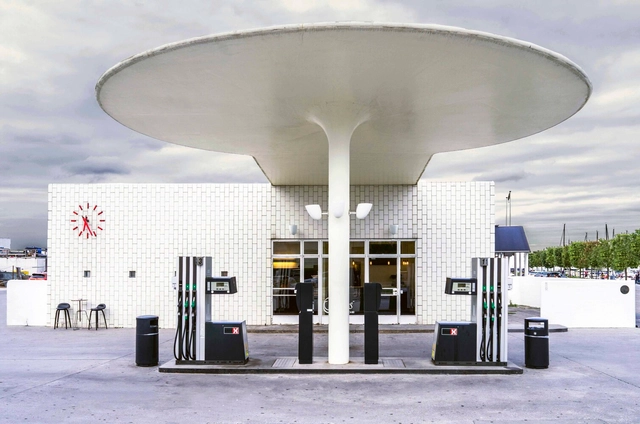
The gas station is an architectural typology that has undergone significant transformations since its inception. Initially, these structures were simple roadside refueling points designed for functionality rather than aesthetics. As automobile culture expanded, gas stations evolved to accommodate new technologies, shifting urban landscapes and changing consumer behaviors. Over time, they became more than just utilitarian stops — they developed into service hubs, integrating restaurants, motels, and leisure spaces, responding to contemporary transportation increasing demands.

By the late 20th century, however, the widespread standardization of gas stations led them to be perceived as "non-places", a concept defined by anthropologist Marc Augé to describe transient spaces that lack social or cultural significance. With uniform designs and a focus on efficiency, gas stations became interchangeable, reinforcing their role as purely functional infrastructure rather than meaningful architectural interventions. This standardization also departed from the era when fuel stations served as recognizable landmarks, contributing to a homogenized landscape devoid of local identity.

The Evolution of Gas Stations: From Roadside Stops to Architectural Landmarks - More Images+ 41

Meama Collect Beach Bar / Khmaladze Architects

Meama Collect  Beach Bar / Khmaladze Architects - Exterior Photography, Bar
© Giorgi Khmaladze

Meama Collect  Beach Bar / Khmaladze Architects - More Images+ 12

Batumi, Georgia

What is the Future of the Gas Station?

For decades, the gas station has been a staple of both urban and rural landscapes. As the 20th century saw the democratization of automobiles, the gas station became arguably one of the most generic, universal architectural typologies. Today in the USA alone, there are 130,000 gas stations serving 268 million cars. However, as populations move to condensed, urban areas with ever-improving public transit systems, and as the internal combustion engine evolves into electric alternatives, it is time to either redesign or retire the gas station.

What is the Future of the Gas Station? - More Images+ 10

Khmaladze Architects Revealed as Grand Prize Winner of the ArchDaily & Strelka Award

The winner was announced by ArchDaily Editor-in-Chief David Basulto at the Future Architect conference at Strelka Institute. The grand prize went to the Coffee Production Plant in Tbilisi, designed by Georgian architecture firm Khmaladze Architects.

Coffee Production Plant / Khmaladze Architects

Coffee Production Plant / Khmaladze Architects - More Images+ 28

Fast Food Slowed Down: What's Behind the All the Redesigns - and Is It Enough?

Subscriber Access | 

Some restaurants don’t need a review to get attention. You might know them for their longevity, their presence, or even just their advertisements. But most importantly, whether it’s their grand luminous logo, or the building’s prominent architecture and color palette, these franchises are more or less the same (the menu, the music, the interior design…), wherever you are, be it London, Lima, or Lahore.

Recently, however, a few of these places have begun to shift away from the “architectural stamp” that they use in all their branches, hiring design firms to rebrand their restaurants - and by extension, their image. This bespoke approach can result in outposts that are atypically site-specific, understated, and individual. For users, it may be a point of curiosity; a reason to revisit what you think you already know. For the brand, it's an attempt to cater to evolving tastes (culinary and otherwise) without having to alter the core product.

Fast Food Slowed Down: What's Behind the All the Redesigns - and Is It Enough?  - More Images+ 15

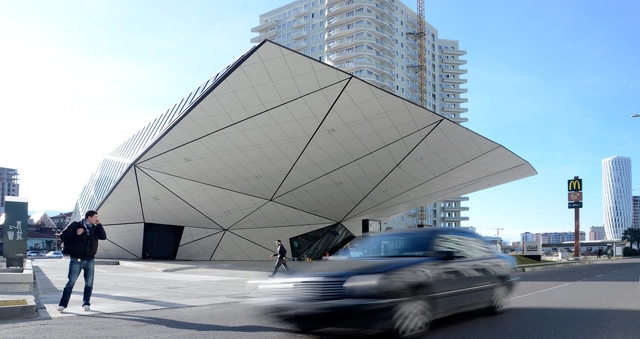
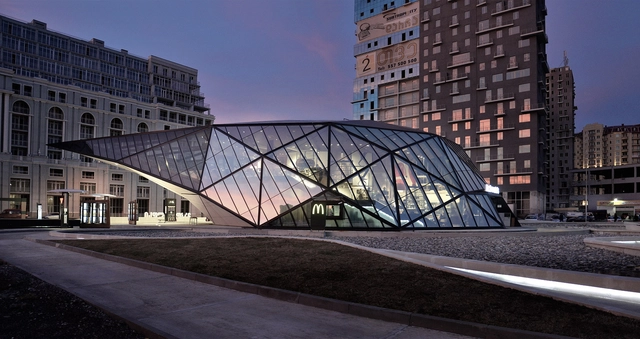
Fuel Station + McDonalds / Khmaladze Architects

Fuel Station + McDonalds / Khmaladze Architects - More Images+ 17