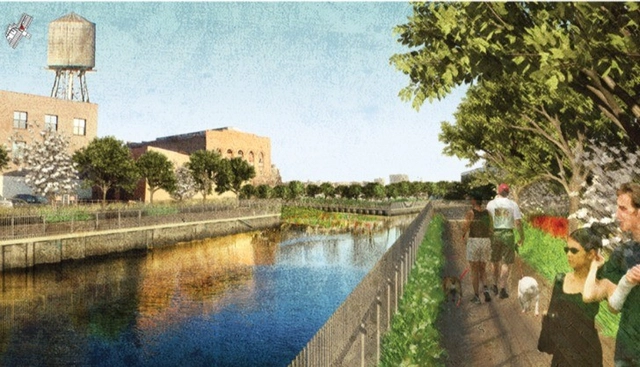
One of the United States’ most polluted bodies of water is about to receive a much needed make-over: In early 2014, construction will begin on a pollution-preventing greenscape that will run alongside Brooklyn’s Gowanus Canal. The proposal, dubbed Sponge Park, was envisioned more than five years ago by Susannah Drake of dlandstudioand has just now “soaked up” enough funds to move forward.
Videos
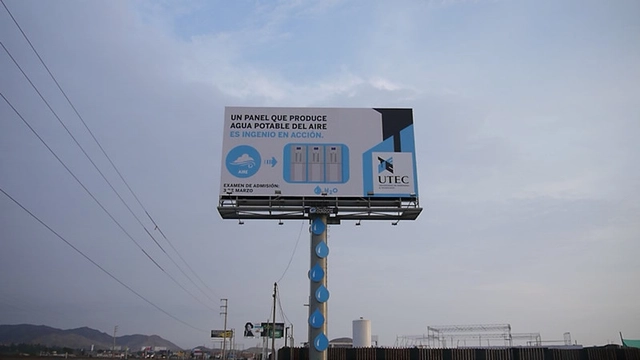
The billboard reads "A panel that produces potable water out of air is ingenuity in action." Courtesy of UTEC.
According to the UN, about 60% of the world's population will be living in cities within the next 8 years - a human migration that adds more and more strain on cities' sanitation and resources. One of these many urban centers is Lima, Peru, the second largest desert capital in the world that receives less than 2 inches of rain a year. Despite its nearly nonexistent rainfall, Peru has some of the highest atmospheric humidity anywhere - 98%.
The University of Engineering and Technology of Peru (UTEC) and an ad agency called Mayo DraftFCBand saw great opportunity in this invisible source of water and created a billboard that can capture this humidity and turn it into potable drinking water for nearby residents.
Which cities are embracing the green revolution? This infographic compares the efforts of six leading cities - New York, Vancouver, Copenhagen, London, Amsterdam and Stockholm - in the race to drastically reduce global C02 emissions. Based predominantly on 2009 statistics, Stockholm seems to be leading the way in carbon reduction. Continue reading after the break to see who claims the blue ribbon for renewable energy, efficient water consumption and rigorous recycling.
In celebration of World Water Day, we have complied a list of ten environmentally conscious designs that epitomize the importance of water conservation. See what they have to offer, after the break.
Who will run the world for the next 100 years? Envision Solar President and CEO Desmond Wheatley argues that it will be whoever has abundant sources of power. That is constructive power, rather than destructive power, which is essential to run the information and technology industries that our world is entirely dependent on. Additionally, Wheatley states that energy equals water. And, with less than 1% of the world’s fresh water available for use, desalination is becoming an increasingly plausible solution. The only problem now is that energy is expensive. But, once cities have the will to switch over to renewables, that will no longer be an issue. Could you imagine San Diego as an net exporter of water? Desmond Wheatley can.