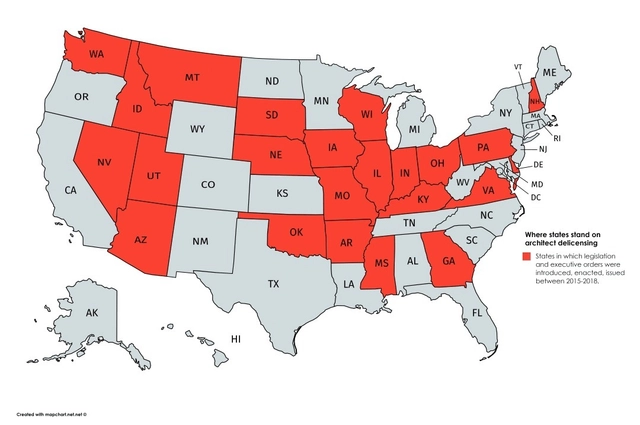
With a growing number of states choosing to rollback professional architectural licensure requirements, the American Institute of Architects (AIA) has issued a “Where We Stand” statement calling for the reinforcement of the practice, which they believe stand to “protect the health, safety and welfare of the public and shield consumers from unqualified practitioners.”
According to the AIA, over the past 5 years, legislative or executive actions have been taken in at least 25 states to impose the “least restrictive regulations” for professional licensure, with several states recommending the elimination of all licenses in the state.
https://www.archdaily.com/887865/aia-responds-to-actions-taken-by-25-states-to-reduce-architectural-licensure-requirementsAD Editorial Team
It’s no secret that the architecture field struggles with diversity. Both personal stories and deeper studies detail the profession’s lack of representation. But despite concerns suggesting diversity in the field remains stagnant, there’s good news: the latest data from the National Council of Architectural Registration Boards (NCARB) reveals that gender, racial, and ethnic diversity is slowly improving.
The 2017 edition of NCARB by the Numbers (NCARB’s annual data report) indicates that while the number of architects and licensure candidates holds steady, the pool of individuals is more diverse than ever before. Although there is still much room for improvement, this data provides an encouraging glimpse into the future of the profession.
https://www.archdaily.com/885908/ncarb-by-the-numbers-report-reveals-positive-trends-for-diversity-in-the-architecture-professionthe National Council of Architectural Registration Boards (NCARB)
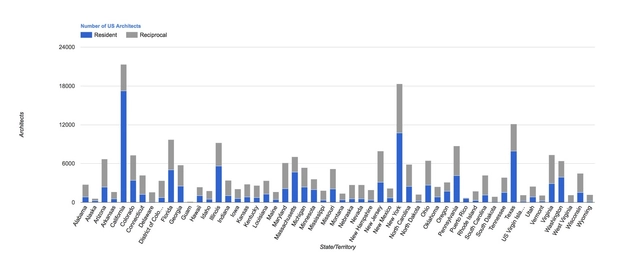
As architects around the country gather for the 2017 AIA Convention in Orlando, the National Council of Architectural Registration Boards (NCARB) has decided to share some initial results from their 2016 nationwide Survey of Architectural Registration, specifically, the number of architects licensed in each state.
The data tracks both the number of resident licenses and reciprocal licenses (licenses for a particular state held by a resident of another state). The 2016 survey found that the number of architects working in the US has held steady, and that architects are working across state lines more than ever before. While the total number architects dropped slightly from the previous year (0.4 percent) to 109,748, the number out-of-state licenses grew a full 3 percent to 126,554.
For U.S. architects, working abroad will now be easier than ever, as the National Council of Architectural Registration Boards (NCARB) has announced a new mutual recognition arrangement with the licensing authorities of Australia and New Zealand. Effective as of January 1, 2017, the agreement allows architects to earn reciprocal licenses that authorize architects to work in the two countries.
For architects seeking NCARB licensure, few things are more daunting than the dreaded structural exam. But now, thanks to a series of videos from structural engineer Dilip Khatri, even those of us who spent more time doodling than paying attention in college engineering classes can acquire the skills needed to pass the structural section of the ARE.
Khatri, principal of Khatri International Structural and Civil Engineers, has a PHD in Structural Engineering from the University of Southern California and over 30 years experience in the profession, including over 20 years of teaching structural engineering. In the videos, he covers everything you’ll need to know for the exam, from test-taking strategy to shear and moment diagramming to complex problem solving, illustrating with the help of a sharpie pen.
With recent streamlining and increased flexibility of architectural licensing programs, the time it takes to earn a license has decreased for the seventh year in a row, and the average age of licensure has concurrently dropped. On average, it takes just over 13 years to become an architect, from the time a student enrolls in school to the date they receive a license.
As of June 29, 2016, the National Council of Architectural Registration Boards (NCARB)’s Intern Development Program will be renamed the “Architectural Experience Program," or AXP. Part of a wider change in the industry to retire the term “intern,” the decision was made after years of research and outreach by various committees, as well as feedback from “state licensing boards, industry leaders and emerging professionals.”
The program, developed by the NCARB, is meant to guide aspiring architects through their early career, helping them earn their license and practice independently. NCARB will continue referring to those working toward licensure as “aspiring architects” or “exam candidates.”
The National Council of Architectural Registration Boards (NCARB) has selected the architectural programs at Mississippi State University, Philadelphia University and the University of Florida as the recipients of the 2015 NCARB Award for the Integration of Practice and Education. The Award helps the selected universities develop "innovative curricula that merge practice and education." This year over $99,000 was awarded to the three programs to develop their proposed initiatives.
“What makes the NCARB Award different from other awards is that it is focused on fostering collaboration between the academy and practice,” said NCARB President Dennis S. Ward, AIA, NCARB in a press release. “This year’s proposals all go further to give students, practitioners, and others within the profession meaningful interactions that will raise awareness for the architect’s role and address issues that are central to practice.”
The National Council of Architectural Registration Boards (NCARB) has named the first 13 accredited architectural schools to implement the "Integrated Path Initiative." Each selected school has proposed a pre-graduation curriculum that would provide students with the necessary mix of education, work experience, and opportunities to complete the Architect Registration Examinations (ARE) to achieve licensure before graduation. The initiative was spearheaded by NCARB to shorten the time it takes for US architects to get licensed.
The 13 accepted schools represent "a wide range B.Arch and M.Arch programs in nine jurisdictions, including both public and private institutions," says NCARB. These schools are:
“The programs in this inaugural class exhibited a high degree of creativity, and are focused on strengthening the relationship between schools, the practice community, and licensing boards,” said Licensure Task Force (LTF) Chair Ron Blitch, a Louisiana architect who is a former NCARB President and current member of the NAAB Board of Directors and the Louisiana State Board of Architectural Examiners.
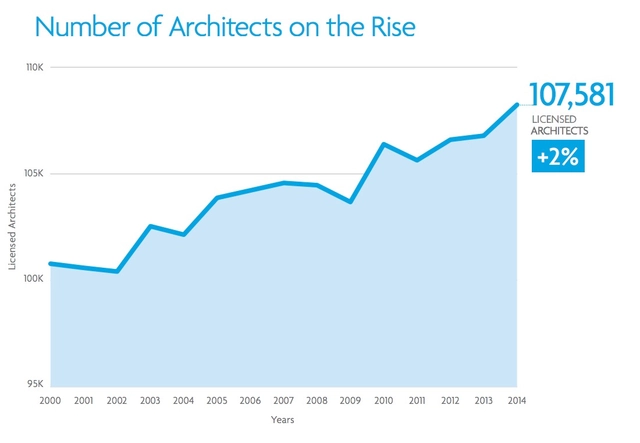
The National Council of Architectural Registration Boards (NCARB) has released “NCARB by the Numbers,” their annual report featuring statistics important to the architecture profession in the US. NCARB’s research portrays a positive future for the profession, with statistics showing that diversity is growing, architects are becoming licensed at an earlier age and progressing through licensure paths more quickly than in previous years, and more architects are becoming licensed than ever before.
The 2015 report covers the causes and effects of the results, looking into the impact of location and education. A section entitled “Jurisdictions by the Numbers,” lays out standardized relevant information for viewers to investigate conditions in the architecture profession in each state. The report also includes an analysis of the role of NAAB-accredited programs in helping architects achieve licensure.
Learn more on the information in NCARB’s report after the break.
The National Council of Architectural Registration Boards (NCARB) has formed an agreement with the Conselho de Arquitetura e Urbanismo do Brasil (CAU/BR) to “exchange information and share best practices” regarding the regulation of architectural licensure and professional standards.
“NCARB is pleased to be in a position to help Brazil strengthen and solidify its regulatory approach governing architects,” said NCARB President Dale McKinney, FAIA, NCARB. “We are also excited to learn from Brazil’s activities, including its effective national system of monitoring various aspects of architectural practice.”
Becoming licensed is no easy feat for the recently graduated architecture student. The combination of required internship hours and exam scores proves a daunting obstacle for most, often taking years of work after college to surpass. Now, however, the National Council of Architectural Registration Boards (NCARB) is testing the waters for an alternative system that could grant licensure to students immediately upon graduation.
New York-based architect Richard Meier’s 180-meter “Reforma Tower” planned for Mexico City (click image for more)
A tri-national agreement between the United States, Canada and Mexico will now allow architects to work across borders in North America. As reported by the US National Council of Architectural Registration Boards (NCARB), in conjunction with the Canadian Architectural Licensing Authorities (CALA) and the Federacion de Colegios de Arquitectos de la Republica Mexicana (FCARM), representatives from the architectural regulatory authorities in all three countries have agreed to mutually recognize architect credentials.
"The Dean of Parsons: Design Education Must Change" (click image for article). Image Courtesy of Metropolis Magazine
The National Council of Architectural Registration Boards (NCARB) has awarded Parsons The New School for Design and Clemson University the 2014 NCARB Award to aid the development of innovative programs that merge practice and education.
"The award honors innovative ways for weaving practice and academy together to address real-world architecture challenges," says NCARB CEO Michael J. Armstrong. "The winning proposals for 2014 explore new paradigms of practice and move students from the theoretical to applied practices working with licensed practitioners."
The U.S. National Council of Architectural Registration Boards (NCARB) has released a statement endorsing licensure upon graduation from accredited programs. Though the release did not specify a definite plan of action, the announcement acknowledges the benefits of restructuring U.S. licensure so that “rigorous internships and examination requirements” are all fulfilled during the education process.
Envisioned by NCARB’s “Licensure Task Force,” the “new path” concept overhaul will move forward by identifying schools interested in participating in the program. A Request for Information will be sent out later this year, followed by a Request for Proposal process in 2015.
Though many U.S. architects have seemingly longed for news such as this, others argue that there are drawbacks to licensure upon graduation. Let us know your thoughts in the comment section after the break.
A few days ago I took part in an AIA-organized Twitter discussion (#aiachat) focused on the subject of IDP, or what we here in the US call the Intern Development Program, administered by the National Council of Architectural Registration Boards (NCARB).
I periodically get sucked into these Twitter discussions when I’m busy procrastinating and not writing what I’m supposed to be writing. Call it a weakness for provocative questions thrown out on Twitter by faceless moderators:
Q1: What advice do you have for interns getting started with IDP?
Q2: Many states allow concurrent completion of IDP and ARE4. What are the benefits of participating in both at the same time?
Q3: What resources have you used to help navigate IDP?
And so forth.
The discussion brought back painful memories of my own tortuous IDP experience. By the time we got to Q7 or Q8 I came to a conclusion: IDP needs to be radically overhauled and re-conceptualized.
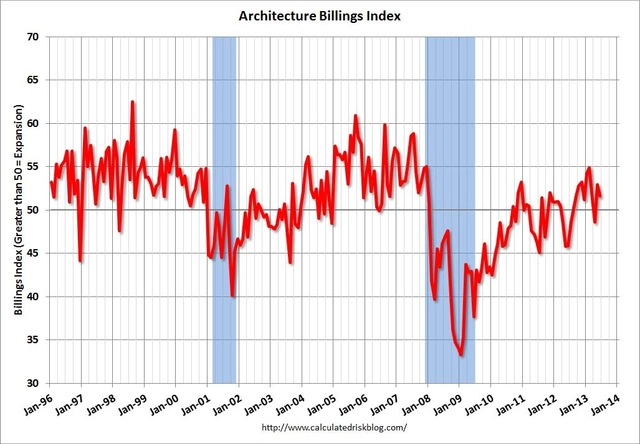
The Architecture Billings Index (ABI) remained positive again in June after the first decline in ten months in April. As a leading economic indicator of construction activity, the ABI reflects the approximate nine to twelve month lag time between architecture billings and construction spending. The American Institute of Architects (AIA) reported the June ABI score was 51.6, down from a mark of 52.9 in May. This score reflects an increase in demand for design services (any score above 50 indicates an increase in billings). The new projects inquiry index was 62.6, up sharply from the reading of 59.1 the previous month.
Key ABI highlights and details on the construction industries remaining threats after the break...