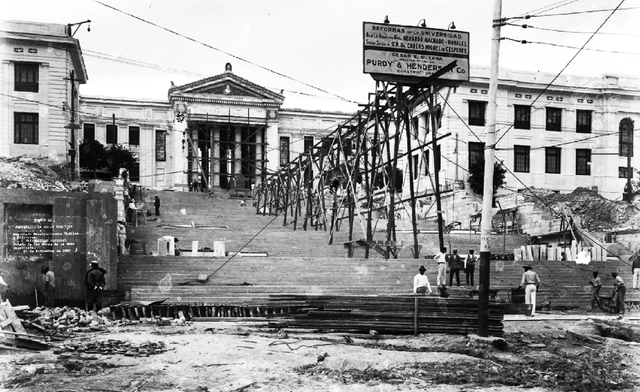
Havana University Staircase by Purdy & Henderson circa 1927 from Beatriz del Cueto's Brunner research.
The Center for Architecture is now accepting applications for the 2020 Arnold W. Brunner Grant. This grant is awarded to mid-career architects for advanced study in any area of architectural investigation that will contribute to the knowledge, teaching, or practice of the art and science of architecture. The proposed investigation is to result in a publicly available written work, design project, research paper, or other form of presentation to be offered at the Center for Architecture. Previous topics of research have ranged from the impact of American architects on Cuba’s historic built environment to the importance of public restrooms in creating greater social equity. Projects are judged based on their engagement with contemporary local and global architectural issues and the usefulness of the research’s product.
During the World Architecture Festival 2018, which will be held this year again in Amsterdam, we had the chance to sit down with Kim Nielsen, one of the founders of Denmark-based firm 3XN.
3XN is today one of the most renowned Danish firms, operating on a global scale. With strong expertise in healthcare and institutional projects, the firm early on decided to focus on a global strategy. "When we came into the crisis in 2008, we have already done a couple of buildings abroad. [...] but after the crisis we realized, we had to be global," Kim explains.
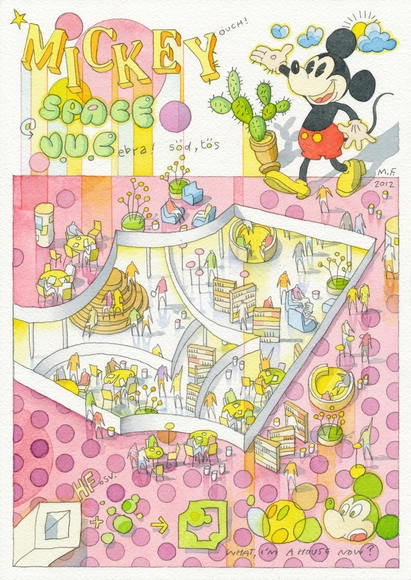
With the aim of generating an architecture that incubates the wellbeing, self-realization, and fulfillment of its inhabitants to become the best version of themselves, CEBRA has launched an ambitious Research and Development Program (R&D) called WISE (Work, Innovation, Space and Education).
As explained by its creators, the purpose of WISE is "to bridge the ongoing and rapid change in the sectors of workspace and education to inform the design of buildings that stimulate learning and innovation. We are connecting ideas of the foremost thinkers of education and entrepreneurship, research and studies in sensory stimuli, cognitive psychology, and behaviorism with architecture."
We spoke with Carsten Primdahl, founding partner of CEBRA, and Klaudio Muca, R&D Architect at CEBRA, to better understand the approach and expected results of the program.
Recently we’ve written a fair amount about the state of architectural research. The general consensus appears to be that it lacks rigor and, even more importantly, is not grounded in good science. Steven J Orfield has some strong opinions about architectural research. He’s been conducting it—for architecture and design firms, as well as Fortune 500 companies—at his Minneapolis-based Orfield Laboratories for more than three decades now. Late last week I talked to him about why architects are afraid of science, how he would introduce it into the schools, and his work in the field of universal design.
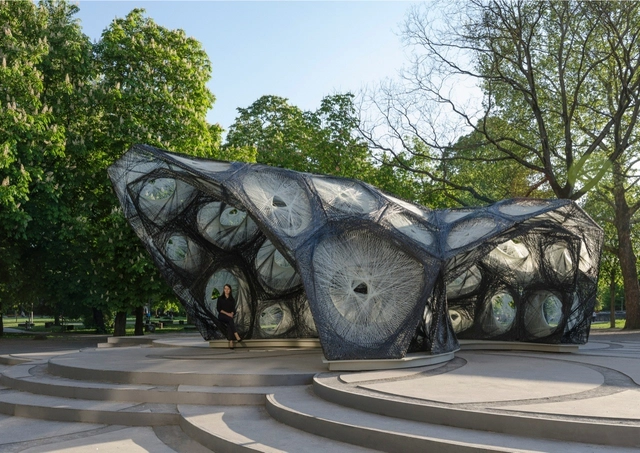
ICD-ITKE Research Pavilion 2013-14. The annual ICD-ITKE Research Pavilion, completed by students at ICD-ITKE University of Stuttgart, is an example of Christopher Frayling's definition of research "Through." In Till's model, this could be categorized as research into architectural products. Image Courtesy of ICD-ITKE
Jeremy Till's paper "Architectural Research: Three Myths and One Model" was originally commissioned by the Royal Institute of British Architects (RIBA) Research Committee, and published in 2007. In the past decade, however, it has grown in popularity not just in the UK, but around the world to become a canonical paper on architectural research. In order to help the paper reach new audiences, here Till presents an edited version of the original. The original was previously published on RIBA's research portal and on Jeremy Till's own website.
There is still, amazingly, debate as to what constitutes research in architecture. In the UK at least there should not be much confusion about the issue. The RIBA sets the ground very clearly in its founding charter, which states that the role of the Institute is:
The advancement of architecture and the promotion of the acquirement of the knowledge of the various arts and sciences connected therewith.
The charter thus links the advancement of architecture to the acquirement of knowledge. When one places this against the definition of research given for the UK Research Assessment Exercise (RAE), “research is to be understood as original investigation undertaken in order to gain knowledge and understanding”, one could argue that research should be at the core of RIBA’s activities. This essay is based on the premise that architecture is a form of knowledge that can and should be developed through research, and that good research can be identified by applying the triple test of originality, significance and rigor. However, to develop this argument, it is first necessary to abandon three myths that have evolved around architectural research, and which have held back the development of research in our field.
https://www.archdaily.com/802766/architectural-research-three-myths-and-one-modelJeremy Till