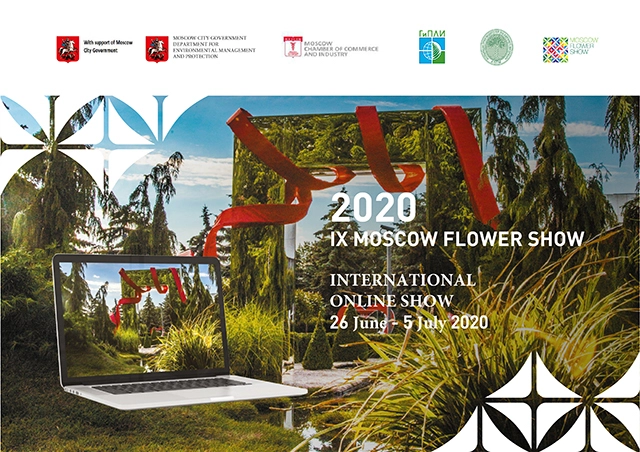
The 9th International Moscow Flower Show announces the first virtual international competition for the Best Garden Design that will be held on MFS ONLINE platform. The participation is open for the students, designers, engineers and other specialists in the field of landscape architecture and garden design.
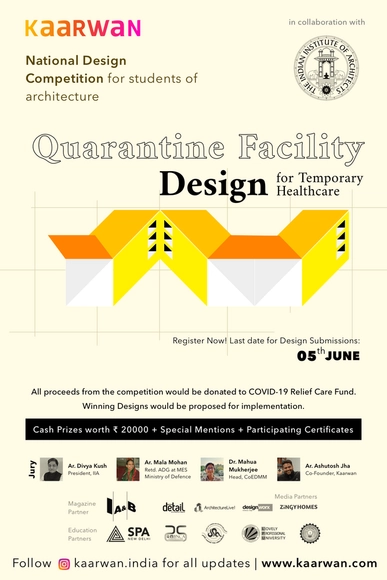
We are living in uncertain times and as citizens of a developing economy, we are posed with an additional challenge of using our resources sparingly so as to ensure minimum impact on our economy.
Humankind has witnessed several historic, life-changing episodes such as industrialisation, colonisation and wars, and society has always adapted to such significant milestones fruitfully. Over the years architecture too, has been a witness the very same happenings, and has shaped itself accordingly to suit the times.
New realismo - inventory of human experience is a catalogue of gestures in PNG to make people reflect on and perceive the city and the social spaces from a new point of view.
GIDA 2020 - Goldreed Industrial Design Award - is the new international design award sponsored by the Xiongan Future Industrial Design Institute, with the aim of promoting at an international level the concept of “harmony” applied to design.
Projects should be delivered using ARCHICAD, the industry first BIM software for architects developed by GRAPHISOFT, and its supported 3rd party applications.
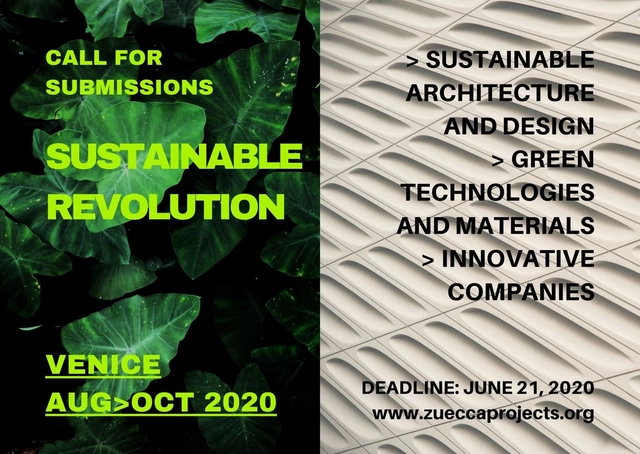
As a reaction to the unprecedented moment that we are all experiencing, Zuecca Projects has decided to launch its first-ever Open Call, on the theme of Sustainable Architecture and Design.
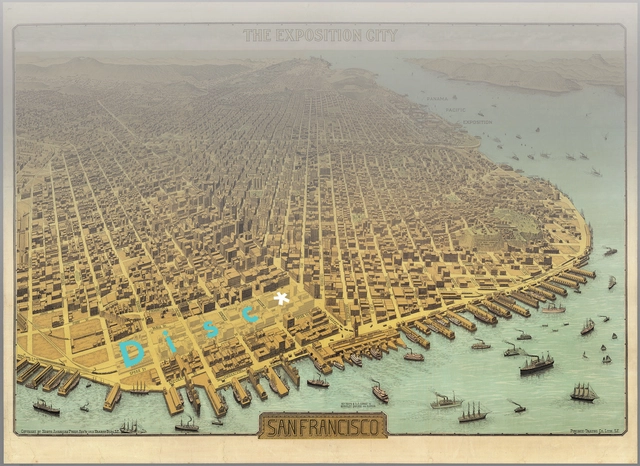
Disc*2020 (Design & Innovation for Sustainable Cities) is a five week summer program for currently enrolled college students that explores an interdisciplinary and multi-scalar approach to design and analysis in the urban environment.
UC Berkeley's College of Environmental Design is now accepting applications for the 2020 Summer [IN]SITU: A Virtual Summer Institute in Environmental Design.
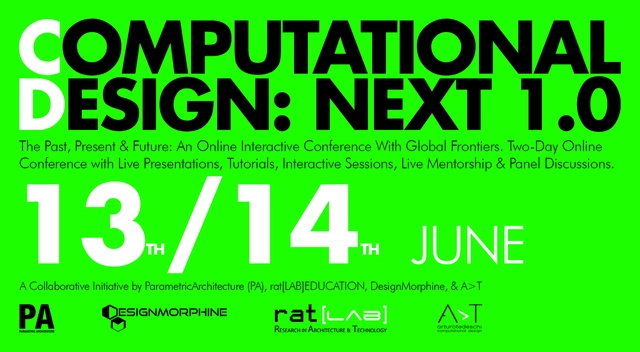
Computational Design: NEXT is a collaborative initiative by some of the global frontiers of Computational Design to open up an Online Learning platform as a comprehensive ONLINE CONFERENCE comprising of discussions, dialogues, tutorials and mentorship to a global audience through thought-provoking and meaningful dialogues curated by Parametric Architecture (PA), one of the leading media platforms focussing on Computational Design and its various subsets.
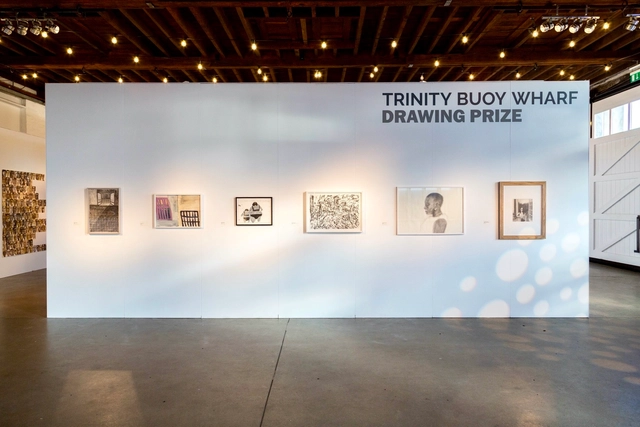
The Trinity Buoy Wharf Drawing Prize is now launching a milestone edition. 2020 will be the 3rd year of support for the Trinity Buoy Wharf Drawing Prize by the Trinity Buoy Wharf Trust and the 25th consecutive annual exhibition since 1994.
The COVID-19 pandemic has presented the world with unprecedented challenges and is impacting our daily lives by restricting our personal movements radically. It almost goes without saying that this month has continued to see extraordinary, rapid and previously unthinkable changes to public and private spaces. As the virus continues to spread, countries around the globe have ordered citizens to retreat to their homes – and stay there. Social distancing measures drastically scaled down our personal range of movement to our ‘own four walls’.
Brian May's micro concerts, goats on the streets, pizza delivery with toilet paper, Two men jam on a balcony. Above left: Brian May's micro concerts on his Instagram page. Above right: Great Orme Kashmiri goats on the streets of Llandudno, Wales. Below left: Pizza delivery with toilet paper, Rotterdam, Netherlands. Below right: Two men jam out on the guitar and flute on a balcony in Turin, Italy
When in 2009 Jacob Ross Boswell, in his article "Dystopic Verdure" in MONU #11 on "Clean Urbanism", introduced the topic of diseases, such as malaria, cholera, tuberculosis, yellow fever, and typhus etc, and how they had impacted urban landscapes and the shape of cities in the past, we were very intrigued and considered dedicating an entire issue on this topic. Particularly fascinating were his elaborations on how, by the second half of the 19th Century, urban designers and landscape architects such as Daniel Burnham, Frederick Law Olmsted, and a host of other architects, planners, and landscape architects collaborated with medical colleagues like Chicago's John Rauch in reshaping American cities: broadening streets and boulevards to allow for more sanitary air flow, moving pestilential cemeteries and dumps to the fringes of the city, carving out, reclaiming, or simply seizing land for America's first great urban parks, such as New York's Central Park. However, in the end we abandoned the idea to create an entire MONU issue on the relation between diseases and cities, since it seemed to us as something that belonged to the past only.
Construction alone accounts for more than 30% of the world’s greenhouse gas emissions and must now be reinvented to meet the ecological, economic and societal challenges of doing better with less, reducing its environmental footprint, limit the consumption of natural resources; build more responsibly and sustainably.
The Intimate City hosts Dining in the Urban, a design competition that offers the opportunity to explore domestic rituals in Skopje's public realm. The brief uses the knowledge gained from domestic rituals to expose the current social and physical forms, unveiling the boundaries between the public, communal, and private within the city. Aiming to reveal social and physical latency the brief is an experiment that acknowledges form as a social commitment in order to mediate the tension in the city.
_English.jpg?1592425114&format=webp&width=640&height=580)



![Call for Submissions // 2020 Summer [IN]SITU: A Virtual Summer Institute in Environmental Design - Featured Image](https://snoopy.archdaily.com/images/archdaily/media/images/5eb3/dae9/b357/65f8/f900/057b/slideshow/open-uri20200507-18601-1e4mmr.jpg?1588845266&format=webp&width=640&height=580)