The decentralization process currently underway in Chile represents one of the major social and structural transformations of the political system in a country historically characterized by a highly centralized culture. In May 2021, with the democratic election of Regional Governors, Chile took a major step toward this goal; true decentralization, after all, occurs when decision-making capacity is transferred to local territories, redistributing power from the central government to the regions.
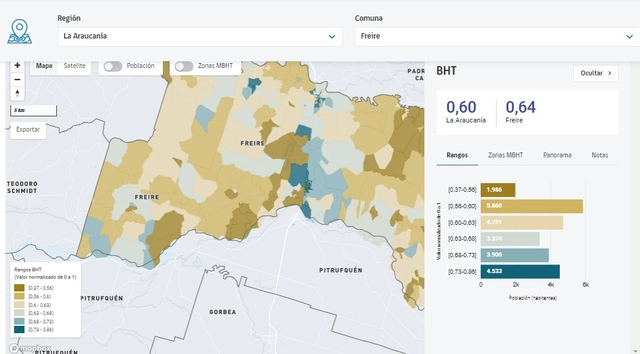
To support a successful decentralization process and strengthen regional governments, the Territorial Human Well-Being Matrix (MBHT) was developed. Designed by the Center for Territorial Intelligence at the Universidad Adolfo Ibáñez Design Lab (CIT.UAI.CL), the initiative is part of the “National Program for Strengthening Regional Capacities” carried out by the Undersecretariat of Regional and Administrative Development (Subdere).
This tool equips decision-making bodies with enhanced capabilities, allowing them to compare different areas, identify patterns, challenges, and opportunities to effectively implement solutions, and pinpoint the gaps and imbalances that need to be addressed.