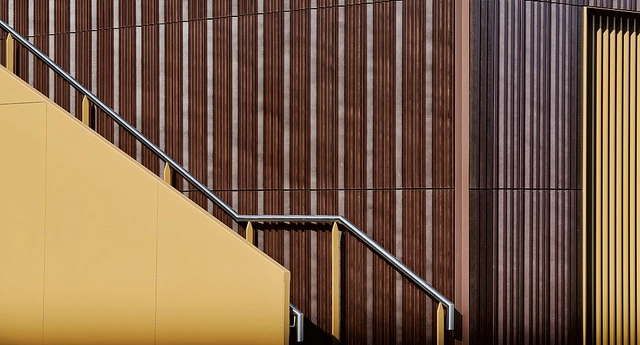
MOEDING is a German manufacturer specializing in brick tiles for facades with a large variety of shapes, colors, and textures, with signature models that simplify their production and installation processes. The first product made by the company, the ALPHATON® brick introduced in 2001, is a rectangular tile meant for uniform facade coverage.
The facade system offers:
- long-lasting materials
- natural resources
- efficient production
- economical development through fast and efficient installation
- high individuality due to large design option potential
- energy efficient
- low maintenance
| |
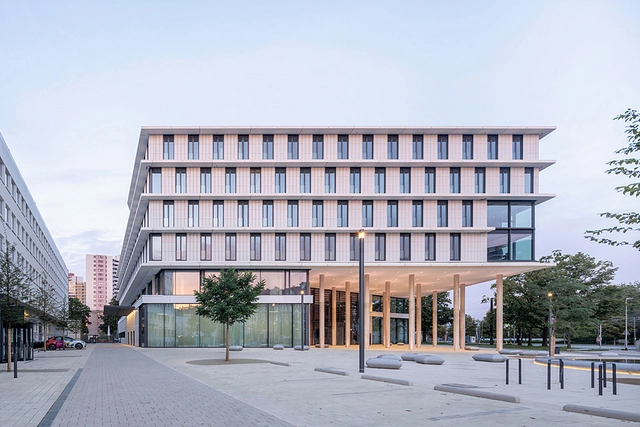
| ALPHATON® tiles on facade of Enercity headquarters © Markus Guhl |
The extruded MOEDING ALPHATON® brick slabs are made from predominantly native clays and are fully colored. Due to the very high firing temperatures and the long firing time, intensive colors and the best strength values are achieved. The brick slabs are double-shelled and 30 mm thick. The breaking loads of ALPHATON® panels are many times higher than those of single-skin panels. The tiles are resistant to weather stressors and their structure can be adapted for diverse climates, to facilitate ventilation or insulation as needed.
| |
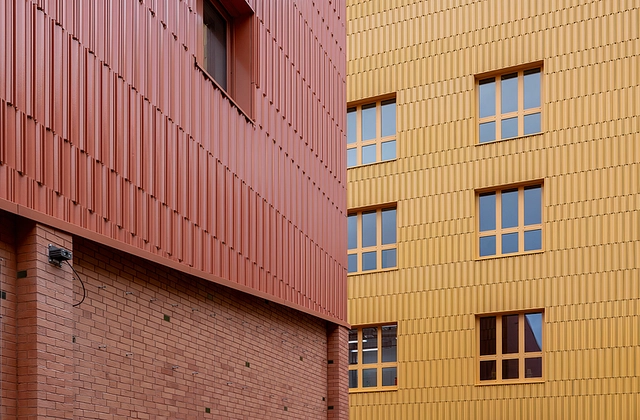
| ALPHATON® tiles on the facades of a thermal energy plant in southern Leipzig © Koy + Winkel |
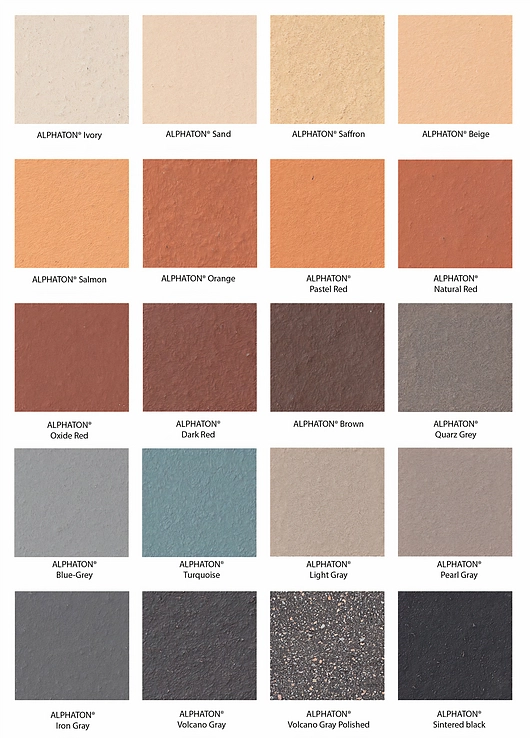
ALPHATON® brick tiles can be used both vertically and horizontally on facades. They are available in 20 standard natural colors, related to the material and chemical composition of the fired, unglazed ceramic tile.
| |
| ALPHATON® classic brick colors |
| |
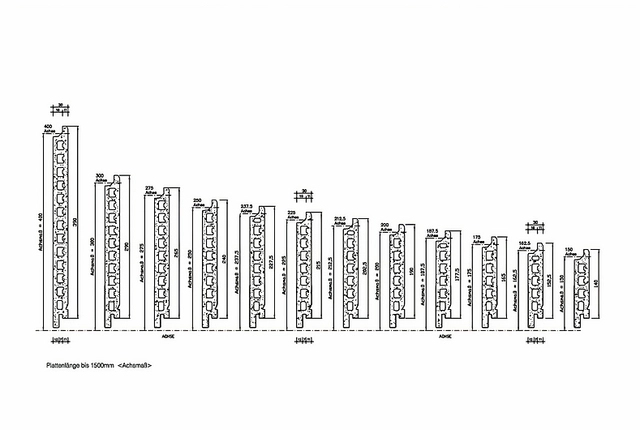
| ALPHATON® standard tile widths |
There are 12 ALPHATON® standard formats from 150 to 400 mm in height, and special formats and colors are possible.
| |
| ALPHATON® facade on new wing of the Martini Schule © Axel Roderus |
For the installation of ALPHATON® brick tiles, there are three systems:
L2 Rapid and Gen.06 for installation in horizontal formats, and L2 Rapid for vertically aligned tiles.
The tiles are useful for projects with regular facades and tile lengths of up to 1,500 mm. Due to the free choice between horizontal and vertical formats, there is a wide design scope that depends on the emphasis of the building, towards width or height. For each tile type, there are specific installation systems:
L2 Rapid and Gen. 06-Rapid for laying tiles.
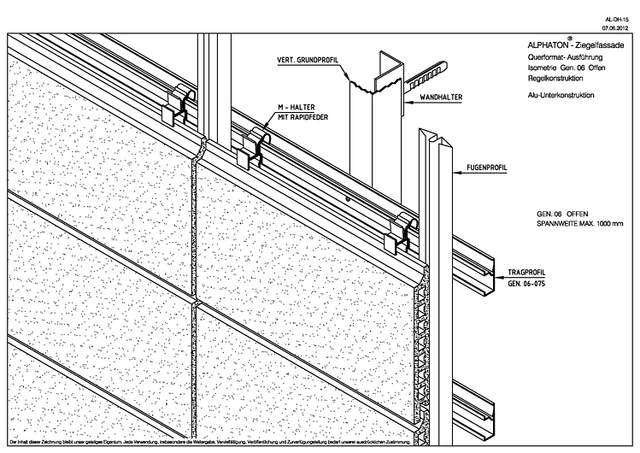
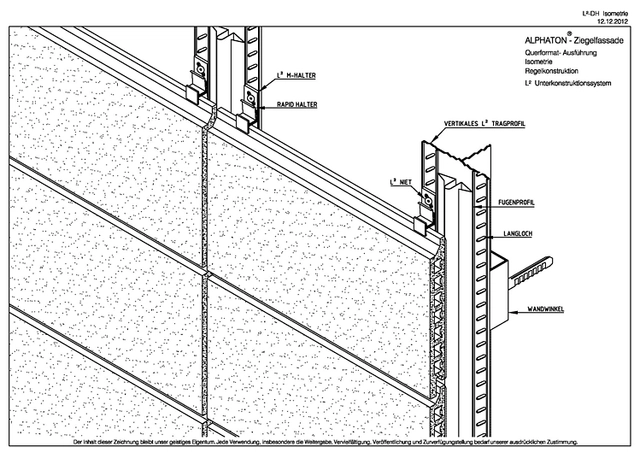
These two patented systems differ in that horizontal support profiles are used for Gen. 06-Rapid and vertical support profiles are used for L2 Rapid. For both systems, the support profiles are mounted first, and then the tile holders are clipped into or riveted onto them. Once the substructure has been installed with all the tile holders, the brick tiles can be mounted manually. All tile holders are fitted with a stainless steel spring at the factory, which enables mounting without tools. The spring engages a groove at the back of the tile, which then secures its position.
In the Gen. 06 rapid system, the brick profiles are attached to the horizontal support profiles. This system is particularly suitable for the installation of horizontal tiles with a cross joint, bracing, or for perforated facades. Here you will find the individual system presentations for this system.
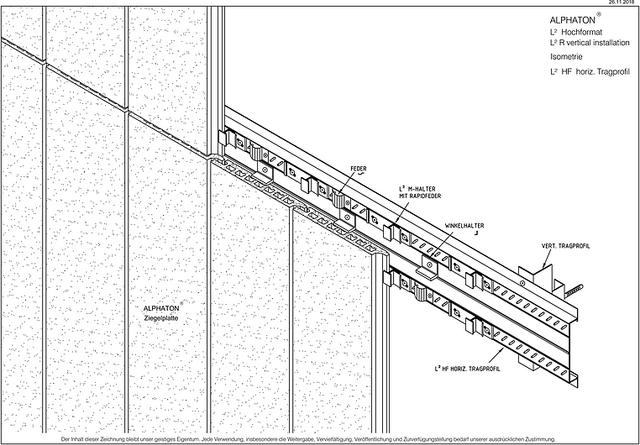
Contrary to the Gen. 06 rapid system, the L² rapid system uses vertical support profiles. From a tile length of 600 mm, this is the most efficient system, since fewer profiles are required for stable support – the tile stretches freely from one L² profile to the next. Here you will find the individual system presentations for this system.
| |
| L2 Rapid vertical system for standing tiles |
L2 Rapid vertical for standing tiles.
This system is based on the L² Rapid System for horizontal format; however, it is adapted to the technical conditions for vertical format tiles. The tiles can assume the same shape as with horizontal installation; however, other tile geometries are also possible.
The L² Rapid System for portrait panels uses Ω support profiles. The new system allows a ceramic, vertical joint, which affords further esthetic advantages.
| |
| L2 Rapid horizontal system for standing tiles |