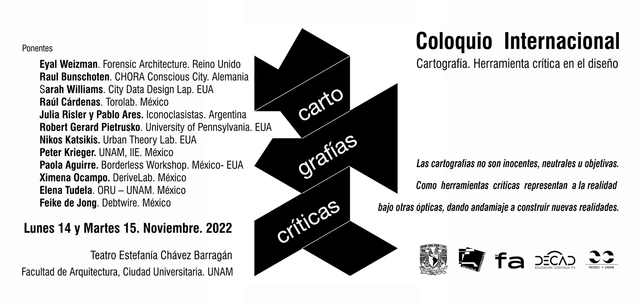
We live in a world immersed in images and their representations. We carry devices that show us the world in real time and locate us through our movements and desires with every application we navigate. In a world saturated with data, yet simultaneously filled with increasingly complex concrete realities, critical cartography reveals new visions and versions of the world we inhabit. It constructs an alternative atlas of ongoing and projective dynamics, challenging us to consider what spaces we are designing in the face of complex challenges across different spatial scales—climate change, violence, migration, extraction, and financial flows. Critical cartography is concerned with crossing, analyzing, and synthesizing data to make information more accessible and intelligible; manifesting complex systems where the human element is not the only priority, thus allowing us to think about nature on a different scale; and mediating participatory processes to visualize and measure social conflicts and inequalities within their spatial context.
Maps are not innocent, neutral, or objective. As critical tools, they present—and represent—the planet through different lenses, providing a framework to intervene in and construct new worlds. As we participate in the construction and production of the spaces we inhabit, architects, urbanists, landscape architects, and designers find that critical cartography reveals different narratives and descriptions to us.
This raises the following questions:
What role has mapping and cartography played in the construction of social space?
How do critical cartographies influence us as producers of the spaces we inhabit?
How can we leverage critical cartography as a design tool to understand, interpret, and project space?
The Faculty of Architecture at the National Autonomous University of Mexico (UNAM) invites you to the colloquium "Cartography: A Critical Tool for Design," where these questions will be addressed through the presentation of various approaches to emerging cartographies. The event will showcase work from diverse actors involved in mapping and cartography through their research, practical methodologies, and field experiences in mapping processes, iconographic design, and atlas development.
Discussions will range from big data analysis to participatory cartography; from methods based on geographic information systems to entirely analog explorations; and from everyday urban narratives to speculations on new utopias.
The presentations are aimed at professionals, faculty, and students involved in the design and production of the urban and social spaces we inhabit, with the goal of exploring cartography and the mapping process as a critical tool for design.