Re-think Dupont Circle is an international competition based in D.C. Now open for registration and submissions.
Dupont Underground has just launched their second International Design Competition: Re-Think Dupont Circle. One of the key public spaces in Pierre Charles L’Enfant’s famous urban plan for the nation's capital, Dupont Circle was not built out until the late 19th century and has not seen a significant redesign since the 1940’s when the automobile was ascendant. We feel it’s well past time to rethink Dupont Circle as a social, human-centered, public space. The competition covers the immediate urban area of Dupont Circle and it takes place at two scales (micro & macro) that must be interwoven through concept and design. Call for submissions and registration is now open through December 4th, 2020.
The vision for the project is to build a Contemporary, efficient, well designed attached villas (town-houses) in Ash Shatti Sharqi, Dammam, Saudi Arabia. Our main goal is to provide the buyers with an extraordinary, smart living space that satisfies their needs and allows them to live comfortably. In addition, being able to live in an affluent area for an affordable price.
The Bernard and Anne Spitzer School of Architecture at The City College of New York is pleased to announce its new SCIAME Global Spotlight Lecture series, “Far South” curated by Associate Professor Fabian Llonch.
City is Nature / Agura (cross-legged) Tea Ceremony
Now being used as a common word after been used as a slogan for environmental and human rights issues, the word “Symbiosis” was originally used in the field of Biology. This word “Symbiosis” became widely known has a lot to due from architect, Kisho Kurokawa, who has been putting forward the “The Philosophy of Symbiosis” since the 1970s. Being trained by Fumihiko Maki who was part of a project that originated in Japan called “Metabolism” with Kurokawa, Norihiko Dan who is active in both Japan and abroad will curate this exhibition.
Image: Brad McCorkle - The University of Texas at Arlington, Professional Physical Submission Winner 2019
The Ken Roberts Memorial Delineation Competition (KRob) has celebrated the best in architectural delineation for 46 years. A Dallas classic that has received international recognition, KRob honors hand and digital delineation by professionals and students throughout the world. Averaging over 400 entries from 25 countries in the past several years, the competition’s visibility continues to grow.
This summer La Biennale di Venezia, architectural exhibitions and events were postponed or cancelled. Three young architectural firms have seen the pause as a chance to create something new.
Neri&Hu is an award-winning interdisciplinary practice based in Shanghai. Founded by Lyndon Neri and Rossana Hu in 2004, the practice has since built up their own distinct approach to architecture that pushes beyond traditional boundaries to incorporate interior, product and graphic design.
Founded in Denmark in 1986, 3XN are known for projects grounded in the application of ongoing research into how human behaviour both reflects and influences buildings and the wider environment. In 2007 3XN founded a sister company GXN dedicated to innovative research into circular design, behaviour design and digital design. In this lecture we will be joined by behavioural specialist and Head of Operations Susan Carruth and Architect and Senior Partner Audun Opdal, who will show us how GXN’s research is directly fed into the work of 3XN to create some of the most innovative buildings in the world.
Architect and 2019 TIME100 Honoree Jeanne Gang leads international architecture and urban design practice Studio Gang. Her award-winning practice emphasises research, experimentation and collaboration resulting in a diverse body of work. Projects range from cultural centres, to high rise towers and installations, as described in a new comprehensive monograph, published by Phaidon.
Towards A Region Of Short Distances Call for Entries featuring photos of Seattle's current urban fabric. Image by Lisa Awazu Wellman
Before the Second World War, central Puget Sound cities grew around neighborhood nodes that were naturally limited to walkable radii around transit access. Development after the 1940s prioritized automobile mobility. Automobile dependence became a hallmark of late-20th and early-21st century American life, and the Seattle metro area is no exception.
Cross-pollinating public health initiatives with physical infrastructures
Similar to our #mOOO3 ISO[NATION] competition, we are donating everything we receive to the World Health Organization (WHO) COVID-19 Solidarity Response Fund. This time, we invite you to cross-pollinating public health initiatives with physical infrastructures.
Renowned Architects & Designers are here to generate an inquiry and an architectural/urban expression of the “Open City”, the participative and inclusive city, the life-affirming city. In doing this, the proposal is to create an alternative narrative, a creative challenge to the notions of 'city' that remain purely organizational, narrowly symbolic, exclusionary, and controlling.
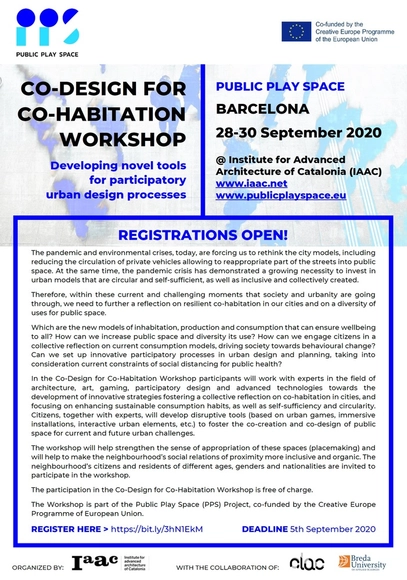
Are you interested in learning more about novel tools for participatory urban design processes? On 28-30 September 2020, PPS will be having its third Creative and Capacity Building Workshop in Barcelona titled ‘Co-Design for Co-Habitation Workshop’, developed by IAAC in collaboration with its partners of BUAS and CLAC.
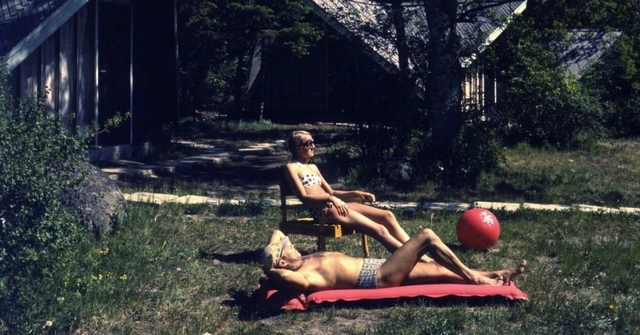
Camping ground near Tallinn, 1960ies. Photo: Estonian National Museum
The first major exhibition on holiday architecture of the Soviet period opens in the Estonian Museum of Architecture. The exhibition gives the first overview of Estonia’s rich Soviet-era holiday and summer cottage architecture heritage – buildings that made holidays accessible for a majority of people in the 20th century. It provides insight into a little-researched topic that explores the system related to holidays and the architectural context governed by regulations and codes, and also introduces outstanding buildings. It allows an important facet of Soviet life to be investigated – the expressive meeting point between institutionalized and individualized worlds.
Videos
Beyond COVID19 Open Call Poster. Registration: https://beyondcovid19-opencall.org/main
What is the question to be asked now? In the crisis from living environment that we called earth, architecture and city are facing due to COVID19, What is To be Asked Platform_WTA Platform is set up, to reflect and gather wisdom from professionals, researchers and citizens globally.
Description via Amazon. Good buildings require an understanding of the principles of structure, light, space, and material, but great buildings require an understanding of people. The most successful inspire through the interactions and connections made within them.