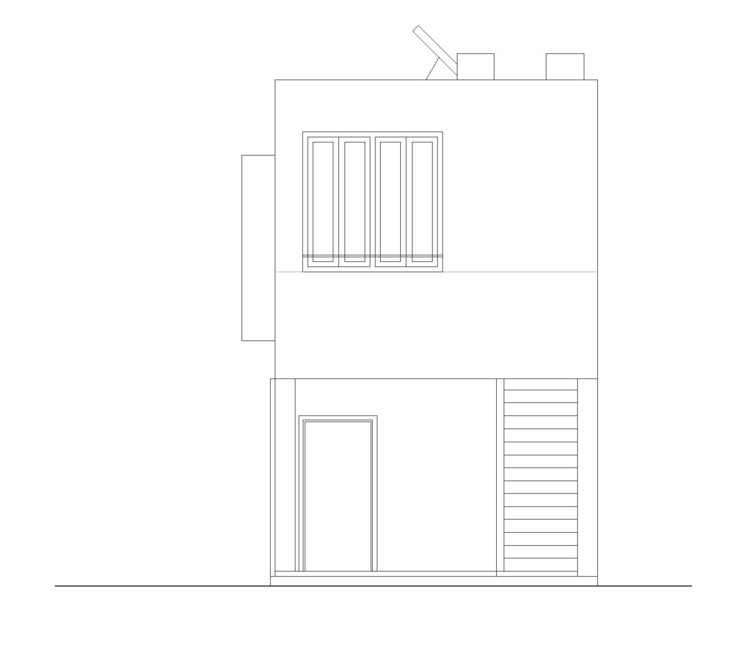
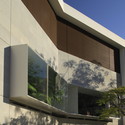
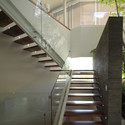
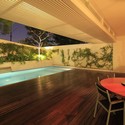
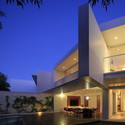
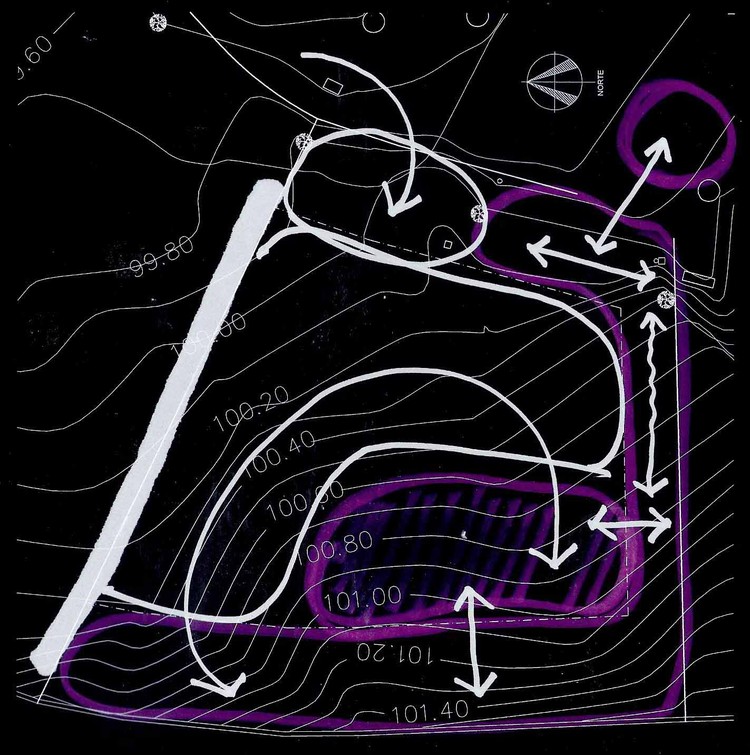
Architects: MUDAARQUITECTURA Location: Malpartida de Plasencia, Cáceres, Spain Design Team: Pablo Rey Medrano, Federico Rodriguez Cerro, Mª José Selgas Cáceres, Jorge E. Ramos Jular Technical Architect: Miguel Ángel Tierno de Dios Client: Dirección General de la Policía y la Guardia Civil Area: 2,946.65 sqm Project Year: 2011 Photography: Juan Carlos Quindós
The main aim of AZPA in their design for the New Library of St. Martin in Passiria was to create an envelope that is not only functional but also representative of the local and global contents of a cultural institution found in a library. This design would have the architectural potential to transcend the specificities of the place to reach a global character. More images and architects’ description after the break.
Inspired by the Harvard Graduate School of Design‘s book, Ecological Urbanism, published in 2010, the school commissioned Portland-based interactive studio Second Story to transform the book into an iPad app. This app aims to be a resource that draws from the original text, focusing on sustainable city-building, but can also be updated with new projects and papers as needed, which is something a physical book would not be able to do. Available now for free here, the app shows how dynamic areas of study can benefit greatly from equally dynamic texts. With the world moving so fast, books can’t keep up – thus technology allows books to remain updated and relevant to our lives.
As one of the winners for the international competition, “Performance architecture”, the agriCultural Mountain project by Group IUT (Nuno Miguel Lima Cruz, Bruno Martins Afonso Gomes, António da Silva Lopes) explores the paradox of an ephemeral monument creation. It´s an artificial mountain placed at the city outskirts, outside the dense urban core, at an agricultural area called “Veiga de Creixomil”. Cultural activities are mainly urban happenings. Rural people and rural areas are usually outside the mainstream circuit of the cultural industry. This proposal aims to bring the cultural phenomenon to the agricultural realm. More images and architects’ description after the break.
The American Institute of Architects New York Chapter and the Hong Kong Economic & Trade Office are opening the “Hong Kong at 15: Redefining the Public Realm” exhibition this Monday, December 10th at 7:00pm and will be on exhibit until January 23rd. Taking place at the Center for Architecture in New York, the exhibit features architectural projects built in Hong Kong designed by New York architects, and highlights the 15 year milestone of Hong Kong’s transfer of sovereignty and highlights the contribution of New York architects to the design of Hong Kong. Fueled by a famously free economy, and reputation as a gateway to China, Hong Kong has continued to grow over the past 15 years with the city’s architects and engineers producing highly sophisticated solutions to the challenged faced in the city. For more information about the event, please visit here.
Organized as part of the launch of IE University’s Master in Work Space Design, which will receive its first intake next February, the school organized a workshop focused on What’s Next in Workspaces? Designing with Change. Distinguished panelists shared their vision on changing forces and trends in work space design, and how it is creating new and exciting working environments. The new program combines modules in Madrid and London with online periods, and is run in collaboration with strategic partner the Helen Hamlyn Centre at the Royal College of Art. Experts agreed that the work place has made a shift in the last years, due to flexibility, mobility and generation gap within the work forces. The role of office designers will become in the future more about facilitation and that simplicity will prevail in office space of the future. For more information on their new, upcoming program, please visit here.
Kohn Pedersen Fox Associates recently announced the launch of their KPF DesignCloud, the first global design charrette involving all 6 of the firm’s offices in New York, London, Hong Kong, Shanghai, Seoul, and Abu Dhabi. The web-based vehicle for interaction amongst designers is intended for the exchange of ideas, observations, and questions. This is done quarterly to frame a specific problem to be solved. Their first charratte focuses on “Rest, Relieve, Relax, Repose” where KPF staff members were given one week to come up with a design concept, after which the jurors and designers were able to review and comment through the KPF DesignCloud website. For more information, please visit here. A video of their last charrette can be viewed after the break.
Aiming to provide a meeting place for information, knowledge, skills, and stories, the proposal by Marc Anton Dahmen | Studio DMTW for the Helsinki Central Library competition reflects the creativity, innovation and interaction for the people of Helsinki. Resulting in the sculptural massing of the building, their design derives from the creation of an vertical circulation element, connecting the building by transiting from one function to another throughout the entire collection area. More images and architects’ description after the break.
Designed by AAIMM, the project of the Solar Towers is based on the analysis of the urban fabric of the city Sabadell, Barcelona. A medium-scale, self-sufficient and productive infrastructure promoting energy production from renewable and clean sources, the project also intends to promote the enhancement of healthy mobility through electric bicycles and electric cars, and to generate productive urban farming spaces and social community spaces for elderly, temporarily unemployed, or displaced inhabitans; all in one single infrastructure. More images and architects’ description after the break.
Bjarke Ingels, who heads up the Bjarke Ingels Group (BIG), was in Sydney recently and did a talk at the Australian Institute of Architects, which was sponsored and organized by HASSELL. With the common design values and easy fit between BIG and HASSELL, they make a powerful team. So BIG, whose projects we have published here, visited Sydney to explore the potential for future project collaborations. More information and a video after the break.
The Department of State’s Bureau of Overseas Buildings Operations (OBO), whose mission is to provide safe, secure and functional facilities that represent the U.S. Government in U.S. foreign policy objectives, has shortlisted eleven design firms for the Indefinite Delivery/Indefinite Quantity (IDIQ) Worldwide New Construction A/E (Architecture/Engineering) Design Services solicitation. The shortlist of firms, selected out of 88 prospective offers, presented projects that were “well conceived and executed, displayed innovation, and showed strength in identity and public image.” A complete list of the shortlisted teams are listed after the break.
By now, there’s no architect in the world unaware of Oscar Niemeyer’s passing, or the legacy he left over his 104 years.
In honor of the greatest Brazilian architect of our time, we invite you to enjoy this interesting documentary, which shows how Neimeyer’s work, which changed the paradigm of architecture and went beyond any stereotype, was just as unique as his noble perspective on life.
PRAUD shared with us their concept proposal, titled ‘The Heart of the Metropolis’ for the Helsinki Central Library competition. With the intent for a building that serves a larger civic function by creating a space for congregation at an urban scale, their library design aims at becoming a ‘Living Room’ for the city. The result is a true metropolitan building that not only creates a dialogue with the city, but one within the architectural language, making it timeless and essential for Helsinki. More images and architects’ description after the break.
The aim of the competition for the Freedom Square And Zdunski Market Place was to select the best urban and architectural design in Kutno, Poland. Such features as spatial development, functionality and practicability were taken into consideration. In the second prize winning proposal by Mado Architekci, they combine the current appearance with the original to create a hybrid square. The hybrid would combine the features of a pro-community, commonly accessible square without any motor traffic, with a square that would satisfy the needs of a modern city. More images and architects’ description after the break.
An industrial and harbor city divided in the north and south by the river Göta, Gothenburg is currently lacking a coherent relationship between the city and the river. The great differences between the north and south sides of the Göta River are in scale, function, and density. The project, proposed by JAPA, Javier Ponce Architects, re-introduces the Göta river to the citizens by means of a urban re-generation; the river seen as a green system connected with the existing landscape. More images and architects’ description after the break.