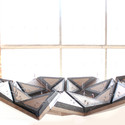
Resonant Chamber, an interior envelope system that deploys the principles of rigid origami, transforms the acoustic environment through dynamic spatial, material and electro-acoustic technologies. The aim of rvtr is to develop a soundsphere able to adjust its properties in response to changing sonic conditions, altering the sound of a space during performance and creating an instrument at the scale of architecture, flexible enough that it might be capable of being played. The project is funded through the 2011 Research through Making Grant, U-M Office of the Vice President for Research, 2011 Small Projects Grant, U-M Center for Wireless Integrated Microsystems, Social Science and Humanities Research Council of Canada Research Creation Grant. More images and architects’ description after the break.
The project is developed through three streams of iterative research and development in both computational testing and full-scale prototype installation: Dynamic Surface Geometries; Performative Material Systems; and Variable Actuation and Response. The faceted acoustic surface is comprised of the composite assembly of reflective, absorbtive and electroacoutsic panels, clustered around an electronics panel that contains circuit controls for linear actuation, electro-acoustic amplification of the distributed mode loudspeaker (DML) embedded speakers and a set of sensing inputs. A single electronics panel may contain enough processing to control four DML speakers, local sensing of acoustic pressure and three sets of linear actuators which in turn controls three flat-folding cells.