
[premise]
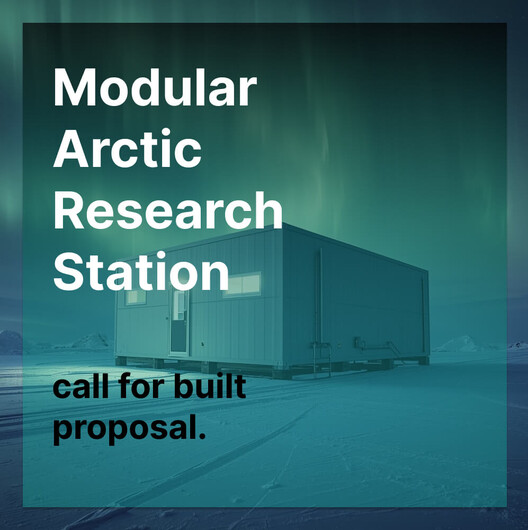
The acceleration of climate change has amplified the scientific urgency to study Earth’s polar regions. Traditional research stations are often permanent, carbon-intensive structures with significant logistical and environmental footprints. This competition challenges architects and designers to envision the next generation of scientific outposts. We seek a paradigm shift towards a mobile, modular, and sustainable architecture that can be deployed, reconfigured, and removed with minimal impact on the fragile Arctic ecosystem. This new model must prioritize energy self-sufficiency, operational resilience in extreme conditions, and the psychological well-being of researchers living in prolonged isolation, thereby enabling more agile and responsible scientific exploration.
[objective]
The primary objective is to design a fully-functional, modular Arctic research station for a crew of 8 to 12 scientists. The proposed design must be a comprehensive system, not just a building, addressing mobility, energy independence, and waste management. Participants are tasked with developing a robust architectural concept that integrates living quarters, laboratories (both wet and dry labs), communal areas, and utility modules. The final design should demonstrate a deep understanding of polar architecture principles, showcasing innovative solutions for rapid deployment, long-term durability, and a “leave-no-trace” operational lifecycle to support critical research in a changing world.
