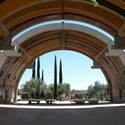
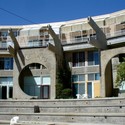
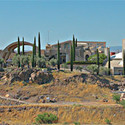
The Dome in the Desert by Wendell Burnette

This article, written by Arizona-based architect Wendell Burnette of Wendell Burnette Architects, recounts the story of Paolo Soleri’s ‘The Dome’ in the desert.
A glass house in the desert? Was it an architectural caprice, a folly, or was it a solution to the problems of desert living whose appropriateness is still not recognized? Having had the experience of living in The Dome for a full year, through all the seasons, I felt it incumbent upon myself to take a fresh look at this remarkable work of architecture.
Paolo Soleri, its designer, was born in 1920 in Turin, received a PhD in architecture from the Torino Politecnico, and in 1947 came to America to study with Frank Lloyd Wright, remaining with him for just over a year. Mark Mills, who assisted Soleri in the construction of The Dome, was born in 1921, received an architectural engineering degree from the University of Colorado, and studied with Wright for four years. It was at Taliesin that Soleri and Mills became friends. In 1948, when they and two other apprentices were working on an experimental structure at Taliesin West, which became what is known as the Sun Cottage, there was a misunderstanding with Wright that led to all four of them leaving. Soleri and Mills went to work with a developer, providing design work for some condominiums at the base of Camelback Mountain, below the north face in Paradise Valley. Soleri developed a scheme that involved a tower element supporting a hex form canopy and he and Mills built a mockup of Camelback out of concrete block and wood. It was shortly after this that “the Cli,” as she was fondly called, came along.
The complete article after the break…
Paolo Soleri: Mesa City to Arcosanti

In 2010, SMoCA initiated a series of three exhibitions exploring the trajectory of Paolo Soleri’s art, architecture and philosophy. Paolo Soleri: Mesa City to Arcosanti is the second in the series. This exhibition begins in the early 1960s when Soleri shifted his focus from bridges and residences to large-scale urban planning based on environmental accountability. Soleri’s first comprehensive vision of a community is Mesa City, an example of what he calls an “arcology,” or an architectural project based on the synthesis of architecture + ecology. In Mesa City, Soleri combines the goals of high-density living, a vibrant urban space, respect for natural resources and a commercial sector based upon creativity. The exhibition will end with Arcosonti (arcology + Cosanti), a project built in the 1970s near Mayer, Arizona.
Remembering Paolo Soleri 1919-2013

Today the world has lost one of its great minds. Paolo Soleri, architect, builder, artist, writer, theorist, husband, father, born on Summer Solstice, June 21, 1919, has died at age 93.
Paolo Soleri spent a lifetime investigating how architecture, specifically the architecture of the city, could support the countless possibilities of human aspiration. The urban project he founded, Arcosanti, 65 miles north of Phoenix, was described by NEWSWEEK magazine as “…the most important urban experiment undertaken in our lifetimes.”
His own lifetime of work is represented in models, drawings, books, lectures and museum exhibits throughout the world. Soleri’s exhibition in 1970 at the Corcoran Museum in Washington DC – and the concurrent publication of his landmark book, CITY IN THE IMAGE OF MAN – changed forever the global conversation about urban planning on our living planet. His term, “Arcology” joining the words architecture and ecology to represent one whole system of understanding human life on the earth is meant to serve as the basis for that conversation.
More on the life of Paolo Soleri after the break…
Paolo Soleri’s Bridge Design Collection: Connecting Metaphor

“Of all things that are man-made, bridges are, with dams, the most “structural,” single-minded, and imposing. As connectors at a breaking point, they have a heroic force that is aided by a challenging structuralism. As a strand of continuity in a non-continuum, the bridge is full of implied meanings. It is the opposite of devisiveness, separation, isolation, irretrievability, loss, segregation, abandonment. To bridge is as cogent in the psychic realm as it is in the physical world. The bridge is a symbol of confidence and trust. It is a communications medium as much as a connector.”
-Paolo Soleri, 1970, from “The Sketchbooks of Paolo Soleri”, published by MIT Press, 1971
Paolo Soleri’s Arcosanti : The City in the Image of Man

70 miles north of Phoenix, in central Arizona lies an experimental town created by Paolo Soleri, intended to house 5,000 people. Arcosanti is the study of the concept of arcology, which combines architecture and ecology. The intensions of this community is to form a gestalt that houses the relations and interactions that living organisms have with respect to each other and their natural environment.