-
Architects: Jacobsen Arquitetura
- Area: 815 m²
- Year: 2017

While the first issue of VAD (veredes, architecture and dissemination) focused on "the beginnings"—those origins and principles that provide, tangibly or symbolically, what seeks to exist—we now aim to broadly explore the parameters belonging to these origins. That emergence, birth, and appearance, where architecture germinates.
In the context of the AIA Conference on Architecture 2019, Craig Schwitter, engineer and partner at BuroHappold Engineering, told with ArchDaily about the structural challenge behind Safdie Architects' latest Jewel Changi Airport and other technology-related topics around architecture:
Jewel is a project along the way of a whole series of grid cells that our firm have done and have been increasingly about experience and space underneath these massive roofs, and I think Jewel has really moved into the next level. These structures are not structures really, they are filters. They are balancing an exterior climate and interior climate; they are trying to make a space, you know, habitable, enjoyable. [...] But we couldn't have done that 10 years ago, because the technology that makes that possible is a culmination of the advances in computer-aided manufacturing.
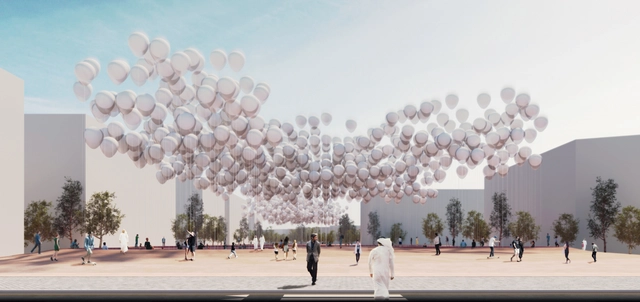
Superspace has designed a system of energy-harvesting balloons for Abu Dhabi. The project, titled “solarCLOUD” formed part of the LandArt generator competition and is intended as the city portal of Masdar City. The system consists of a group of solar balloons woven with solar fabric, creating a shaded park during the day while tracking and harvesting solar energy. At night, the system settles down to become a kinetic light art show.
Since the 1970s, humanity’s resource consumption began to exceed what the planet could renew in a year. That is, we are withdrawing and polluting nature more than it can naturally recover. According to the World Bank, if the world's population reaches even the projected number of 9.6 billion people by 2050, it will take almost three Earth planets to provide the natural resources needed to maintain humanity's current lifestyle.
Every day an enormous amount of carbon dioxide is released into the atmosphere through industry, transportation, burning fossil fuels and even respiration of plants and living things. As the consequences of climate change become clearer, both governments and private sector companies are setting targets for carbon emission reductions, since these are regarded as the main greenhouse gases, and their high concentration in the atmosphere lead to air pollution and acid rain, among other consequences.
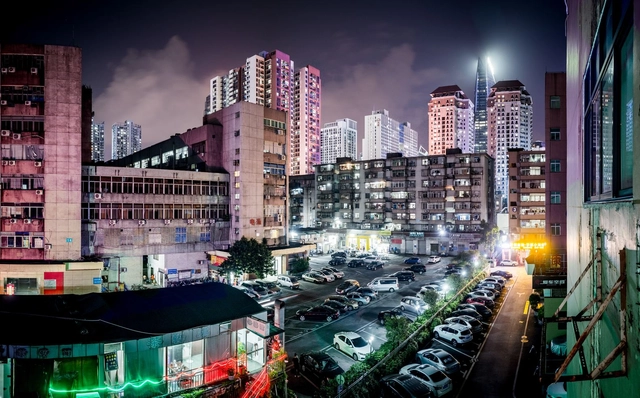
What happens when the sensor-imbued city acquires the ability to see – almost as if it had eyes? Ahead of the 2019 Shenzhen Biennale of Urbanism\Architecture (UABB), titled "Urban Interactions," ArchDaily is working with the curators of the "Eyes of the City" section at the Biennial to stimulate a discussion on how new technologies – and Artificial Intelligence in particular – might impact architecture and urban life. Here you can read the “Eyes of the City” curatorial statement by Carlo Ratti, the Politecnico di Torino and SCUT.


The 14th SEMAU - Architecture and Urbanism Week presents this year's theme: "(IN)VISIBILITIES: POLITICS, DEMOCRACY, AND RESISTANCE." The event aims to discuss and reflect on the social and political landscape and its relationship with urban dynamics in Brazil. Likewise, it seeks to showcase and share positive experiences in addressing the urban challenge of overcoming socio-spatial inequalities, highlighting the political role of architecture, urbanism, and related fields as a means of resistance.


The Modern Architecture in São Paulo course presents a special edition in July dedicated to Lina Bo Bardi. The sessions will feature historical-critical theoretical approaches to the architect's work, in addition to guided tours of two projects: MASP and SESC Pompéia. During these tours, the architecture will be experienced and discussed in detail on-site.

The Modern Architecture in São Paulo course presents a special edition in August focused on Lina Bo Bardi. The sessions will provide historical and critical theoretical approaches to the architect's work, in addition to guided tours of two projects: MASP and SESC Pompéia. During these visits, the architecture will be experienced and discussed in detail on-site.




.jpg?1563006346)
.jpg?1563006593 "© Luis Beltrán")
.jpg?1563007109 "© Luis Beltrán")
.jpg?1563006832 "© Luis Beltrán")
.jpg?1563006895 "© Luis Beltrán")
.jpg?1563391256)