Casa Wakasa / wHY Architecture

Uploaded by — Filed under: Houses ,Selected , , , ,
 

Architects: wHY Architecture
Location: Osaka,
Area: 279 sqm
Project Year: 2006
Program: Private Residence
Photographs:

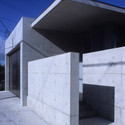
Casa Wakasa, home to a young family of four is located in the suburbs of Osaka, Japan. The house attempts to be both a reflection into contemporary Japan’s family life (sense of family vs. privacy) as well as a solution to balance individual freedom and space with collective activities and time.

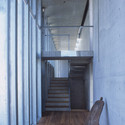
The basic unit of the house is an amalgam of a room and an outdoor courtyard; each room for each member of the family has an integrated garden as its counterpart.

perspective

The house design gives emphasis and space to the glass-sided living room, surrounded by open gardens. The father who works as a dentist from 9AM to 9PM everyday wants to have a place in his own house that at the end of the day he could withdraw even from his family, his wife and two young daughters, to pursue the subjects of his personal interest – music, films and books. This open glass room, connecting to the house only through an underground corridor, is the sanctuary where he can be himself. The family has meals and activities together in the family living and dining room but each one of them could withdraw into their own world in their own room / garden.

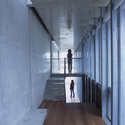
The spine promenade / passage linking all the rooms is designed as an “engawa”, the semi-outdoor transitional space seen in traditional Japanese architecture. This implies its ambiguous and transitional essence; it is not a room yet functions as one, not merely a corridor but used as linkage. Like traditional “engawa”, it is the true linkage in many senses; it links the indoor rooms with outdoor gardens, links spaces together into a composition, and it links multiple individual worlds into a family.


Thumb up Thumb down 0
Cameron says:

Another example of a beautiful, contemporary, culturally influenced Japanese design piece.
wHY do they not cease to please?

 
# December 12, 2008 at 09:18
Thumb up Thumb down 0
Alex (CorbusieLer) says:

Project Hollywood House – wHY Architecture
http://ru.youtube.com/watch?v=D5vtu1iKMZ4

 
# December 12, 2008 at 10:25
Thumb up Thumb down 0

Wow, this is beautiful. It looks great lit up at night, and the interior manages to be fairly warm in spite of the concrete and steel.

http://www.contemporaryartdaily.com

 
# December 12, 2008 at 12:27
Thumb up Thumb down 0
roadkill says:

obvious thermal bridging is not an issue in Japan… how do they get away with it?

 
# December 13, 2008 at 10:26
    Thumb up Thumb down 0

    ” how do they get away with it?” – you must be american :)

     
    # August 22, 2010 at 17:28
Thumb up Thumb down 0
MZ says:

roadkill:

Climate. Subtropical climate make it unnecessary to think about such things. I know what kind of technical difficulties it means to build a concrete building in nordic climate but there are beautiful examples in Switzerland, in “Passivhaus” standard as well.

 
# December 15, 2008 at 04:51

Leave a Reply »


Latest Comments »

As a student of Tom Fisher,...[+]
Yawn… Fireworks! Yawn…[+]
на скетче красиво. столб перенести никак?[+]
very nice work[+]
Abu Dabhi airport is wonderful[+]

Upcoming Architecture Events »

got events? invite us! click here

Architecture Books & Magazines »

Reverse Effect: Renewing Chicago’s Waterways / Jeanne Gang

Reverse Effect: Renewing Chicago’s Waterways / Jeanne Gang

Our friends from Studio Gang Architects recently sent us their new book Reverse Effect. ”The culmination of a yearlong collaboration between Studio Gang Architects and the Natural Resources Defense Council (NRDC), Reverse Effect is dedicated to exploring the importance of


After Crisis

After Crisis

“‘After Crisis’ concentrates around the new conditions for architectural practice and around the new epistemologies that may inform it in the next future. That is, in the period after the financial bubble has collapsed and living and working conditions


A Peripheral Moment

A Peripheral Moment

This book is an account of the highly productive decade of architectural experimentation in Croatia lodged between the violent break-up of Yugoslavia and their slow integration into the EU. Ivan Rupnik guides the reader through the emergence of this


Our partners »

AD on iPad via Pulse

Browse by date »

Browse by category »

Friends »