
Architects: Bakers Architecten
Location: Utrecht, The Netherlands
Project Team: Jan Bakers, Martijn Boer, Erik Feenstra, Noor van de Loo, Remko Verkaar
Structural Engineering: CIHR bv, Delft
Lighting: Maikel van Burik
Contractor: Bouwonderneming Van Bekkum Houten, Houten
Project Area: 1,100 sqm
Project Year: 2010
Photographs: Maarten Noordijk, Frank Stahl
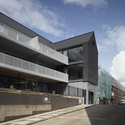
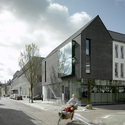
In Utrecht’s museum quarter, just south of the city centre, there was for many years a vacant plot on the corner of Lange Nieuwstraat and Vrouwjuttenstraat. This site in the midst of historical buildings is now occupied by ‘Het Zwarte Huis’ (The Black House), a complex containing six apartments with semi-underground parking and the new premises of Bakers Architecten.

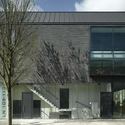
The streetscape is characterized by heterogeneous, lot-by-lot development with distinctive corner buildings. Het Zwarte Huis is a contemporary addition to the existing urban fabric, in which the notion of ‘living above work’ has been accentuated by placing the dwellings in a solid volume on top of a glazed podium.

Lange Nieuwstraat begins at Domplein and runs via a gentle curve to the Centraal Museum. The site lies at the mid-point of the curve from where there is an overview of the entire street. This unique vantage point is fully exploited with a large bay window.

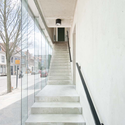
An internal courtyard has been created by placing the black volume parallel to the Lange Nieuwstraat. This volume also contains the various means of access for the complex as a whole. The semi-underground car park is reached via a car parking lift, while a communal staircase leads to the walkways along which the apartments are situated. The wide walkways also serve as outdoor space for the dwellings.

Het Zwarte Huis was constructed using 55-centimetre-long ‘Kolumba’ bricks. The apartments facing Vrouwjuttenstraat have a white rendered facade. The party walls on this side form a cantilever on Vrouwenjuttenstraat, thereby relieving the podium facade of any structural function and allowing it to be entirely of glass.
- © Maarten Noordijk
- © Frank Stahl
- © Frank Stahl
- © Frank Stahl
- © Frank Stahl
- © Frank Stahl
- © Frank Stahl
- basement plan
- ground floor plan
- first floor plan
- second floor plan
- third floor plan
- roof plan
- section 01
- section 02


Terrible concrete finishing. Either by fault of the project team, poor contractor workmanship, or both; but it really diminishes the final result.
The concrete work is a bit sloppy… but I do think the choice of materials for the project in general work really well within the context of the block’s existing historical buildings. Understated. Especially like the Zumthor Kolumba bricks
http://petersen-kolumba.dk/en/products.aspx
Seeing the first floor doesn’t have the same wall finishing as the rest, is just glass, I think they wanted to give it the look of to be floating.
well, may be is not meant to be floating and is only a new fashion.
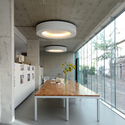
Quite beautiful overall, but that cables running from the display in the meeting’s room really bother me.
Actually, I think the contractor is good… The quality of this looks-like-poor surfaces if perfect because of it’s exelent geometry… Everything is very sharp…
I don’t believe the finishing is as important as the design as a whole. When I looked at the first photo, I thought “this looks like it belongs in the Netherlands” before even reading that it was located in Utrecht. It takes a well designed building to read like it belongs in it’s site in a photo without much context. It looks like it belongs here, without feeling old or worn out.
I agree! If you like or dislike the materials is an opinion (actually, I like them, you hardly get a better construction in Spain). But the fact of being a project belonging to the place is what makes it a special one. Unluckily, this a situation that everyday happens less, with a lot of architects thinking they are sculptors.
I was immediately attracted to this project from its materialality, and its use of brickwork. The design reminds me of a design of similar characteristics in Lincoln, England, called The Terrace, anyone heard of it?
http://www.ttcq.co.uk/