Mado Building / Atelier Bow-Wow

Uploaded by — Filed under: Housing ,Selected , , , ,
 

Architects: Atelier Bow-Wow / Yoshiharu Tsukamoto, Momoyo kaijima, Shun Takagi
Location: Setagaya-ku, Tokyo,
Construction year: 2006
Structural Engineer: MKanebako Structural Engineers
Contractor: KATAYAMA Corporation
Site Area: 192 sqm
Constructed area: 575 sqm

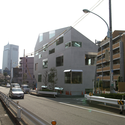
This is a project for speculative building – the land is bought, value is added through design, tenants are found, and the project is sold off. The site is located in the wedge between a fork in the road on sloping land, so something with character as a landmark was sought by the client.

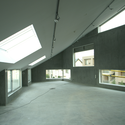
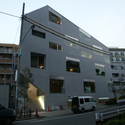
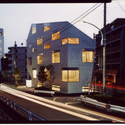
Since the tenant details were not determined, in developing the design we could not help but concentrate on contextual elements. In seeking out common criteria from responses to various separate external factors, such as the difference between levels on the site, the shading envelope, assumed circulation paths and so on, we came to feel the necessity of some internal rhythm. Here we started looked at the windows and balconies of the apartment buildings that surround the site, and in a mirroring relation, arranged openings in a chequered pattern on the three frontages facing roads. For the windows, we took the largest standard dimension for double glass windows as a baseline, varying the proportions in response to external conditions. As a result, the exterior façade came to have in parts an elastic expression, suggesting movement.

We placed an entrance in each frontage, and allowed this to be absorbed into the partial deformations of the repetition of windows in the façade, yielding parts revealing difference amidst the general pattern. The window can be understood here as an element that is shared in common with the surrounding context, as well as something engendering an internal rhythm; as a device that responds flexibly to external conditions while creating diverse internal settings; as a tool negotiating a multi-layered context. The name “Mado(means window in Japanese) Building” was taken from this.


Thumb up Thumb down 0
xing says:

Is this a structural skin? I do not see any columns

 
# August 22, 2008 at 16:49
Thumb up Thumb down 0
Fistule says:

It seems to be a simple concrete building.

 
# August 22, 2008 at 19:56
Thumb up Thumb down 0
El Greco says:

No internal columns. There are columns between the windows from the ground to the roof. The infill portions act as shear walls.

 
# August 25, 2008 at 17:13
Thumb up Thumb down 0

This is very up-to-date info. I’ll share it on Digg.

 
# April 15, 2009 at 09:30
Thumb up Thumb down 0
Lucas Gray says:

Tokyo has some crazy good design. Fantastic project. I would like to see some interior images of it being lived in.

 
# May 25, 2009 at 02:46
Thumb up Thumb down 0
jp says:

looks like a BIG project

 
# January 15, 2010 at 22:48
Thumb up Thumb down 0
ALeyRA says:

Good Thank Admin Pst

 
# April 2, 2010 at 17:47

Leave a Reply »


Latest Comments »

What even is that lake room oval thing!!?? I still don’t know…[+]
why is there noone with the necessary NO !! don’t...[+]
Simplicity and complexity in the same place: composite functionality...[+]
why shall this happen again? the 70′ are back in town (do we...[+]
seem like Osler Hous by kogan marcio[+]

Upcoming Architecture Events »

got events? invite us! click here

Architecture Books & Magazines »

Architectural Modelmaking

Architectural Modelmaking

“The representation of creative ideas is of primary importance within any design-based discipline, and is particularly relevant in architecture where we often do not get to see the finished results, i.e. the building, until the very end of the…


MacMag 36

MacMag 36

We were excited to receive Mackintosh School of Architecture’s 36th addition of MacMag – a student publication that catalogues the work of the student body in a way that is as much about the graphical expression as it is…


A Peripheral Moment

A Peripheral Moment

This book is an account of the highly productive decade of architectural experimentation in Croatia lodged between the violent break-up of Yugoslavia and their slow integration into the EU. Ivan Rupnik guides the reader through the emergence of this


Our partners »

AD on iPad via Pulse

Browse by date »

Browse by category »

Friends »