
Tampa Museum of Art / Stanley Saitowitz | Natoma Architects

Uploaded by — Filed under: Museums and Libraries ,Selected , , , , ,
 

© James Ostrand

Architects: Stanley Saitowitz | Natoma Architects
Location: Tampa, FL,
Project team: Stanley Saitowitz, John Winder, Neil Kaye, Markus Bischoff
General Contractor: Skanska USA Building
Civil Engineering: WilsonMiller, Inc.
Structural Engineering: Walter P. Moore and Associates, Inc.
Project year: 2010
Photographs: Richard Barnes & James Ostrand

Museums began in ancient times as Temples, dedicated to the muses, where the privileged went to be amused, to witness beauty, and to learn. After the Renaissance museums went public with palatial structures where the idea of the gallery arose, a space to display paintings and sculpture. Later, museums became centers of education, researching, collecting, and actively provoking thought and the exchange of ideas. By presenting the highest achievements of culture, museums became a stabilizing and regenerative force, crusading for quality and excellence. The role of the modern museum is both aesthetic and didactic, both Temple and Forum.

© Richard Barnes

The design of contemporary museum can be characterized by two polar approaches. On the one-hand buildings which aim to be works of art in themselves, independent sculptural objects as signatures of their architects. The new Rome Museum is the most extreme example, where the building opened empty, without any art to compromise its architecture. On the opposite end of the spectrum are museums as containers, as beautiful jewel boxes, treasure chests whose sole purpose is to be filled with art, like the Tampa Museum.

© Richard Barnes

This museum is a neutral frame for the display of art, an empty canvass to be filled with paintings. It is a beautiful but blank container, a scaffold, to be completed by its contents. We are interested in openness, in unknown possibilities in the future, in Architecture as infrastructure. We have created compelling space in the most discreet way, avoiding the building as an independent sculptural object, and using space and light to produce form.

© Richard Barnes

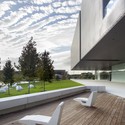
A glass pedestal supports the jewelbox of art above. The building floats in the park, embracing it with its overhanging shelter and reflective walls. It is a hovering abstraction, gliding above the ground. The building is not only in the landscape, but is the landscape, reflecting the greenery, shimmering like the water, flickering like clouds. It blurs and unifies, making the museum a park, the park a museum.

© Richard Barnes

The long building is sliced in the center. This cut divides the programs in two, the one public and open, the other support and closed. Each of the two sections is organized around a court, one the lobby, the other a courtyard surrounded by the offices and curatorial areas.

sections 01

The 40’ cantilever provides a huge public porch for the city, raising all the art programs above the flood plane. The walk along this porch, flanked by the park, focussed on the river, leads to the lobby. The procession through this quiet and levitating space is the preparation for viewing art.

© Richard Barnes

The lobby is at first horizontal, with entirely glass walls, two clear, two etched. The clear walls allow the site to run through the space, linking the Performing Art Building on the north with the turrets and domes of the University of Tampa on the south. Above the glass, the perforated ceiling wraps from the exterior into vertical perforated walls that turn into an upper ceiling, perforated again by a series of skylights. The galleries are reached from the lobby below via a dramatic cinematic stair reaching up. Below the stair is a bed of river rock.

Off the lobby is a long glass room that houses the café and bookstore in a storefront along the riverwalk.

© Richard Barnes

We have built the most expansive and generous field of galleries as instruments to enable, through curation, a world to expose art. They are arranged in a circuit, surrounding the vertical courtyard void. The galleries are blank, walls, floor and ceiling all shades of white, silent like the unifying presence of snow. The floors are ground white concrete with a saw cut grid to echo the illuminated white fabric ceiling above. Linear gaps in the ceiling conceal sprinklers, air distribution and lighting.

© Richard Barnes

The second segment, around the open court, contains all the support for the museum. Offices surround the court on three sides. A bridge on the lower level is a secondary crossing from preparation to storage, a place for museum staff to be outside.

The image of the museum results from the nature of its surface – it does not symbolize or describe. It disengages through neutral form, providing a kind of pit stop in the attempt to represent. It is a moment to savor things in themselves.

By day the surfaces appear to vary almost, but never quite. They are smudged and stammering, with moray like images of clouds or water or vegetation, a shimmering mirage of reflections. It is an expansive and illusive image of a museum about things we don’t quite know, about things we don’t quite see.

By day, light reflects on the surfaces.

© Richard Barnes

© Richard Barnes

By night, light emanates from the surfaces.

By night the exterior become a canvass for a show of light. The art from within bleeds out onto the walls and escapes into the darkness. By night it is the magical illumination of the skin changing colors and patterns in endless variations which turn the building inside out, revealing it secrets as it broadcasts light, color and form into the city, duplicated in its reflection in the water.

This museum is both timeless and of our time, an electronic jewel box, floating on a glass pedestal, a billboard to the future, and a container to house works inspired with vision and able to show us other ways to see our world. The museum hovers in the park, a hyphen between ground and sky.

* Location to be used only as a reference. It could indicate city/country but not exact address.
 
 
Thumb up Thumb down 0
jcisaza says:

exelente

 
# March 10, 2010 at 08:38
Thumb up Thumb down 0
paul says:

absolutely gorgeous.

 
# March 10, 2010 at 09:29
Thumb up Thumb down 0
archilocus says:

Unfortunately this building doesn’t provoke any feeling to me. No envy, no soul, only neat shape and details.

 
# March 10, 2010 at 09:42
Thumb up Thumb down 0
Mookie says:

Where art goes to die. Perfectly suited for its environment though. Is there an Imax theater inside?

 
# March 10, 2010 at 09:46
Thumb up Thumb down 0
lee says:

i find it beautiful from the outside. however i cannot understand why aren’t those great terraces filled with life. i believe they should have positioned cafés shops and meeting points next to them.

 
# March 10, 2010 at 10:41
    Thumb up Thumb down 0
    Rouan says:

    Agree completely…instead of making it simply a museum why not extend upon that idea and turn it into an urban centre of sorts, where people can socialise and make this building a node for sharing ideas and knowledge underneath the umbrella of cultur and art. At the moment it does seem as though its urban impact isnt as good as it could be.

    Beautiful building nonetheless…

     
    # March 10, 2010 at 11:06
      Thumb up Thumb down 0
      Mookie says:

      You’ve never been to Florida, have you?

       
      # March 11, 2010 at 11:27
Thumb up Thumb down 0
Sperdu says:

It is very easy to criticize such a subjective art as architecture, particularly from a photograph. But I have found it is much more difficult to understand the actual feelings and the implications of this place through these photographs.
For example, through these photographs we cannot understand the overwhelming feeling of the cantilever as it changes the transition of the museum throughout the day and jets out as the facades meet each other at a corner, like a finger that is pointing you in the direction of its beautiful context (in this case the historic University of Tampa). Furthermore, we cannot understand the idea that as the sun sets on the Hillsbourough river and the people begin to leave before nights set, the floating art box begins to glow beckoning for you to stay and witness her other half, her colorful reflection on the river. But perhaps the most difficult of things to understand through this visual review, is the fact that a metropolitan city such as Tampa, one with such potential has managed to escape the notion of city centre and city culture for so long, but I can say that this musuem albeit “feelingless” or “souless” (as mentioned above) has offered us the people of this city, a place to call our urban home, a place to congregate, a place where art, water and culture are given back to the people.
All these feelings and more cannot be explained through these photographs but perhaps a visit to Tampa might help clarify some uninformed, perhipheral criticism.

 
# March 10, 2010 at 14:09
    Thumb up Thumb down 0
    ScottinNYC says:

    Having been to Tampa, and to the previous museum, I add my plaudits. Aside from Ybor City circa 1996, nothing about Tampa spoke “urban” to me except the excellent museum and it’s excellent collection. I am looking forward to my next trip down to see Mr Saitowitz’ building. The photos do give me a sense of the impact it has already made. I see from comments below that people in Tampa are appreciating the new museum already.

     
    # March 11, 2010 at 16:52
Thumb up Thumb down 0
dankle says:

It’s a very nice building sperdu, it’s just like rouan said, it’s urban impact isn’t as good as it could be. Especially in a large city like tampa, where mostly suburban commuters exist within the city, It could’ve made more sense to give these people more, in terms of programs to interact with in the urban landscape..

 
# March 10, 2010 at 17:48
Thumb up Thumb down 0

Tampa Museum of Art. http://bit.ly/c6hmvw

 
# March 10, 2010 at 20:16
Thumb up Thumb down 0
WPstudios says:

RT @nicholaspatten Tampa Museum of Art. http://bit.ly/c6hmvw

 
# March 10, 2010 at 20:16
Thumb up Thumb down 0

RT @nicholaspatten: Tampa Museum of Art. http://bit.ly/c6hmvw

 
# March 10, 2010 at 20:17
Thumb up Thumb down 0

RT @nicholaspatten: Tampa Museum of Art. http://bit.ly/c6hmvw

 
# March 10, 2010 at 20:24
Thumb up Thumb down 0
Daniel says:

I have visited this museum twice since it has opened and have enjoyed the park during the day and night many times. The building is actually quite simplistically beautiful. It is not trying to be art, rather than house it and it does so very well. The detailing is simple and beautiful. I think it’s quite an appropriate building.

The terraces are filled with life. You don’t see it in the images though. The terrace that faces the river is going to be a sculpture gallery, but right now it’s empty. I always see people up there enjoying the sunset (which is has a perfect view of), the river and the activities on the park. Down on the first level there is a very active Cafe. This whole area has really been brought to life because of the new art museum, soon the new children’s museum (though not architecturally exquisite) and the park which includes a river walk (which has more phases being built) a modern children’s playground and a modern dog park.

This area has become a point of interest and it’s, so far, being successful. So in regards to it NOT being an urban intervention I have to highly disagree, it’s playing it’s role in the whole composition of that site.

 
# March 10, 2010 at 22:29
Thumb up Thumb down 0
squidly says:

yawn.
This project is absolutely dumb. It claims to have stepped back from making “art” itself, as if that is so bad, in deference to the art displayed, but in fact it reeks of an object sitting in space, aware of its (non) cleverness in presenting a pixilated box hanging in the air with no obvious means of support for its deep cantilevers. It is a piece of art, and i don’t mean that as a compliment. In fact, this project, like many fashionable projects, doesn’t address primary issues of architecture such as structure, entry, movement/circulation, or context. i see a lot of mean spaces, including those under the cantilever, which i guess has thrilled the bored citizens of Tampa, and a badly detailed monumental stair.

 
# March 10, 2010 at 23:10
Thumb up Thumb down 0
Michael says:

yep. what squidly said.

 
# March 10, 2010 at 23:40
Thumb up Thumb down 0
ManTor Ching says:

I think this building is designed for night…an attempt to be spectacular in darkness…
during the day looks like a beached battle ship or an elevated BestBuy…
I think its a shame that the details (the Micro) did not translate into a nicer building (Macro)
Better luck next time Stan…I think you are more successful with smaller scale projects.

 
# March 11, 2010 at 01:02
Thumb up Thumb down 0
yeah says:

@ squidly

I think there is a lot of truth in your comment. The building is very nicely done but somehow something is lacking in the overall impression. ‘Boring’ is a good word – while designing a building this is the word that keeps me in check. I spent a week on a concept but is the geometry boring? When the answer is yes – back to the drawing board, maybe even from scratch.

A plain design doesn’t have to be boring. Somehow Louis Kahn designed buildings with simmilar design principles as this one (a huge volume with an enormous hole) but he actually managed to pull this off with fantastic results.

 
# March 11, 2010 at 04:19
Thumb up Thumb down 0

RT @archdaily: Tampa Museum of Art / Stanley Saitowitz | Natoma Architects http://archdai.ly/c56Kqe

 
# March 11, 2010 at 07:28
Thumb up Thumb down 0
Kevin Parent says:

Tampa Museum of Art / Stanley Saitowitz | Natoma Architects | ArchDaily: http://bit.ly/d4Mphg via @addthis

 
# March 11, 2010 at 10:05
Thumb up Thumb down 0
grumps says:

Sometimes sobriety is a welcomed thing. Here, however, the relentlessness of the perforated facade not only serves to highlight faults in the detailing but leaves one with the impression that the architect was too troubled with misguided minimalist fetishes. So much so that the art on display looks terrible. I mean, the Calder mobile looks so sad around all those holes. And the night lighting? Seems like an afterthought to make this art sarcophagus more lively, but instead makes it look cheap.

 
# March 11, 2010 at 09:09
Thumb up Thumb down 0
bluevertical says:

Tampa Museum of Art by Stanley Saitowitz | Natoma Architects http://bit.ly/aIIBDZ #architecture #design *nice design

 
# March 11, 2010 at 12:20
Thumb up Thumb down 0

the new #Tampa #Museum of #Art (#Architecture)
http://www.archdaily.com/52247/tampa-museum-of-art-stanley-saitowitz-natoma-architects/

 
# March 11, 2010 at 19:00
Thumb up Thumb down 0
cortebrezo says:

Tampa Museum of Art / Stanley Saitowitz | Natoma Architects http://j.mp/cqF8sN

 
# March 13, 2010 at 08:32
Thumb up Thumb down 0
Bo says:

So simple-pure and beautiful.

 
# March 15, 2010 at 13:20
Thumb up Thumb down 0
Glauco Tonon says:

gostei (em especial do material usado como revestimento na fachada) : http://bit.ly/bzprMF

 
# June 28, 2010 at 18:45
Thumb up Thumb down 0
wizum says:

Squidly,

Have you actually visited this building and understand the actual context it sits within? Otherwise your comments are just uniformed and baseless. I had the pleasure of visiting it a few months ago. I grew up in the area and was very happy with the changes to the waterfront in this particular area of downtown.

I do agree on comments about potentially more urban engagement, but from what I saw on a lazy Sunday evening I was impressed with the activity… especially within a downtown area that isn’t known for a lot of activity in it at night. The presence of the building works really well in my opinion and is fitting piece that helps create an exciting edge to the large open plaza space along the river. the landscaping and terracing works really well and there is a certain energy that the building seems to invoke. Maybe I’m just biased because I enjoy modern architecture :)

 
# July 11, 2011 at 17:30
Thumb up Thumb down 0

3:22 PM May 15th

Tampa Museum of Art / Stanley Saitowitz | Natoma Architects | ArchDaily http://t.co/oWeFL8E via @archdaily #Architecture #Architettura

Thumb up Thumb down 0

2:48 PM Oct 5th

Tampa Museum of Art / Stanley Saitowitz | Natoma Architects | ArchDaily http://t.co/0W0msj0N vía @archdaily

Leave a Reply »


Latest Comments »

Lovely. I like the mystical quality of the light. Though,...[+]
Architecture shall always keep...[+]
I have been browsing on-line more than three...[+]
I really like split levels AND penne.[+]
beautiful and raw. I feel like it could not have been done anywhere else. the US...[+]

Upcoming Architecture Events »

got events? invite us! click here

Architecture Books & Magazines »

Bolles+Wilson / A Handbook Of Productive Paradigms

01

“Established initially in London in 1980 and based in Germany since 1988 the architectural office of Bolles + Wilson has firmly established itself as an international practice underpinned by thorough research and theoretical discourse. This monograph chronicles a variety


Louis Kahn on the Thoughtful Making of Spaces / Michael Merrill

Louis Kahn on the Thoughtful Making of Spaces / Michael Merrill

From previously unpublished material and new analytic drawings this book explores Louis Kahn’s Dominican Motherhouse, his unbuilt masterpiece. Kahn pushed and prodded modern architecture into a crisis that questioned aspects of space that modernism had proudly banished from its…


KieranTimberlake: Inquiry

KieranTimberlake: Inquiry

We recently received KieranTimberlake’s newest book, Inquiry. Instead of listing one project after the next, as in most monographs, this book is organized around ten gerunds: bending, coupling, filtering, inserting, offsetting, outlining, overlapping, puncturing, reflecting, and tuning. This is…


Our partners »

AD on iPad via Pulse

Browse by date »

Browse by category »

Friends »