

Vallecas 11 / SOMOS Arquitectos

Uploaded by — Filed under: Housing ,Selected , , ,
 

© SOMOS Arquitectos

Architect: SOMOS Arquitectos
Location: ,
Project Architects: Pablo Fernandez Lewicki, Jose Antonio Tallon Iglesias
Structural Engineer: Deroman S.L.
Engineering: GD Inco S.L.
Quantity Surveyor: Miguel Asensio Rivera
Contractor: Ferrovial Servicios S.A.
Budget: $2,526,764.17 Euro
Project Area: 5,174.23 sqm
Project year: 2004
Construction year: 2007-2009
Photographs: SOMOS Arquitectos

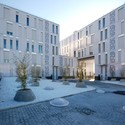
From the first moment we saw ourselves forced to MAINTAIN the VOLUME of the block, since the urban plan had already fixed it in order to establish a dialogue with neighboring buildings that at that time were inbuilt. Our intuition asked to us to reshape the marked volume, especially in the corner, BREAKING IT UP to create an irregular profile in both sides of the plot. The urban fabric of Vallecas follows the typical squared block grid comprising residential units, public facilities and green zones, all tied up by roads. This type of urban fabric falls into monotony: similar built masses, without hardly any variation in their four sides, without remarkable differences between blocks.

ground floor plan

© SOMOS Arquitectos

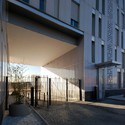
Volume fragmentation gives us the chance to develop buildings with enough identity to be recognizable and absorbed in the city’s memory, and to provide visual richness for pedestrian routes. In our case, a first step to fragmentation is given: the plot is a QUARTER of the original block. We decide to continue with this operation dividing the volume in two HALVES held in tension through a void. We characterize the urban IMAGE through the interplay of space and volume, we establish a dialogue with the neighboring buildings through the VIRTUAL VOLUME (previously defined by the height and width scheduled in the urban plan), composed by means of the void which has been incorporated in the overall composition, improving sun exposure and ventilation. Thanks to the great access space which leads into the patio, we make the block PERMEABLE at the spot where public space demands it most (green area in front of the building), at the same time solving the CHAMFER fixed in the urban plan: the sidewalk is integrated and extended under the great overhang.

© SOMOS Arquitectos

façade details

Translucent polycarbonate panels give shape to an homogenous façade that helps to understand the volumes in an abstract way.

* Location to be used only as a reference. It could indicate city/country but not exact address.
 
 
Thumb up Thumb down 0
SB says:

Look at the proportion of the openings in relation to how deep the plan is! The smaller bedrooms are attrocious.

 
# February 25, 2010 at 04:14
Thumb up Thumb down 0
METS says:

Well this is a perfect example of what the residential buildings have in comon here in spain nowadays: the focus is on the facade/volume. The quality of living is not an issue. Deep plan, super small narrow rooms, ridiculous kitchens. Windows are reduced to the minimum as a responce to the terribly hot summers and the quality that a large window gives to a room is just ignored, although it is technically possible – with proper shading devices…(traditional madrid buildings have beautiful french windows with shutters). Another issue is the poor insulation. Suprisingly it gets quite cold in winters around here and the buildings are just not ready for that. Although spain is trying to push its ecological image and it is for example obligatory to install solar panels on each new building (at least the public ones for sure) the insulation levels are super low. Compared to other countries in europe, taking into account the relation of the average temperature and the amount of insulation, here it is less than half of what it proportionally should be. Termical bridge is almost a forbidden word. To generalize a little: what matters in spain is how things look not how they perform! And at last but not least – better not talk about the settings – the new suburbia of madrid…

 
# February 25, 2010 at 07:00
    Thumb up Thumb down 0
    zero2one says:

    First of all, my congratulations to the architects just for the fact of finishing an affordable resi scheme that sticks out of the Spanish standards, which is not easy.

    After that, I have to say METS is right, there is a trend in focusing on the facades to get something new and unusual at least for the next 6 months, I don’t blame anyone, but it is becoming to be understood as something normal and it looks like nobody cares nowadays about the quality of finishes inside the building and its performance during extreme weather conditions.

    I understand that during the live expentancy of the building the internal layout of the flats and their finishes will be renovated several times by their occupants, whereas the facade just wont do. I just leave it there for an open debate, whether the budget for the “experimental” facades is justified or when dealing with tight budgets as the case of Social Housing, this budget should be used in such a way that the internal finishes improve against the “experimental or innovative” facades.

     
    # February 25, 2010 at 09:01
Thumb up Thumb down 0
gc says:

It would have been interesting to see photos from the apartments to get an accurate view of what the minimal fenestration does. They did mention that facade is made of translucent panels, so at least the amount of light may not be an issue..

 
# February 25, 2010 at 14:28
Thumb up Thumb down 0
Antonio says:

Social housing regulations just don’t allow for spacious living. Lets be clear, this are houses for the least favoured… You just can’t put huge windows into social housing, its not logical and most of all, it’s not allowed. And about isolation, the last CTE (Technical Building Code) which is compulsory to comply with, states more than enough isolation for our climate here in Spain, I don’t know where Mets or Zero2one got that issue from. About thermal bridges (i don’t know if that is a correct translation), that is part of the good work of the architect. It’s not difficult to avoid them and you have no reason to doubt they have been correctly dealt with in this project. About internal layout, people that come to live to this houses just want common plans! They are not interested in a different point of view, most of all, they would complain if the layout wasn’t “regular”! They had this problem with the well-known “Mirador” building by MVRDV, and they have learned the lesson… (not that people weren’t right for complaining, at least this time xD)
So, in social housing here in Madrid, the only place where some innovation can be made is in the facade, courtyards, entrances, common spaces… If you want to blame someone for that, blame the EMV (Local Housing Consortium, dependant from the municipality of Madrid) that heavily regulates how the interior layout and finishes must be.

 
# February 26, 2010 at 13:38
Thumb up Thumb down 0

8:09 PM Sep 13th

Vallecas 11 / SOMOS Arquitectos | ArchDaily http://t.co/zaqCEwi via @archdaily

Leave a Reply »


Latest Comments »

I’m sure this post made sense in your head.[+]
Looks like an upscale version of a Coop...[+]
Jen Camp on TuboHotel / T3arc
It’s not hot and muggy! it’s at an altitude of about 8,000 feet. It’s a very...[+]
like this one most :D[+]
Facebook Funny Pictures on The C114 House / Postarch
It is the best time to make a few plans for the future and it’s...[+]

Upcoming Architecture Events »

got events? invite us! click here

Architecture Books & Magazines »

Louis Vuitton Architecture and Interiors / Frederic Edelmann, Ian Luna, Rafael Magrou and Mohsen Mostafavi

Louis Vuitton Architecture and Interiors / Frederic Edelmann, Ian Luna, Rafael Magrou and Mohsen Mostafavi

“In the more recent past, it is the architecture of minimalism that has provided the most explicit and significant contribution to the reciprocal relationship between fashion and architecture. In many ways the abstraction and literal emptiness of minimalism has…


KieranTimberlake: Inquiry

KieranTimberlake: Inquiry

We recently received KieranTimberlake’s newest book, Inquiry. Instead of listing one project after the next, as in most monographs, this book is organized around ten gerunds: bending, coupling, filtering, inserting, offsetting, outlining, overlapping, puncturing, reflecting, and tuning. This is…


Urban Interventions / Vallo Sadovsky Architects

Urban Interventions / Vallo Sadovsky Architects

Vallo Sadovsky Architects recently sent us their latest book, Urban Interventions. We have featured one of Vallo Sadovsky Architects’ projects before, BA_LIK. That project gets to the heart of what this book is about. Small urban interventions can completely transform and…


Our partners »

AD on iPad via Pulse

Browse by date »

Browse by category »

Friends »