

Rainy|Sunny / Mount Fuji Architects Studio

Uploaded by — Filed under: Houses ,Residential ,Selected , , , ,
 

© Ryota Atarashi

Architects: Mount Fuji Architects Studio
Location: ,
Site area: 108.3 sqm
Building area: 53.1 sqm
Total floor area: 79.5 sqm
Project Year: 2008
Photographs: Ryota Atarashi

The site is there in a residential area in Tokyo, dense with low-rise buildings, located a little bit west to the center of the Kanto plain. The climate there is about to change from warm humid climate to rainforest climate in near future.

site plan

I’m not making a “house” this time. It should be a lasting “terrain” that induces “habitation”. My goal is to shape the terrain up to a freshly designed “residence” with no preestablished harmony sensed.

If I want a landscape with high habitability, the architecture should go beyond some abstract morphology. After all, a terrain is created as a consequence of long time conversation held between physical substances such as rocks and soils and unique climate of the area. Finding a best balance between materials and climate and incarnate that in the form of architecture… This is a challenge to take elements that modern architecture has long been ignored – climate, materials and many problems posed by aging – into design factor once again and shift them to architectural blessings.

© Ryota Atarashi

The project started with questing the best structure and materials to realize “a terrain that lasts forever”.

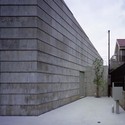
One existing way to match the structure and finished shape is to use bare reinforced concrete as walls. But it’s of questionable value when it comes to durability. Rain washes alkali away from wall surface and makes it extremely short-lived. Shuttering of coated plywood board makes a smooth surface that looks great on the day of completion, however, weather-beaten, it will look sad and old within a few years. So I invented new construction system. Bare reinforced concrete wall with creasing (h=18mm) every 500 mm apart would keep alkali in and stain off. Larch plywood is used as mold instead of coated plywood in order to transfer wood grain to the surface of the wall to make it textured. That way, aged deterioration turns into something of aesthetic value, just like wrinkles of well- used jeans.

© Ryota Atarashi

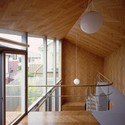
The block of reinforced concrete thus made is placed on the site at an angle to separate exterior into two spaces: to the north, the “front garden” on the road, used as parking. To the south, the “private garden” surrounded by main building and neighboring houses where wind is gentle and sun shines warmly. The private garden offers privacy and security and makes it possible for the architecture to have large window that views sunny garden and “vault of heaven”. The architecture geometry is not conventional rectangular. Its unique shape brings about “darkness” to the corners everywhere, provides it with appearance of depth and liberates the air of the rooms.

© Ryota Atarashi

Residents enjoy a life under boundless sky indoors. On sunny days, unevenness of the exterior walls cast strong shadows. On cloudy days, the architecture sucks in humidity and turns into a dark crag. And on rainy days, it wears lace of raindrop. It transforms itself according to the weather.

Here, a modern architecture that lives in harmony with climate is born.


Thumb up Thumb down 0

The detailing on this building is fantastic; my only suggestion would be to do away with the herringbone interior surfacing and replace it with a calmer pattern and/or material…it’s distracting, even dizzying at times, even in the photographs. I truly appreciate the house vs. habitable terrain distinction though, its a often-argued concept (meaning that it is rooted in the convention of “home”) that has no discernable resolution in sight. Nice work!

 
# February 3, 2010 at 18:59
Thumb up Thumb down 0
Doug says:

At first glance it appears to give a cold shoulder to the neighbors. But on second reading it is strangely calming (the exterior). However, the interior is some crazy OCD with the herringbone.

Surprised they didn’t find a way to make the stair treads align with the overarching pattern.

A nice departure from the sameness of white boxes that are churned out in Japan. This is truly magnificent.

 
# February 3, 2010 at 20:50
Thumb up Thumb down 0
Max says:

the room don’t have any light, the room’s window is front of a big fence. that’s why there’s no pictures of it.
what a pity for this nice project.

tokyo have stranges urban rules. the only rule i heard about is a kind of sun taxe: when you build high you to pay your neighboor.

 
# February 3, 2010 at 22:05
Thumb up Thumb down 0
Ashley says:

In my humble opinion this is a work of great control, its construction and materials are poetic. The care and interest put into how it will weather and how it reflects the weather and site are magnificent. A lesson to all of us architects on how the present is fleeting and fashion has no place in our work.

 
# February 3, 2010 at 22:41
Thumb up Thumb down 0
SPUD says:

HOLY PARQUE!!

i dig the concrete shingling!

 
# February 4, 2010 at 03:35
Thumb up Thumb down 0
bLogHouse says:

I like the typical Japanese minimalism and the clever way of dividing the lot into ‘private’ and ‘public’ areas, which at the same time increases the length of the house. However, this is also a typical example of how keeping architectural gestures ‘clean’ and uncompromising can go overboard. The parquet flooring on walls and ceilings, the tiny gap between the stair and the exterior wall (how about cleaning those areas), the very sharp corner at the entrance, the unusable ‘loft’, etc.

 
# February 4, 2010 at 22:02
Thumb up Thumb down 0
... says:

I find this to be a great project.

-whenever you see such small houses in Japan it always seems you see different bright pictures in the same frame – since the context is always similar;
- I wouldn’t say this house is turning away from the street or the neighbours – I find that to be the main orientation;
- the explanatory text is funny but one does wonder, as one does about Sou Fujimotos texts, or SDO’s why the architects have this feeling of grandeur (“Here, a modern architecture that lives in harmony with climate is born.”);
- would describe the interior as being “charming”;

 
# February 5, 2010 at 07:27
Thumb up Thumb down 0

I'd Live Here: Rainy/Sunny. http://bit.ly/9otcXn

 
# February 5, 2010 at 18:31
Thumb up Thumb down 0

6:42 PM Feb 3rd

Rainy|Sunny / Mount Fuji Architects Studio | http://bit.ly/aSdt04

Thumb up Thumb down 0

8:00 PM Feb 3rd

RT @archdaily: Rainy|Sunny / Mount Fuji Architects Studio http://bit.ly/colJjT

Thumb up Thumb down 0

1:40 AM Feb 4th

Rainy|Sunny http://bit.ly/colJjT (via @archdaily) Pas mal du tout cette maison "fermée" dans un espace urbain sévère. Photos et plans… ++

Thumb up Thumb down 0

1:45 AM Feb 4th

Suite http://bit.ly/colJjT (via @archdaily) j'aime pas le revêtement intérieur mais qq idées à piocher pour traiter un voisinage moche…!

Thumb up Thumb down 0

2:44 AM Feb 4th

Rainy|Sunny / Mount Fuji Architects Studio | ArchDaily: Rainy|Sunny / Mount Fuji Architects Studio | ArchDailyArch… http://bit.ly/ac3WwB

Thumb up Thumb down 0

4:20 AM Feb 4th

さいきんArchDailyにマウントフジがすごく載っている。http://www.archdaily.com/48381/rainy-sunny-mount-fuji-architects-studio/

Thumb up Thumb down 0

11:00 PM Feb 4th

Can you say herringbone? Check out this interior. Rainy|Sunny / Mount Fuji Architects Studio. http://bit.ly/apcigG

Thumb up Thumb down 0

11:33 AM Apr 19th

Rainy|Sunny by Mount Fuji Architects Studio http://bit.ly/b5IpC2 #architecture #interiordesign #minimalism *sharp design

Thumb up Thumb down 0

1:03 AM Jun 10th

Leave a Reply »


Latest Comments »

Architecture shall always keep...[+]
I have been browsing on-line more than three...[+]
I really like split levels AND penne.[+]
beautiful and raw. I feel like it could not have been done anywhere else. the US...[+]
reading again the same ol’ simplifications is not funny. reading a...[+]

Upcoming Architecture Events »

got events? invite us! click here

Architecture Books & Magazines »

Volume 27: Aging

Volume 27: Aging

I never can get enough of Volume. This issue is loaded with provocative articles that stimulate discussion about a pressing reality, the dramatic demographic shift in the age of human populations. Throughout this issue there are articles like Martti…


Architectural Lighting: Designing with Light and Space / Hervé Descottes with Cecilia E. Ramos

Architectural Lighting: Designing with Light and Space / Hervé Descottes with Cecilia E. Ramos

As part of Architecture Briefs series, produced by The Foundations of Architecture, this short book on lighting gives a very good introduction into architectural lighting. The authors start by explaining the six visual principles of light; illuminance, luminance,…


Combinatory Urbanism: The Complex Behavior of Collective Form

Combinatory Urbanism: The Complex Behavior of Collective Form

Thom Mayne recently sent us his latest book, Combinatory Urbanism: The Complex Behavior of Collective Form.  MIT Professor of Urban Design and Landscape Architecture, Alan Berger, hails this book as “nothing short of a tour de force and should be…


Our partners »

AD on iPad via Pulse

Browse by date »

Browse by category »

Friends »