Plus / Mount Fuji Architects Studio
Architects: Mount Fuji Architects Studio
Location: Shizuoka, Japan
Site area: 988.58 sqm
Building area: 232.77 sqm
Total floor area: 380.44 sqm
Project Year: 2009
Photographs: Ken’ichi Suzuki
The site locates on mountainside of Izu-san, where Pacific Ocean can be looked down on the south. The untouched wilderness, covered with deciduous broad-leaved trees such as cherry trees and Japanese oaks, gives little level ground. But we saw faint glimmer of architectural possibility along the ridge. The architecture would be used as villa for weekends.
I didn’t want to just form the undulating landscape dotted with great trees as normal, nor design an elaborate architecture bowing down to the complex topography. What sprang to my mind is a blueprint for an architecture which is perfectly autonomous itself, at the same time seems to emerge as an underlying shape that the natural environment has been hiding. It’s abstraction of nature, to say.
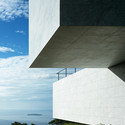
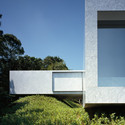
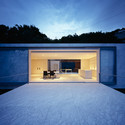
The architecture was realized by crossing two rectangular parallelepipeds at very right angles. The lower one contains private rooms and bathroom, and sticks half of the body out to existing narrow level ground. The upper one incorporates salon and kitchen, and lies astride the lower one and the mountain ridge. It almost seems like an off-centered cross pinned carefully on natural terrain.
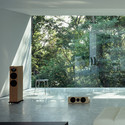
One axis of the cross stretches toward the Pacific Ocean on south, and the other, the forest of Japanese oak and some white birch on west. The rooms in the lower structure and terrace on it enjoy broad vista of the sea and blue sky. And gentle shade of natural forest embraces the space in the upper one. Water-polished white marble (cami #120) was chosen as interior finishing material. It glows softly like Greece sculptures to blend blue light from the south and green light from the west gradationally, thus creates delicate continuous landscape of light which suggests the character and usage of the space. Exterior is also finished with white marble. The surface get smoother as it approaches to the southern/western end till it takes mirror gloss (cami #1000) at the ends. The southern end of white cross melts into the blue of sky and sea, and the eastern end to the green of forest.
Abstraction is nothing to conflict with nature here.
Carved out of nature, it never stops being a part of nature itself, however highly abstracted. Never relativizes the nature with its foreignness, nor generate contradiction to settle for being “artificial nature” by giving up being abstract and mimicking the nature.
The abstraction inspired by Mother Nature defines the nature itself, and still, stays natural.
That’s what I wanted from this abstraction and architecture.
- © Ken’ichi Suzuki
- © Ken’ichi Suzuki
- © Ken’ichi Suzuki
- © Ken’ichi Suzuki
- © Ken’ichi Suzuki
- © Ken’ichi Suzuki
- © Ken’ichi Suzuki
- © Ken’ichi Suzuki
- © Ken’ichi Suzuki
- © Ken’ichi Suzuki
- © Ken’ichi Suzuki
- © Ken’ichi Suzuki
- © Ken’ichi Suzuki
- © Ken’ichi Suzuki
- © Ken’ichi Suzuki
- © Ken’ichi Suzuki
- © Ken’ichi Suzuki
- first floor plan
- basement floor plan
- section 01
- section 02
- section 03
- diagram


“Abstraction is nothing to conflict with nature here”
i love it! the building is really cool! the idea, inspiration…
I’m not really into the floor material and tiles of building skin.. looks bad~~
agree
reminiscent of ando..with a different skin.serene.
anytime a project has any purity of form, someone always brings up ando. has he become the only frame of reference people can come up with?
nothing
Its excellent concept and contrast with nature, just sircular stair does not fit this building, for saving space for sure, but for use and feeling is wrong. Also its quite super cold interior, but its just my point.
looking at the plan, i consider that the stairs are dimensioned just enough to be comfortable. It is the house concept, to make the lower, private zone a cavern like space, and the upper zone completely dedicated to the holy nature around it. Therefore, i would say, that the spiral acts, as a clearly marked, but not as a intrusive passage between the too dimensions. A more accentuated, or a standard stair like connection would make the profound hierarchy of these contrasted worlds to collapse… but its just one point, as You say.
what happens to rain water in this house? everything appears to be flat.
Flat roofs are never truly flat, wew.
Like a deck, or a parking lot; drainage is considered even if it’s not visible.
thats true but there is no rain-pipe or anything similar hidden, so the water goes from the roof right on façade.
I’m just curious how for eg, isolations works. if there are no problems then i really want to know how.
the inspiration is good
i like the visual qulity of such a minimalism space, but can people have enough intimacy of living inside.
seems to me there is more spatial potential could be developed when the vertical meets the horizontal, just like a hinge…. currently only a spiral stair, could it be accentuated more, by offering some real space connection?
the concept means one box above the other. It doesn´t happen. The house only has one slab between the two boxes. In part of that there are some interesting aspects
i love the concept but that marble looks so fake, it’s a shame. The tiles look like a wrong bump map. If they wanted to use white marble why not use “white” marble?
Whatever you all say, I just love it.
I love how there’s a center channel speaker in the one image but no television. Center channel speakers are only intended for home theater applications.
I would love to see what the house looks like after it’s been lived in for a couple years. Everyone talkes about the “architecture” or “building” but what about discussion on what makes it a “home”???
i’d say it doesn’t look as minimalistic, as it does look boring.
perhaps a gallery, but a home? not so much.
simple.
elegant.
one can catch cold in there just by psycho-spatial means.
nice place for a thriller with a serial killer.
‘looks nice.’
(i think this last sentence is the most popular, the most powerful yet the harshest negative critic of these times)
Beautiful piece of coldness.
And why, why why do all these architects risk children’s lives with such “railings”?
Do the users sign a paper where they agree not to sue the architect in case of accident?
I just couldn’t sleep at night if I designed something like that…
might have been nicer in dark wood cladding, to better reflect the wooded site and traditional buildings nearby… i think the pure form alone is enough to set it apart in the spirit of modernism.
still, whatever material… it’s very hard to argue with that view.
this is what i like from asians designers, they just do what they want, instead of complaining about everything i love it
It is hard to tell, but is the terrace railing partly glass?? It’s hard to tell, but would be an excellent solution.
simply excellent
the contrast with the entorn is evident, without it´s a sustent dialog betwen two parts.
the basics forms remember in my mind a real connection with ours abstractions ideas.
simply beautiful.
less is more, but made with sensibility and right proportions.
Simply and amazing!
2:02 AM Sep 13th
・・・次世代基準の建築デザイン、日本の受賞建築の画像を探してみました。
http://bit.ly/9u81Rt
http://bit.ly/8YVfNA
8:46 AM Oct 4th
I love when i'ts simple… http://t.co/YrGujHR via @archdaily
4:45 AM Oct 24th
Quiero una casa así, sencilla. http://www.archdaily.com/48096/plus-mount-fuji-architects-studio/?f=selected
12:08 PM Apr 10th
Plus / Mount Fuji Architects Studio | ArchDaily http://t.co/BLPunHT via @archdaily AWESOMEEEEEE