Bug Dome / the WEAK!

By — Filed under: Architecture News ,Cultural , , , ,
 

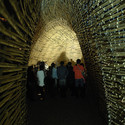
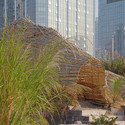
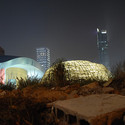
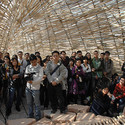
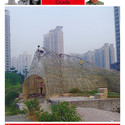
Inspired by insects, the Bug Dome is a small sheltered area used during the for underground bands, poetry reading, and discussions, and after the Biennale as an un-official gathering place for illegal workers from the Chinese countryside.  Built on a wasteland of a ruined building site in-between the Shenzhen City Hall and an illegal workers camp, the structure is intended to reveal the connection we share with nature:  ”In large scale, if we learn to understand the connection what the hundreds of millions of hands that are now migrating from the rural China to the modern cities might bring along them, we might be able to ruin the industrial city. We might be able to make the city to be part of nature.”

More about the dome after the break.

“The design process was painful. We were all ripping the design to all three individual directions but in the end we gave up and the design became the boss and we learned to listen. Architecture gives the commands and architects listen,” explained Marco Casagrande, Hsieh Ying-chun and Roan Ching-yueh who make up WEAK!

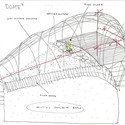
The building is made of bamboo and was adapted to meet the site-specific conditions.  Inside the cocoon, “a weak retreat for the modern man to escape from the strength of the exploding urbanism”, a small area allows people to come together, and a space to share a fire is also provided.

“What comes to architectural control, we must give up in order for the nature to step in and for the human nature as part of nature.”

For the complete photo set, visit here.

2009 Shenzhen & Hong Kong Bi-City Biennale of Urbanism/Architecture

Architects:

Hsieh Ying-chun 謝英俊

Marco Casagrande 馬可·卡薩格蘭

Roan Ching-yueh 阮慶岳

Construction Work:

Chen, Jiang Zhou, Leo Cheng, Marco Casagrande, Nikita Wu, Shao Lei, Wei Jia-kuan, Wei Jing-Ke

Design Assistant:

Frank Chen

Local Knowledge:

Wei Jia-kuan

Wei Jing-Ke

Location: Shenzhen, China

Site: 3000 m2 waste land, ruined building site

Building footprint: 120 m2

Materials: bamboo, wood, gravel, recycled concrete

Completed: 2009


Thumb up Thumb down 0
marta says:

a very beautiful and intelligent project! i not only love the structure and the amorph shape, but also the contrast between hi-tech and low-tech against the skyscrapers in the surrounding.

 
# January 17, 2010 at 13:01
Thumb up Thumb down 0

Great community project and contrast of simple/natural and complex/man made.

 
# January 19, 2010 at 11:04

Leave a Reply »


Latest Comments »

hi[+]
In gally office[+]
...[+]
They must call that the “Towering Inferno law”, their code is a...[+]
You are wrong completly. This is brillant. It have harmony, scale and...[+]

Upcoming Architecture Events »

got events? invite us! click here

Architecture Books & Magazines »

Combinatory Urbanism: The Complex Behavior of Collective Form

Combinatory Urbanism: The Complex Behavior of Collective Form

Thom Mayne recently sent us his latest book, Combinatory Urbanism: The Complex Behavior of Collective Form.  MIT Professor of Urban Design and Landscape Architecture, Alan Berger, hails this book as “nothing short of a tour de force and should be…


Golconde: The Introduction of Modernism in India

Golconde: The Introduction of Modernism in India

Sited on the coastal edge of the Bay of Bengal, Golconde, a dormitory for the Sri Aurobindo Ashram in Pondicherry, India, was designed by architects Antonin Raymond and George Nakashima. Golconde is a remarkable architectural edifice, seemlessly negotiating between


Volume 27: Aging

Volume 27: Aging

I never can get enough of Volume. This issue is loaded with provocative articles that stimulate discussion about a pressing reality, the dramatic demographic shift in the age of human populations. Throughout this issue there are articles like Martti…


Our partners »

AD on iPad via Pulse

Browse by date »

Browse by category »

Friends »