
Ministry of Internal Affairs of Georgia / M-Ofis Architecture

Uploaded by — Filed under: Public Facilities ,Selected , , , ,
 

mia 69 completed building 11

Architects: M-Ofis / aMDL / F&P
Location: Tbilisi, Georgia
Architects in Charge: Sinan Timoçin & Serkan İğdelipınar
Project Team: Burcu Ersan, Erkan Tural, Sümeyra Mezik, Simin Ghalichi, Pelin Özdemir, Fırat Çoban, Fatma Aliosman, Abidder İnci, Buse Albay
Conceptual Design: Michele De Lucchi – aMDL(Italy), Freyrie-Pestalozza – F&P(Italy)
Project Management: M-Ofis Architects CO.
Structural: ASM Engineering (Turkey)
Mechanical: Elmaksan Engineering (Turkey)
Electrical: HB Engineering (Turkey)
Main Contractor: Nurol Construction
Site Area: 49,652 sqm
Construction Area: 11,660 sqm
Project Year: 2007-2008
Construction Year: 2007-2009
Photographs: M-Ofis

mia 59 completed building 01 mia 62 completed building 04 mia 66 completed building 08 construction process

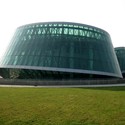
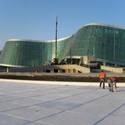
Ministry of Internal Affairs of Georgia building was designed within a site near the Kakheti highway between Tbilisi International Airport and city center. This building not only was designed as an official building but also as a landmark for Tbilisi and Georgia. The building has been located within a 49,652 sqm area consists of a 3,580 sqm area curvy basement and ground floor also having linear form of first and second floors. The total area of the main building is 10,579 sqm. The main building was located in the middle of the site as a little bit closer to the highway. Thus, like a ceremonial square is available in front of the main building. At the same time, a 1000sqm pool with a depth of 30 cm was designed in front of the main building, in order to reflect the facade of building by the means of water within the big pool. The main building located within a pit on the ground and rising from there has two entrances. The first one is from the front part by the means of a bridge for VIP and the second one is from north part as opposite direction for civilians. The bridge reaches to the building by crossing over a grass inclined area. VIP persons enter to the ground floor by the means of this bridge directly. At the north part of the site an open car park for civillians/visitors and a heliport were designed. At the same time, all civilians can enter to the site by using the gate located this part. Civilians reach the main building by walking through the pathways which are among a 50 meter long green area including grass and trees after passing carpark zone. Exposed concrete stairs were designed towards the basement open area surrounding the building, in order to provide arrival to the entrance point at the basement floor from North side of the building. In this way, entrances for VIP and civilians could be arranged from different floors separately in design. A service road was designed for ambulances, fire trucks and other service vehicles at the west-south part and as adjoining to the neigbour plot of the site reaching to the basement level (-4.80). Basement open area which surrounds the building is bounded by an exposed concrete retaining wall. At the North-east side of this retaining wall, there is the front facade and entrances of a 1164 sqm construction area mechanical building as buried by top and other sides. A transformer building was designed in the green area at the north-east side of the site as adjoining to the car park. This building was designed as concealed by soil and grass as if a natural hill, in order to disappare the volume of the building from outside. This 148 sqm building includes transformers and generators and its entrances were provided from the car park area.

schematic floor plan

schematic floor plan

mia 64 completed building 06

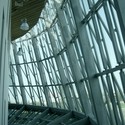
By opening the facade and creating a large open space around the basement of the main building in design, not only lets the sunlight and fresh air enter inside, but also creates a base for the extraordinary volume consisting of and on the top. Basement facade consists of walls and openings both. In order to create a base view for the basement facade, similar pattern and colour should have been used on the facade and outside ground both.In this way, by having permanence of same texture and colour for both surfaces, the base effect for the top volume would have been obtained. Therefore, while brushed concrete has been used for the outside ground but concrete texture paint used for the facade. Main building was designed as an linear form inner two storey block and an extraordinary three-dimensional outer facade consisting of . Only basement and ground floor was produced by reinforced concrete but all upper floors and columns were made by structural system. As the opposite character of the facade, inner block has rectangular shape above from the ground floor (±0.00 level). In this way, on the ground floor a three-dimensional inner volume was obtained as atrium. This space which is between building facade and the inner block, which has 12 meter high, is used a big circulation area on the ground floor, also behaves a foyer for the auditorium and having a cafe which serves to employees and visitors. Besides, a closed open office was designed at the east side of this part. There are auditorium, kitchen of the cafe and stairs within the rectangular block on the ground floor. Inner block consists of two wings as left and right with a central large bridge for access. Upper floors have been closed by the means of a glass facade in order to prevent noise effect could be from the atrium and to highlight the inner rectangular block in design. In the first floor while minister’s and deputy minister’s rooms also their related rooms were located on the west wing, open offices were placed on the east wing. In second floor, open offices were designed on both wings. Two open stairs serve mainly to the central bridge in order to provide main vertical circulation. At the same time, three fire stairs and a special elevator for use of VIP and also handicap peds.

construction process

construction process

façade detail 02

façade detail

The main building facade consists of 200x400mm steel box profiles main frame as the inmost structural system and 150x150mm steel box profiles were used as the secondary frame and including Ø60mm circular steel profiles, PVC, aluminum profile system together with glass was used as the outmost layer of the three-dimensional extraordinary facade.

mia 65 completed building 07

The facade consists of there different surfaces totally in section. First facade is the bottom facade starting from +0.00 level. The second one is the main front facade. The third one is the top part of the facade connecting the top point of the second facade to the roof slab (+12.00 level). All section parts of the facade have different angles and also different surfaces everywhere. This three-dimensional variable movement on the facade determines the characteristic of the building. At the same time, glass facade was formed by 3567 item tirangle glass pieces totally, while 1947 of them have disparate sizes from each other. Due to natural ventilation considered within the atrium in addition to HVAC system, some triangle modules on the bottom and top facade have been designed as openable windows which open synchronously by the means of automation system. At the same time, windows located on the top part open separately from bottom part, in order to provide smoke-exhaust for the atrium in case of fire. The atrium part was divided into four closed pieces by five fire walls made by steel and glass, in order to prevent any smoke transfer throughout the different spaces inside of the building.

The movement of the building facade to up and down creates an entrance point turning into an eaves at the middle of the front elevation apparent from the highway.


Thumb up Thumb down 0
Andrew Geber says:

this is awesome!

 
# December 2, 2009 at 04:28
    Thumb up Thumb down 0
    David says:

    why do u think its awesome?

     
    # December 2, 2009 at 07:07
      Thumb up Thumb down 0
      Andrew Geber says:

      because of the shape and because it was actually built

       
      # December 2, 2009 at 09:03
Thumb up Thumb down 0
WSBY says:

some kind of……….supermarket! :)

 
# December 2, 2009 at 05:48
Thumb up Thumb down 0
Yorik says:

One thing it is, is a show of technology… The detail drawings are quite cool

 
# December 2, 2009 at 07:23
Thumb up Thumb down 0
Mac says:

What a monster…

 
# December 2, 2009 at 08:52
Thumb up Thumb down 0
Nicolas says:

woah… very impressive, i wonder how much it costed?

 
# December 2, 2009 at 10:47
Thumb up Thumb down 0
jibrur says:

impressive, well done, enough said
despite of the form, how the details are being applied on the facade is well versed…

 
# December 2, 2009 at 11:19
Thumb up Thumb down 0
oqd says:

what a waste
in every single way

i cant see any architecture

what would happend if you take off the skin?

 
# December 2, 2009 at 13:17
Thumb up Thumb down 0
m! says:

I see a Kisho Kurokawa museum (Fukui).

 
# December 2, 2009 at 14:04
    Thumb up Thumb down 0
    MK says:

    I agree

     
    # February 12, 2010 at 05:37
Thumb up Thumb down 0
teo says:

Oh those details, and drawings!!! This is like giving a 3 yr old candy :D:D:D I bet I can’t afford one panel :)

 
# December 2, 2009 at 14:17
Thumb up Thumb down 0
arnold says:

it must be very expensive object as it built in Georgia. Many compliments to client (Employer), who wanted to built modern building to represent this beautiful country.

Some things are strange:
- the basement – it looks not good if it compare with all building; basement very discord with steal/glass structure;
- in one photo, I saw bend steal column/pillar. Some problem with tech.quality.

 
# December 2, 2009 at 15:53
Thumb up Thumb down 0
u says:

vis moafiqrda neta amis dadeba :)

 
# December 2, 2009 at 16:44
Thumb up Thumb down 0
tommo hcmc says:

wow, great amount of detail drawings for this one, it’s always easy to just look at a wavy glass facade but actually designing it is something else altogether… more projects with detail drawings please!

Thanks for sharing

 
# December 2, 2009 at 23:28
Thumb up Thumb down 0

An example of the perfect art of complicating things unnecessarily…
is the building not sensitive to the cardinal directions…

 
# December 3, 2009 at 01:53
Thumb up Thumb down 0
greenita says:

ra jandabaaaa . es aq vin dado. rad gvindoda vigac italieli. georgian architects can built better.

 
# December 4, 2009 at 11:45
Thumb up Thumb down 0
chris says:

the outside is has some nice aesthetic qualities but if you look at the plan it’s just a bunch of boxes wrapped in a cool skin. That’s probably why there are no interior photos.

 
# December 7, 2009 at 08:39
    Thumb up Thumb down 0
    whistler says:

    I agree with you about the inner building. However, the exact reason of not having more interior photos is different and infact very simple: It’s kind of a military building, so it’s prohibited to take photographs. But it’s also has a transparent façade, so anyone can see inside the building. Rules are rules!

     
    # December 9, 2009 at 11:27
Thumb up Thumb down 0
dE says:

i think interiors are just as good. they’re actually balancing the masculine look and lots of metal with nice and soft touches, like sleek design and use of wood.
and .., i do agree with criticism also, as building doesn’t consider ecological climate at all.
anyway, i think it was very brave from the clients point of view, as it seems to work and attracts a lot of attention.
well done!

 
# December 22, 2009 at 06:36
Thumb up Thumb down 0
SA says:

The outer skin has an interesting ribbon effect, but I’m not sure how much I like its aesthetic qualities in the end; corporate. It’s a cool system, just not realized into architecture all that well. Why does the base have to sit on those stupid “legs”? I like the contrast between the inner rectilinear office building and out curvilinear facade. By the way, who wrote the description?? …wow

 
# April 7, 2010 at 03:26

Leave a Reply »


Latest Comments »

Some of our top sellers are: Mr. Magic, Monster Melt, Stop Ice, Safer Than Salt Commercial, Safer Than Salt Premium, Safer Than Salt with Corrosion Inhibitor, EarthGuard and of course, sodium chloride otherwise known as rock salt or halite. on Wexford County Council Headquarters / Robin Lee Architecture
...[+]
hi[+]
Ingunn Opsahl on Kimball Art Center / BIG
I was wondering about the size of the timber myself, so if the reclaiming of wood...[+]
I will right away snatch your rss feed as...[+]
I do like the design, but the proposal package and...[+]

Upcoming Architecture Events »

got events? invite us! click here

Architecture Books & Magazines »

Work Environments / DETAIL

Work Environments / DETAIL

We recently got to preview the newest addition to In DETAIL’s typological series, Work Environments: Spatial concepts, Usage strategies, Communications. It will be available next month (August 2011), and it is great for anyone who is interested in improving…


Passive Solar Architecture / David A. Bainbridge and Ken Haggard

Passive Solar Architecture / David A. Bainbridge and Ken Haggard

David Bainbridge, founder of the Passive Solar Institute, recently sent us his book Passive Solar Architecture. The book is a great introduction for anyone interested in passive solar architecture. The content is kept simple and straightforward. It allows any…


Louis Kahn on the Thoughtful Making of Spaces / Michael Merrill

Louis Kahn on the Thoughtful Making of Spaces / Michael Merrill

From previously unpublished material and new analytic drawings this book explores Louis Kahn’s Dominican Motherhouse, his unbuilt masterpiece. Kahn pushed and prodded modern architecture into a crisis that questioned aspects of space that modernism had proudly banished from its…


Our partners »

AD on iPad via Pulse

Browse by date »

Browse by category »

Friends »