
Cages for Macaws / Enric Batlle & Joan Roig Architects
Architects: Enric Batlle & Joan Roig, arquitectos
Location: Barcelona, Spain
Collaborators: Francesc Puig, architect & Elena Mostazo, engineer
Project year: 2007
Construction year: 2008
Client: Foment de Ciutat Vella, S.A. – Barcelona Serveis Municipals
Contractor: COPISA
Project Area: 1,375 sqm
Budget: $343,239 Euro
Project year: 2009
Photographs: Eva Serrats, Wenzel
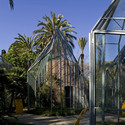
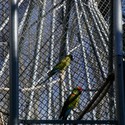
The palm grove in the Parc de la Ciutadella is a small 1,500 sqm garden made up of a wide collection of palm trees of different heights and a thick tropical bush vegetation. It has always been used as an habitat for the macaws. Its remote location and the noisy and colorful presence of the birds turn it into an exotic oasis inside the park and a unique place inside the city.
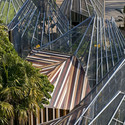
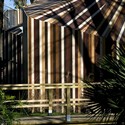
The design of the cage was developed following the instructions of the Zoo’s technicians. The total surface of each unit is 21.5 sqm, from which 14.40 sqm can be seen by the general public. The rest is divided in 5.20 sqm of ‚sleeping area‚ and 4.90 sqm of maintenance corridor. The main structure of the cage is made up with several leaning metal tubes that bend and close on the top like a metal wheat sheaf.
The project focused on the cage design, which is complex enough to arrange the garden through the path of the visitor by its repetition.
The main criterion was arranging the cages in an apparently random way making them always offer different perspectives, creating a system than can be perceived as a picturesque system lacking of any rule and continuously surprising. Its immersion into the palm grove looks for coexistence, respecting its hidden nature and increasing its exoticism.
- situation plan
- site plan
- floor plan
- unfolded plan + elevations
- sketches


12 comments »
ha just what we need more cages for animals. wtf is wrong with architects.
isn’t that what all architects do? cage animals?
so true…
While we should appreciate and thank the city of Barcelona’s commitment to design, I think the project itself was slightly off-target as a means to display animals. Rather than worrying about creating a “picturesque system lacking of any rule”, the architecture should seek to expose the beauties inherent of the garden itself. Too much architecture in this one, folks.
Yeah maybe so on the “too much architecture” comment.
surely the best way to show these birds is with the lightest structure possible – not behind a forest of metal poles.
the problem with this is that they made it about the cages and their arrangement and not about the event of looking at the birds.
Has anybody thought about the possibility WHY they made it all about the arrangement of the cages? because the birds might want to have some sheltered place of course! And in my opinion, they managed nicely to create a nice arrangement of shelters for both the birds and people walking inbetween them. So the comments about too much architecture are a bit simplistic.. they even say that it was all designed according to zookeepers rules and regulations.. don’t judge projects so fast people!
I’m totally agree with you VIC, it’s a great job!
ive had enoughhh of branches and trees, can we please go back to dots or lines or something?
The place gives me a sense of a maze. I agree with the fact that the designer wanted to create a sense of randomness but still not to that extend!
Architecture is all about freeing yourself but that can’t but done like this!
gorgeous in appearances. i cannot judge its success or failure from blog photos, but i would hope that with the consult of zookeepers it is an effective blend of an enriching bird habitat, beautiful architecture and an educational, visual experience.
10 links to this article »