Church of living / Zecc Architecten
Architect: Zecc Architecten
Location: Utrecht, The Netherlands
Project Architects: Rolf Bruggink, Marnix van der Meer
Collaborators: René de Korte, Marc Brummelhuis, Thijs Toxopeus
Project area: 250 sqm
Project year: 2006-2007
Photographs: Cornbread Works
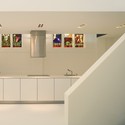
The balcony at the organ is maintained and extended in the shape of a organizing element, free in the space. This element defines the different living spaces, like living, cooking and studying, in the chapel.
A new spatial hierarchy is created by the asymmetric placing of the organizing element. The object is kept very minimalistic and is given abstract shapes, by which it creates an contrast with the original, soft shapes of the chapel.
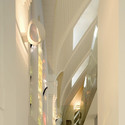
Despite of their contribution to the dark character of the church, the leaded glass is maintained. For this reason roof light are attached to the space, through which diffused day light enters the chapel. In combination with a completely white surface finishes, the leaded glass comes to life.
Specific, characterizing elements, like relics, are maintained and used, by which a nice field of tension comes into existence between the old and new function of the chapel.
Because of the lack of windows on eye level in the chapel, the church made a closed impression. There had to be made contact with the city. By introducing an new, somewhat bold, abstract modern version of a leaded glass front framing, this contact is created.
The glass front is almost Mondriaan-like, and contains references to the original leaded glass, that tells a religious story in a more aesthetic way.
- © Cornbread Works
- © Cornbread Works
- © Cornbread Works
- © Cornbread Works
- © Cornbread Works
- © Cornbread Works
- © Cornbread Works
- © Cornbread Works
- © Cornbread Works
- © Cornbread Works
- © Cornbread Works
- situation plan
- ground floor plan
- second floor plan
- section 01
- sections 02


33 comments »
very nice ! ! !
tym razem przegięli! Czemu nie zorbią np mieszkalnego meczetu?? ŻENADA!
Pathetic…
mi się podoba :) przełamanay stereotyp kościoła jako zimnego i mrocznego wnętrza. Nowa forma nabożeństwa ugotuj niedzielny obiadek z księdziem wikarym :)
Kitsch.
не фонтан (((
Projects like this – transforming old church buildings into private residences – always strike me as deeply wrong. There is a very insensitive juxtaposition between the formal characteristics of sacred space and the informal profanity of casual modernity which seems inevitably to lead to what Tanja above calls “kitsch.”
HOw’s that? I’m not a religious person, I couldn’t care less if it was a church or not. (I would find it kinda creepy though)
I might be wwrong, but probably your opinion is based on your faith.
HOwever, even if that isn’t so, a church is the ultimate “shelter”, through the centuries churches have been used to provide shelter, the whole building isn’t only just a big altar.
If you feel that way, how do you feel with regular catholic traditions of hanging Jesus’ pictures, crosses, etc above bed frames in people’s bedrooms? some people even do it in their bathrooms!
WHat about churches being converted into restaurants?, bars? or discos?
I would give you atleast some reason in those cases, just simply out of respect, but then again, I don’t see a big issue with it.
Crap, can’t edit my post.
Forgot to add, I also find it “kitsch”, but not for the reasons you expressed.
I know about the problems with religious / church /- less and less people are going there – even thought christmas is still
popular :) Yes I like the design – even mondrian´s pictures. I
if it´s residence of pastor or some church staff or church
for young, active, modern comunity – yes way of church celebrations are different now – I agree. but if it´s just house – NO. why somebody should have house like this.Why it should be pub, restaurant . . . is´t it a bit sick. Why make
a church loft – becouse houses like church has a own place in urban structure and nemtal map. but if we dont need them – why to have it?
My opinion is influenced in part by my own religious beliefs, yes. The bare structure, however, is not really the concern. It’s the incorporation of formal sacred elements – or rather, the lack of sensitivity in incorporating those elements – that bothers me. The structure was built for more than simply providing shelter, and this project seems utterly to ignore that fact.
I’m not sure how transforming a traditional church building into a private residence could be successful since I’ve never seen a successful example, in my opinion. In fact, I can’t recall many successful church conversions I’ve seen that weren’t simply public auditoria of some sort. There was recently one example of a bookstore & cafe that was quite good overall but suffered from placing a cross-shaped table for the cafe in the chancel.
As for such traditions as hanging small crucifixes above the bed, I don’t find these bothersome in the same way, although they too can be kitschy! Yet it is one thing to incorporate religious symbols into the informal environment of a private house, quite another to take the informal environment of a private house & install it within the formal environment of a church building.
That’s my thinking at any rate. Why do you find this project kitschy, sullka?
What do I find kitsch?, some details, probably the same most see:
- keeping the benches as dinig chairs
- chandeliers at bathrooms (specially the one chosen, eth rest of the bathroom is pretty nice)
- plastering all the back wall but the arch, cross and side doors.
- Some “gothic meets modern” features I don’t like, etc
All interior design issues (a purely personal view, others surely think different)
But based stricly in formal, abstract, relative, mundane or even banal points.
Not because of “profanity” or “insensitive” decisions.
I feel it is important to reuse existing structures whether they be churches, factories, etc. I would imagine that this structure was sitting empty prior to it’s new life. Certain people might regard this as a sacred place, but the deity honored here would only recognize it as wood and stone.
I love the design! it is one of the best interior in 2007. but this is very out-dated! other blogs had this one in 2007, archdaily in 2009.
still beautiful interior!
No one else finds it odd that the bath and sinks are wide open in the bedroom. You’re sleeping in a bathroom.
I recall the swiss architect Valerio Olgiati mentioning there are only two tipes of buildings: Contextual buildings and temples. Even thou i think he was refering to a landscape-pressence point of view, the fact that this project fails to achieve an identity make’s it very relevant. Somehow when a public structure with religious icons is reused in a concert hall or a discoteque, it remains a public gathering place for a commuity. If it losses the icons, certanly the structure can become anything. But this project is neither as simple as a “reused structure” (because it keeps the icons) neither a gathering place.
Certanly the project wants to comunicate something but it dosn’t know what. Like teenagers.
Im not sure why my comment was not posted but here it is again:
“I recall the swiss architect Valerio Olgiati mentioning there are only two tipes of buildings: Contextual buildings and temples. Even thou i think he was refering to a landscape-pressence point of view, the fact that this project fails to achieve an identity make’s it very relevant. Somehow when a public structure with religious icons is reused in a concert hall or a discoteque, it remains a public gathering place for a commuity. If it losses the icons, certanly the structure can become anything. But this project is neither as simple as a “reused structure” (because it keeps the icons) neither a gathering place.”
Gives me the same feeling when I see a circus animal which is meant to be beautiful and strong, that is put in chains and a cage, and becomes a slave to a small piece of meat that means nothing..
confusing, eclectic… I’d rather sleep and live in real church.
What is perhaps a worse example: http://dornob.com/countryside-church-building-converted-into-luxury-home/
Links to this article »