
Wellington Zoo Amphitheatre / Jasmax

Uploaded by — Filed under: Infrastructure ,Selected , , ,
 

B3

Architects: Jasmax
Location: Wellington,
Client: Wellington Zoo Trust
Project Area: 500 sqm
Project Completed: 2007
Photographer: Paul McCredie

B1 B5 Zoo6 Zoo14

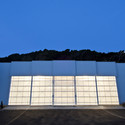
The Wellington Zoo Amphitheatre is a multi purpose performance space. The primary challenge was to create a powerful and symbolic building with a very tight budget. The most difficult – and hence innovative aspect of the project – was opening up the rear of the theatre in a way that was technically simple, robust and yet elegant whether open or closed.

floor plan

floor plan

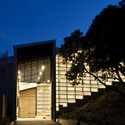
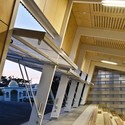
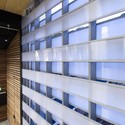
The building is comprised of tiered seating covered by a simple lean-to roof that folds down to an inclined rear wall. The roof at its lower edge is staggered and the rear wall stepped to allude to the concept of a traditional (radial) amphitheatre. The sides are semi-enclosed with translucent plastic sheeting. The rear wall folds open to a public area allowing the audience to overflow on fine summer days.

B2

The zoo context demanded a robust building. In response, we worked with very simple and effective building technologies but deployed them in a highly crafted way: areas of striated wood soften and warm the space; rigorous attention to critical details – flashings in particular – give a fineness to its edges; the translucent sheeting creates a light effect that is soft and slightly mysterious and when lit up in the evenings it glows like a lantern in the heart of the zoo.


Thumb up Thumb down 0

What makes a theatre, an amphitheatre?…anyone?

 
# October 6, 2009 at 07:53
Thumb up Thumb down 0
João says:

The shape.
And this is not an amphitheatre…

 
# October 6, 2009 at 09:24
    Thumb up Thumb down 0
    salvadore says:

    and how did you get to this smart conclusion that this in not an amphitheatre??

    before you say things that you don’t know, make some research.

     
    # November 15, 2009 at 15:41
Thumb up Thumb down 0
astor says:

I wish they had put a central photo of the stage…

 
# October 6, 2009 at 10:02
Thumb up Thumb down 0
PB says:

An amphitheatre is usually an out-door, open air performance venue, usually with the seating being semi-circular in plan. The semi circle was used because of it’s natural amplification qualities that allowed performances to be heard clearly in the back rows without the aid of artificial amplification.

This is an enclosed space, but is not cut off from the out doors (the building is more of a shelter). It does not look like it has or needs artificial amplification, so, regardless of the shape in plan, I think it qualifies as an amphitheatre.

Regardless, I think it’s a quite attractive design and hope it sounds as good as it looks while in use. I like the variety of materials, and it seems warm and inviting while being a contemporary design.

 
# October 6, 2009 at 10:59
    Thumb up Thumb down 0
    Ruth says:

    The theatre was in fact semi-circular (or at least fan shaped) in it’s very early design, however this was “value engineered” away – as described in the blurb, cost was a key driver. Nonetheless the rectangular seating works well and we think provides a very elegant form – Amphitheatre or not!

     
    # October 6, 2009 at 22:31
      Thumb up Thumb down 0
      james says:

      Did you have a part in it’s design or something?

      i think its pretty nice

       
      # October 8, 2009 at 01:35
    Thumb up Thumb down 0
    salvadore says:

    ascending seating makes a it an amphitheater!

     
    # November 15, 2009 at 15:47
Thumb up Thumb down 0
Goldschmidt R says:

Hey come on, let the ancient Greac to rest in peace, bought of them have that shape semi circular, but the differance is that: The amphitheatre it is an open air, and thea theatre is enclosed. And I think that is a hybrid, because it is an open space, but it is just coverd. Anyway, I like the design, it is using warm material, and I don’t think the sound will be bad.

 
# October 7, 2009 at 08:51
    Thumb up Thumb down 0
    salvadore says:

    who are you ppl???? does nobody learn history of art or something??? ascending seating makes it an amphitheater…..

     
    # November 15, 2009 at 15:50
Thumb up Thumb down 0
Squidly says:

Lucky they didn’t build this in the US, they would have been required to add a ramp access to the stage!

 
# October 7, 2009 at 10:08
Thumb up Thumb down 0
João says:

Well, considering that “amphi” is a latin word that comes from Greek, and means “on both sides” or “around”, we must conclude that an amphitheatre is related wiht the circular form, and not the out-door.

So, even recognizing the lack of importance of it… this is not an amphitheatre!

 
# October 7, 2009 at 10:58
Thumb up Thumb down 0
Goldschmidt R says:

João my friend, I dont said literaly, but it is one open space, eh, but why do we bother for the name it have. I like the building and that is all. If I like to call one building of mine Train staiton, and it is a Post office, I don’t see what is the problem, and the shape it is an “fan” plan, but it is more today than thousand’s of years ago. Abd don’t bother João, it isn’t a personal thing!

 
# October 7, 2009 at 11:36
Thumb up Thumb down 0
KJS says:

Classically, an amphitheatre is a complete circle or oval, and a theatre is a semi-circle. An amphitheatre was distinguished from a theatre precisely by having seating that surrounded the viewing area entirely, as e.g. in the Colosseum. This project would fit neither specification as far as classical models are concerned. But modern English usage is much looser, and “amphitheatre” is more frequently used to denote an outdoors venue as opposed to an enclosed “theatre.” Since this project does open to the outdoors, I would say “amphitheatre” is an appropriate appellation. More importantly, I think it is very attractive & well-done!

 
# October 7, 2009 at 12:51
Thumb up Thumb down 0
sarkis says:

What the hell is the big deal, I think its a nice project very well done!

 
# October 8, 2009 at 01:12
Thumb up Thumb down 0
dito says:

haha…lots of critic on the text! build a bridge (i.e get over it!)

Go New Zealand!!

 
# October 8, 2009 at 17:32
Thumb up Thumb down 0
Craig VanDevere says:

I agree it is a nice looking project, well done. The only thing that I could add to this discussion is if the seating had been placed in a semi-circular design you would have had more comfortable sight lines for all viewers. That is everyone’s bodies would be basically perpendicular to the stage allowing one to look straight on versus having to turn their heads and/or bodies to comfortably see the what was going on at the stage. Must keep in mind that this is an amphitheatre for a zoo and therefore can be somewhat more lax on how they design for sight lines and comfort.IMO

 
# October 10, 2009 at 08:18
Thumb up Thumb down 0
salvadore says:

NO NO NO! the amphitheater is all about the ascending seating not circular or open air or anything like that… the first most important ones were made like that. a round table with some seats around out in open air is not an amphitheater!!

 
# November 15, 2009 at 15:56
Thumb up Thumb down 0
Matt Gibala says:

what are enclosures, please? (in the floor plan)

 
# November 9, 2011 at 10:59

Leave a Reply »


Latest Comments »

Not to take away from Switzer or...[+]
ArchDaily features nice projects. But is obviously run by morons.[+]
They thought about the scale of wood. The intent is to use Trestlewood, which is wood...[+]
So creepy![+]
why is heidi montag in every swimming pool project? nice[+]

Upcoming Architecture Events »

got events? invite us! click here

Architecture Books & Magazines »

Review: De Stoel van Rietveld: Rietveld’s Chair, book + film by Marijke Kuper & Lex Reitsma

© Jules Gianakos

“It is hard to tell what the value of something eventually will be”
– Gerrit Rietveld, 1937.
This new insight into a classic illustrates Gerrit Rietveld’s transition from humble cabinet maker’s son to Architect and leading designer in the De…


KieranTimberlake: Inquiry

KieranTimberlake: Inquiry

We recently received KieranTimberlake’s newest book, Inquiry. Instead of listing one project after the next, as in most monographs, this book is organized around ten gerunds: bending, coupling, filtering, inserting, offsetting, outlining, overlapping, puncturing, reflecting, and tuning. This is…


Interiors Construction Manual

01

The Interiors Construction Manual supports planners in their daily work as a practical planning aid and reference work with the relevant standards, guidelines, reference details and constructional solutions, all illustrated by built example projects. It brings together the crucial…


Our partners »

AD on iPad via Pulse

Browse by date »

Browse by category »

Friends »