
Support on the -- Click here to nominate us for Best Online Magazine!Close
Become a fan of ArchDaily on Facebook!

Svalbard Science Centre / JVA

By Nico Saieh — Filed under: Institutional Architecture , Public Facilities , Selected , , , ,
 

Architects: Jarmund/Vigsnæs AS Architects MNAL / Einar Jarmund, Håkon Vigsnæs & Alessandra Kosberg
Location: Longyearbyen, Svalbard, Norway
Design Period: 2001-2003
Construction period: 2003-2005
Collaborators: Anders Granli, Nevzat Vize, Sissil Morseth Gromholt, Thor Christian Pethon, Halina Noach, Harald Lode, Stian Schjelderup
Client: Statsbygg / Norwegian Directorate of Public Construction and Property
Interior Desgin: Jarmund/Vigsnæs AS Architects MNAL, Nina Stokset Nilsen
Landscape Architect: Grindaker A/S
Structural Engineer: AS Frederiksen
Electrical Engineer: Monstad AS
Mecanical Engineer: Erichsen & Horgen AS
Climatic Consultant: Byggforsk v/Thomas Thiis
Gross Area: 8.500 sqm
Photographs: Nils Petter Dale


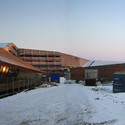
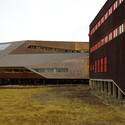
The project was commissioned through an invited competition. The new structure is an addition to an existing university and research building, which is extended to about 4 times its original size. The project also provides new facilities for the Svalbard Museum. The project is the very largest building in Longyearbyen and Spitzbergen.

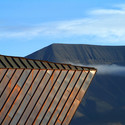
The insulated copper-clad skin is wrapped around the program demanded, creating an outer shell adjusted to the flows of wind and snow passing through the site. Climatic 3D simulations has been undertaken to assure that the accumulation of snow would not create undesired conditions in front of doors and windows. In the process, the skin has been flexible to adjustments, both geometrical changes answering to the climatic studies and alterations of program. The building is elevated on poles to prevent the melting of the permanent frost – the only thing fixating the construction. The main structure is in timber, to facilitate on-site adjustments and avoid cold bridges. The outer copper cladding retains its workability even at low temperatures, thereby extending the construction period further into the cold season.

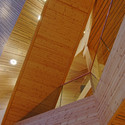
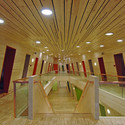
An important consideration has been to create vital public spaces and passages in the building, an “interior campus” area providing warm and lighted meeting places during the dark and cold winter. The pine-clad spaces have complex geometry relating to the outer skin of the building- the effectiveness of the circulation is maximized but at the same time it offers varied vistas and experiences. The technical infrastructure is hidden in the tilted walls of the interior. The use of color has been a necessity in a natural condition where colors are scarce.

snow study scheme 01

Both physical and virtual models have been important tools in the design process, while an accurate 1:50 construction model has facilitated work on site.

The Danish / Islandic artist Olafur Eliasson will provide an extensive glass installation on the main lobby window.

 

7 comments »

egyptian architect says:

awesome
i like it soooooooo

 
# November 20, 2008 at 13:43
Nya says:

I like this design!

 
# January 27, 2009 at 23:10
lubna says:

i like it so much even i think i will take my major in master with this science parks new and promising:)))

 
# March 28, 2009 at 02:34
Joshua says:

I think Norway is developing a monopoly on sweet work in wood.

 
# June 16, 2009 at 13:32
Doug says:

Beautifully conceived and executed. The interaction between the floor and the ceiling give one the impression of movement through the space without taking a a step. Brilliant.

 
# August 16, 2009 at 15:37
plots says:

This is really quite nice, the cladding material is great and the relationship to the landscape is evident without feeling forced or too literal a translation, also a lot of interesting spatial conditions coming about on the interior.

My only real contention is that while I love the wood on the interior for the stairs and the vertical surfaces I think it becomes visually overwhelming in combination with the floor and ceiling in some of the interior shots. In some places, where the line between horizontal and vertical orientation of surface is blurred, it works nicely but where the difference between surface orientation becomes more obvious I think a corresponding differentiation in materiality would have improved the quality of the space.

 
# October 30, 2009 at 13:32

Links to this article »

Leave a Reply »

Want to have your own avatar? Get yours at Gravatar.

Latest Comments »

sorry, i dont see any Taiwanese culture on this one.....[+]
it would be nice if there was some...[+]
damn idioms[+]
is interesting to u ke do not use much of their context it...[+]
without words a project with many flaws[+]
so bad design[+]
a nice intervention.. so clean![+]
Living in this nice place will keep people in shape!!![+]
sergio de oliveira on House in Foz / Sergio Koch:
….o racionalismo leva a conclusões muito rapidas...[+]
Projects NOT for consideration: ::...[+]
I like the work by TGH… well...[+]
wow, now that’s what i’m talking about.[+]

Browse by category »

Our partners »

Browse by date »

Friends »

Proudly hosted at »