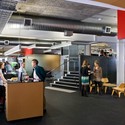
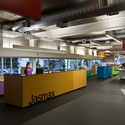
Jasmax Studio / Jasmax
Architects: Jasmax
Location: Auckland, New Zealand
Program: Jasmax Auckland Studio
Building Owner: KCL Property
Construction Year: 2008-2009
Project Area: 2400 m2
Photographs: Simon Devitt
INTRODUCTION
The decision to review the performance of their offices three years ago started the practice of Jasmax on an exciting journey… just as it had 10 years earlier with the move to Upper Queen Street.
The new studio location within the regenerating fringe of Auckland City, between Parnell and the City, was chosen in part for its proximity to public transport and a rejuvenating creative neighbourhood. However, equally important was the opportunity to be able to author a unique and identifiable architectural solution that reused a tired existing warehouse and adding a purpose designed extension. Providing the perfect business answer to the needs and values of this expanding practice.
The new building extension is conceived as a green hedge along the edge of Eglon Street linking the green embankments of Fraser Park with the Pohutukawa lined Parnell rise ridgeline. This vertical garden consists of a planter along the length of Eglon Street from which Three Kings vines rise through stainless steel tension stays to the front of the façade. The hedge provides visual amenity and relief within an intensified urban development and respects and moderates the privacy of the neighbouring residential apartments.
CLIENT BRIEF
The key objective was not to limit the project to simply the design of a new internal space but to explore how the project could positively influence the architectural fabric of Auckland’s urban environment. The briefs agenda included the responsibility of being a good neighbour, the opportunity to set an environmental benchmark and internally, the exploration of the relationship between the workplace and creative output, whilst reflecting the culture and values of New Zealand’s largest creative studio.
The creation of a tangible expression of Jasmax’s enhanced design methodology and increase the visibility of this within the practice and it’s multi-disciplinary expertise to clients and visitors was also a critical goal. The result is a highly energized internal environment which encourages free expression and portrays the mantra of the “organized chaos” of creative learning environments. Three offset levels of honest, open and creative space are highly interconnected by a narrow day lit, full height void which brings a dynamic heart to the studio and sits over the tight urban entry tunnel.
SPATIAL CONCEPT
The concept addressed the conflict between enhancing cross-team interaction over a large floor plate whilst defining individual team identities and retaining flexibility within the workspace.
The answer was to place defined objects within the space. This produced a series of isolated coloured “tool boxes” that contain the creative support tools of model making, printing and art supply, which assist the practices creative endeavours. Their placement separates and defines team spaces and celebrates the individual effort.
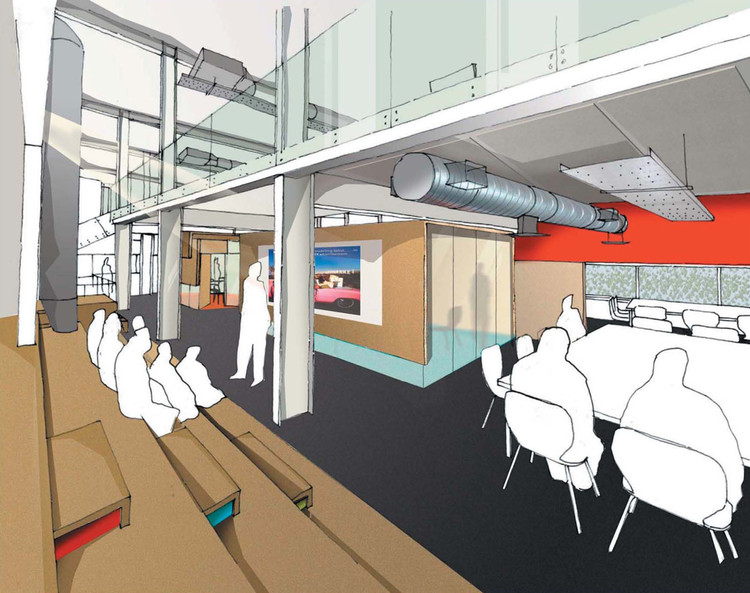
The spatial concept also recognises that the formality of business is evolving and that an essential ingredient is collaboration. This is reflected in the variety and number of meeting spaces that has been dramatically expanded to include a range of highly facilitated meeting rooms, named S, M, L and XL and a larger number of informal and less conventional meeting spaces. The ‘Sandpit’, the ‘Terraces’ mini theatre, the ‘Snug’ private space, the deliberately ambiguous ‘Open Meeting’ zone and at the social heart, the fully barista operated ‘Jx Café’. Throughout the studio the ‘hydrostations’ have been placed to encourage interaction and energise behaviour.
The need for great food and coffee to build strong social interaction, fuel the creative process and express the community culture of the practice was deliberately brought upfront to be highly visible. The reception and entry becoming a shared experience for visitors and staff alike.
The aesthetic was strongly aligned with the brand identity. Honest, unadorned and naturally expressed finishes invigorated by a spectrum of brand colours which characterize the individual “diversity” of Jasmax’s people, clients and solutions.
The desire for “organized chaos” has lead to all objects and elements (work stations and pods alike) being purposely misaligned. The scattered effect across the floor, giving permission to change and modify and yet all this is patterned to ensure that every work point is within a calculated short reach of support amenities.
SUSTAINABILITY
No project decision was made without the environmental sensitivities being considered and this has arguably produced a new environmental benchmark within the New Zealand market. Some of these measures include:
• An external ‘Green Wall’, rainwater irrigated and growing one of the world’s previously most endangered plant (Three Kings Vine – Tecomanthe Speciosa)
• A ventilated ‘twin skin façade’ to the west with sun sensor.
• VRF ventilation system with 100% fresh air capabilities , predicted COP rating 4 which equates to four units of heat for every unit of energy consumed.
• Daylight dimmable lighting within the studio using only 2 watts per meter combined with occupancy sensors to all ancillary spaces.
• Reduced water usage 6A WELS rated tapware, rainwater flushing toilets and 3 minute cycle dishwashing.
• Reduced applied finishes, paints and adhesives; new floor laying techniques without glue for the carpet, exposed concrete external walls and structure, raw finished ceiling panels.
• The use of materials with recyclable content; recycled car tyre rubber flooring, recycled backed carpet tiles, woodtex ceiling panels, cardboard core panels.
• Committed waste management with complete separation of landfill, recycling and organic waste for Jasmax’s worm farm!
- © Simon Devitt
- © Simon Devitt
- © Simon Devitt
- © Simon Devitt
- © Simon Devitt
- © Simon Devitt
- © Simon Devitt
- © Simon Devitt
- © Simon Devitt
- © Simon Devitt
- © Simon Devitt
- © Simon Devitt
- © Simon Devitt
- © Simon Devitt
- © Simon Devitt
- © Simon Devitt
- Cafe
- Entry
- Entry to void
- Mezzanine Studio
- Reception
- Studio
- Terraces
- Eglon Street Elevation
- Marston Street Elevation
- Fox Street Elevation


Jasmax Studio / Jasmax: © Simon Devitt Architects: Jasmax Location: Auckland, New Zealand Program: Jasmax Auckla.. http://bit.ly/WVGVL
Jasmax Studio / Jasmax: Location: Auckland, New Zealand. Program: Jasmax Auckland Studio … The decision to rev.. http://bit.ly/WVGVL
Jasmax Studio / Jasmax | ArchDaily http://bit.ly/igMze
RT @nicholaspatten This place looks cool: Jasmax Studio. http://bit.ly/oK4K9
Thanks to Jasmax for regularly hosting the Revit User Group Auckland meetings at this impressive venue!
i like those drawings with flat people :)
Go NZ Arch!!
what a great space.
thank you for doing a full story on this office!…
Lighting: Jasmax Studio / Jasmax | ArchDaily http://bit.ly/DYHul
I enjoy the building. “Street art”? not so much. Corporate graffiti?mehhhh
Drawings are unique and interesting. Well done!
It’s a bit of a bore, a copy of the latest trends in industrial architectural fashions without really adding anything new. It doesn’t deliver any inspiring innovation especially considering it’s an architects own office *yawn…*
I love the design,i have been to see it a month or so ago they have used a lot of sustainable options which is great. Thanks for writing a more detailed peice, there hard to find!
Is it possible to see floor plans?