
Serta International Center / Epstein | Metter Studio

Uploaded by — Filed under: Featured ,Institutional Architecture ,Offices ,Selected ,
 

serta03

Architect: Epstein | Metter Studio
Location: Hoffman Estates, Illinois, USA
Principal Designer: Andrew Metter, FAIA
Design Architect: Daesun Park, AIA|LEED AP
Interiors: Epstein Interiors
Landscape Architect: Jacobs/Ryan
Engineer: Epstein Engineering
General Contractor: G.A. Johnson
Constructed Area: 8,360 sqm
Project year: 2009
Photographs: Mark Ballogg

serta05a serta16 serta05b serta07a

Program

This project is a 90,000 s.f. Corporate Headquarters for Serta International Mattress Co. located in the Prairie Stone Development of Hoffman Estates, IL. The program includes 65,000 square feet of office, wholesale showroom, and presentation areas plus a 25,000 square foot research & development center. The selected site borders a protected wetlands area, resulting in all work spaces having sweeping views of the natural landscape.

floor plans

Solution

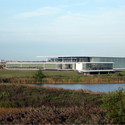
Serta’s priorities have resulted in a design which respects and promotes an employee’s right to work in an environment enriched by a connection to the natural world, through the extensive use of natural light, natural ventilation, outdoor work spaces and terraces. Serta has blazed a trail which redefines the nature of “work” for employees in the 21st century by commissioning a work of architecture which is not only functional, but also considers the mental and physical health of their workers as a main design priority. The building is located on a 20 acre parcel, situated on the edge of a natural wetlands system. Serta has developed the site to include natural prairie landscaping, overland drainage bioswales, previous paving, and other features which reinforce Serta’s deep commitment to preserving and protecting the site’s natural features. In fact, Serta chose to build less than 10% of the area allowed on the site and less then 50% of the required parking, in order to minimize the building’s impact on the surrounding landscape.

serta06

The architectural composition of the building has been developed to express the two main programmatic functions: Research & Development and office work space. Each of these functions is distinctly articulated in the building massing. Located at the heart of the building are the public spaces such as showrooms, lunch room, and training Auditorium.

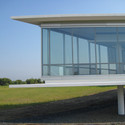
The building (700′ long x 67′ wide) has been designed to facilitate equal access to natural light, ventilation, and views of the wetlands for all employees. As a result, the building is expressed as a horizontal bar, generating a strong horizontal datum line.

To maintain this strong horizontal line, while accommodating excess program, finely detailed, projecting cantilevered bays have been developed which hover over the prairie landscape. The structural and architectural detailing has been designed to allow each bay to slide into the building, incorporating reveals between multiple wall layers, and sandwiched between the upper and lower concrete brows. This allows the program to grow organically, while reflecting the natural contours of the site.

serta18a

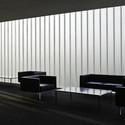
In addition, the floor plan has been designed to facilitate natural light penetration. The plan has been layered from a glass edged public circulation path on the east, defined by a translucent core zone, to an open office area on the west toward the wetlands. All private offices and conference rooms are clear or translucent glass to preserve the views, with a second level glass pavilion lunchroom, outdoor wood deck, and terrace with trellis.

Serta expressed an interest in creating a work of architecture which would exhibit their unique approach to their business and craft. Textiles, fabrics and textures are a critical and integral part of the “craft” aspect of the products Serta produces. Toward that end, the design takes advantage of the variations in the topography of the site, to weave together the building and landscape into a strong holistic composition. The design intent of the building is to float lightly on the landscape, reinforcing the notion of environmental sustainability and echoing the lines of the prairie landscape.

Through a collaborative client/architect design process, Serta has realized an appropriate expression for its corporate priorities, environmental responsibility, and employee enrichment.

[as_products]


Thumb up Thumb down 0

the section detail is just great.

 
# July 9, 2009 at 23:45
Thumb up Thumb down 0
richie says:

It’s getting in there, but the handrails, what happened with the handrails men….

 
# July 9, 2009 at 23:48
Thumb up Thumb down 0
MZ says:

Classical modernism at its best. Clean, transparent, floating, glänzend like a Mies pavilon. So many shades of white/grey, materials. It is really refreshing to see something so calm and natural in these days, when some just can´t get enough of form and color, with the result of buildings with very short optical-walue-half-time.
@tricky: I don´t know what is great about the section detail. That it is published, find it also great. Not so great is the obviously low standard the heat-isulation (e.g. floor), lack of thermal-bridge-breaking (at the cantilivering), but that is the responsibility of the technical regulations.

 
# July 10, 2009 at 03:43
Thumb up Thumb down 0
scud says:

Beautifully detailed, minimulation of light looks amazing in the photos. Very nice material palette!

Sweet project

 
# July 10, 2009 at 11:11
Thumb up Thumb down 0

The siting is spectacular, giving the impression of wilderness to what actually appears to be a medium density industrial area. The horizontal expression of the building is a perfect match to the place.

Most of the detailing is likewise superb and there is really nothing to complain about. I do find myself wishing that there was more consistency in the lighting approach to this building. I want to get very enthusiastic about the use of fluorescent lighting in some of the spaces. It would be great if that rigor were carried through to its logical conclusion and the cans and track lighting (illuminating a blank wall) could have been eliminated.

@Arch Daily – Thank you very much for improving the photograph navigation, this makes a big difference in the usability of the site.

Terry Glenn Phipps
http://web.me.com/tgphipps

 
# July 11, 2009 at 09:16

Leave a Reply »


Latest Comments »

why do you let this guy write here?. have anyone gone to his...[+]
I like it.[+]
except for the word “traditional” i do all of the other donts….writer is...[+]
“By focusing his lens on the lesser known cities,...[+]
I am proud of this project realized. Arief Budiman, whether you are an...[+]

Upcoming Architecture Events »

got events? invite us! click here

Architecture Books & Magazines »

Mark Magazine #33

Mark Magazine #33

We recently received the newest edition of Mark Magazine. Number 33 offers in depth looks of several  projects ArchDaily has previously featured such as: Sunset Chapel by BNKR Arquitectura, iGuzzini Illuminazione Spain Headquarters by MiAS Arquitectes, Villa Geldrop by Hofman Dujardin…


Reverse Effect: Renewing Chicago’s Waterways / Jeanne Gang

Reverse Effect: Renewing Chicago’s Waterways / Jeanne Gang

Our friends from Studio Gang Architects recently sent us their new book Reverse Effect. ”The culmination of a yearlong collaboration between Studio Gang Architects and the Natural Resources Defense Council (NRDC), Reverse Effect is dedicated to exploring the importance of


Architectural Lighting: Designing with Light and Space / Hervé Descottes with Cecilia E. Ramos

Architectural Lighting: Designing with Light and Space / Hervé Descottes with Cecilia E. Ramos

As part of Architecture Briefs series, produced by The Foundations of Architecture, this short book on lighting gives a very good introduction into architectural lighting. The authors start by explaining the six visual principles of light; illuminance, luminance,…


Our partners »

AD on iPad via Pulse

Browse by date »

Browse by category »

Friends »