Taiwan Center for Disease Control Complex / Studio Shift

By — Filed under: Architecture News ,Healthcare Architecture , ,
 

Studio Shift received an honorable mention for their design of the Taiwan Center for Disease Control.  The complex, which fuses public landscape with scientific research, is poised to be one of Taiwan’s most important scientific centers.  ”The complex will set a new standard in laboratory and research facilities design, paralleling the work that will inevitably take place behind its walls,” stated the architects.

More images, diagrams and information about the break.

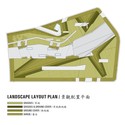
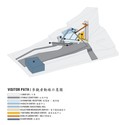
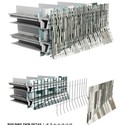
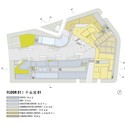
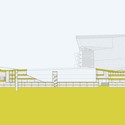
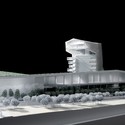
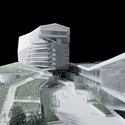
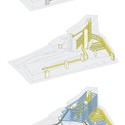
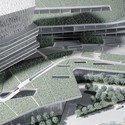
The placement of the CDC marks a symbolic gateway into the Hsinchu Biomedical Science Park.  The architecture literally extends toward the public, welcoming all with its two central arms.  A pedestrian path runs throughout the grounds of the complex, encircling the tower and providing views of both the inner workings of the CDC and the natural landscape.  The users are constantly connected with both structure and landscape as they utilize the public areas and the interior of the building.

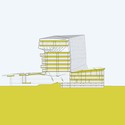
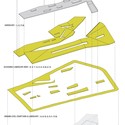
As the building emerges from the ground, its landscaped roof rises with it.  This creates a large, flexible area accessible by a recreational path that connects to the grounds below.   Vast areas of open space, both on the plaza level and on the landscape roof, allow the footprint of the building to add nearly as much green space as it occupies.

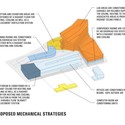
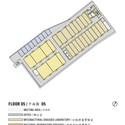
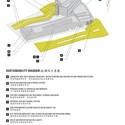
While the landscape successful cooperates with the community, the structure creates a highly efficient organization and security system for the researchers. The majority of the labs are stacked within the tower to utilize a central circulation spine dedicated for service and waste removal. The separation of this space from the pedestrian path ensures that users never have to cross paths with waste, dangerous chemicals or fumes.

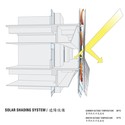
The new CDC design offers a holistic approach of operational efficiency and conservation of resources.  All major building systems conserve natural resources and minimize any potential negative impacts on the environment.  In addition to solar power collection, solar shading devices, and geothermal technology, access to natural light within all functions will enhance the psychological well being of workers, improving their productivity and the overall sustainability of the CDC.

By not imposing on the site, but rather aiming to seek harmonious relationship,  the CDC engages with the public realm while still providing efficient means for furthering science.  ”…The architecture of the Taiwan Centers for Disease Control must embody the same fervor and determination found in its researchers’ quest for scientific progress. It must also promote connectivity and cohesion within the scientific community at large while opening its arms to the public which it serves,” the architects exclaimed.

was recently featured on our site for their project the Miyi Tower.

All images courtesy of Studio Shift.

Credits

Design Architect:  Studio Shift – Los Angeles www.studioshift.com

Studio Shift Principals:  Mario Cipresso and Chris Warren (Chris recently formed a new design studio in Los Angeles, WORD – Warren Office of Research and Design – www.WarrenOffice.com )
Project Assistants Stage 2:  Ryan Ramirez, Irina Krusteva, Marisol Mejia

Project Assistants Stage 1:  Carolyn Ng, Kelly Wong, Andrew Kim, Chris Hyun, Hana Ogita

Local Architect:  HOY – Taipei www.hoy.com.tw

Principal:  Chao-Shin Hsueh

Project Team:  Anchi Liang, Yuh-Mei Chen, Chi-Wen Lee, Tzu-Ai Hsaio, Yi-Hsing Hsu, Zih-Sin Yang, Ying-Chun Chi, Chang-Chiang Chen, Shih-Hei Chen, Yu-Ying Lin, Shui-Shan Kao, Xu-Cheng Jin

Mechanical Engineer:  IBE (Ideas for the Built Environment) Los Angeles

Structural Engineer:  Thornton Tomasetti Los Angeles

Laboratory Design:  RFD (Research Facilities Design) San Diego

Landscape Architect:  SWA Group Los Angeles

Renderings:  Lifang China

Model:  Hwa Yu Artistic Design Ltd. Taipei

Photography:  Jeffrey Cheng Taipei


Thumb up Thumb down 0
viniruski says:

ugly formalism.

 
# June 16, 2009 at 20:31
Thumb up Thumb down 0
m48 says:

hi!!, anyone knows with what software can i do illustrations like
this? not the render ones, the other, the pretties illustrations,like infografies, jeje tks

 
# June 16, 2009 at 20:59
Thumb up Thumb down 0
db says:

illustrator, maybe some autocad to do the isometric view, then everything else illustrator

 
# June 16, 2009 at 21:45
Thumb up Thumb down 0
Dan Al says:

Damn, it’s way to complicated.

Viniruski, I am with you.
It looks like a really bad Disease CENTER!

 
# June 16, 2009 at 22:01
Thumb up Thumb down 0
Drub says:

Complicated? But it’s so simple…

 
# June 16, 2009 at 22:10
Thumb up Thumb down 0
otis says:

i think it’s beautiful. love the use of green roofs and the emphasis on pedestrian walkways. the main big building maybe a little alien but might be more effective in real lighting conditions.

 
# June 16, 2009 at 22:33
Thumb up Thumb down 0
Abe Froman says:

Morphosis backwash.

 
# June 17, 2009 at 00:56
Thumb up Thumb down 0
JL says:

DB wrote…”illustrator, maybe some autocad to do the isometric view, then everything else illustrator” DB is a moron to not understand the amount of effort to put together this presentation. Great job Studio SHIFT. Very inspiring.

 
# June 17, 2009 at 03:10
Thumb up Thumb down 0
Temple says:

another clone

 
# June 17, 2009 at 06:36
Thumb up Thumb down 0
Junot says:

Disease Control Complex?
How are they suppose to control the diseases when the building itself got contaminated?

 
# June 17, 2009 at 07:14
Thumb up Thumb down 0
Duncan says:

For the illustration, I guess my way of doing is sort of retarded but anyways… If, I have the model as solid on AutoCAD, I use the “solprof” command to obtain the profile lines on 2D plane. Then take an EPS plot of it and the rest is Photoshop…

 
# June 17, 2009 at 09:45
Thumb up Thumb down 0
Shawn Chong says:

Uhh… an inanimate object such as a building cannot be contaminated with disease.

It looks marvelous and it will be even more so once it’s completed!

Maybe you guys think it looks too complicated because the renderings company tried to give us pictures of the building at sunset or something.

 
# June 17, 2009 at 10:41
Thumb up Thumb down 0
Leo says:

conusing…unecessary…expensive…awesome…

 
# June 17, 2009 at 11:37
Thumb up Thumb down 0
lafricans says:

Sans faire de commentaires sur le projet, je dirais juste en reponse quand aux questions sur les illustrations: elle sont faites à coup sur avec Sketchup + Adobe (photoshop ou illustrator). Sketchup est un programme 3D gratuit (version pro obligatoire pour tout ce qui est export/import 3DS..) à télécharger ici : http://sketchup.google.com/download/
Terriblement efficace pour les rendus dans ce style…

 
# June 17, 2009 at 11:51
Thumb up Thumb down 0
db says:

ok jl, iluminate us with your knowledge, how did they do it?
maybe you were an intern there and did not like my comment

 
# June 17, 2009 at 13:44
Thumb up Thumb down 0
db says:

and actually, its autocad with photoshop coloring
peace

 
# June 17, 2009 at 13:46
Thumb up Thumb down 0
Tarek sakkal says:

ok

 
# June 17, 2009 at 17:28
Thumb up Thumb down 0
Lana says:

I like the green roof tops and walkways, but i cannot understand the large building… its elements are too many, it seems a bit wierd..

 
# June 18, 2009 at 02:28
Thumb up Thumb down 0
Rolia says:

hi!
does anybody know what kind of software they might used?
i’m just guessing is 3D max + Vray. what kind of light might be there : direct light or vray sun, probably also phisical camera…
give me some tips.
Thanks !

 
# June 18, 2009 at 06:05
Thumb up Thumb down 0
Quan says:

Hey, I have an idea how they made diagram : All could be done with 3dS + Vray. There is a function called Render Elements. Use it to render some flatten perpectives then you can fill anycolor you want with photoshop

 
# June 18, 2009 at 07:54
Thumb up Thumb down 0
samuel says:

For the outlined axonometrics you can use 3ds max + mental ray (outlines: enable “contour” in the render dialog and in “mental ray connection” of each material).

In the Free software side you can use blender + pantograph to get some nice “flattened 3d” vector rendering. If pantograph is too hard ton instal for you, then use toon shaders of the internal render (it rocks!).

 
# June 18, 2009 at 11:32
Thumb up Thumb down 0
roger says:

credit when its due.. this is a good looking building.. i dont agree that’s its unnecessarily complicated.. good job..

 
# June 18, 2009 at 11:54
Thumb up Thumb down 0
jearded says:

i love these kind of renderings. how to they do it? outsource?
 
# June 18, 2009 at 12:21
Thumb up Thumb down 0
chi says:

Duncan wrote… “If, I have the model as solid on AutoCAD, I use the “solprof” command to obtain the profile lines on 2D plane. Then take an EPS plot of it and the rest is Photoshop”

Duncan: Adobe Illustrator is great for these graphic illustrations because it produces crisp vector lines and shapes. Illustrator is vector-based, with the flexibility to scale and rescale illustrations to any desired size, as in one for screen resolution to share online and one for print resolution for 2′x4′ presentation boards. And if the illustrations are a real success and your boss wants to make them into wall murals, you won’t be screwed.

Whereas with Photoshop, which is bitmap based, the size is confined to the initial print resolution that is set – it’s challenging to go to a larger size without compromising image quality. Also, you can directly open a DWG inside of Illustrator, skipping the need to plot or make 2d profiles.

 
# June 18, 2009 at 13:10
Thumb up Thumb down 0
A. A. says:

Thom Mayne should not be allowed to spread his seed.

 
# June 18, 2009 at 14:47
Thumb up Thumb down 0
HppyRobot says:

Mish-mash of formal moves…

SWA did a good job landscape design… ))

 
# June 19, 2009 at 09:00
Thumb up Thumb down 0
HppyRobot says:

missed an “on”. Sorry )

 
# June 19, 2009 at 09:08
Thumb up Thumb down 0
Rolia says:

hi
its me again. somebody maybe have an idea about vray and 3dmax? my quiestion is about those photorealistic renders… lightning basiclly and camera.
please :)
thanks a lot

 
# June 19, 2009 at 09:55
Thumb up Thumb down 0
Quan says:

Rolia, imo it’s not up to renderer. The artist must be a master of compositing.

 
# June 20, 2009 at 02:33
Thumb up Thumb down 0
x says:

real, finished and in use buildings are beter than images and words

 
# June 20, 2009 at 15:26
Thumb up Thumb down 0
student says:

Mario is my professor at my university
The diagrams are renderings from rhino with an edge texture applied to them
He then exports these renderings into illustrator for the finishing touches.

 
# October 6, 2010 at 01:37
Thumb up Thumb down 0

Hello my friend! I want to say that this article is awesome, great written and include almost all important infos. I would like to look extra posts like this .

 
# November 11, 2011 at 12:37
Thumb up Thumb down 0

10:56 PM Jun 16th

#architecture Taiwan Center for Disease Control Complex / Studio Shift:
Studio Shift received an h.. http://bit.ly/OgxPD

Thumb up Thumb down 0

11:14 PM Jun 16th

Reading: "Taiwan Center for Disease Control Complex / Studio Shift | ArchDaily" (http://twitthis.com/79p2yg)

Thumb up Thumb down 0

11:49 PM Jun 16th

entry for Taiwanese CDC complex – http://bit.ly/ZaCsM
#fb

Thumb up Thumb down 0

1:15 AM Jun 17th

Taiwan Center for Disease Control Complex / Studio Shift | ArchDaily: The complex, which fuses public landscape .. http://bit.ly/137PrH

Thumb up Thumb down 0

1:46 AM Jun 17th

attól még hogy publikálják, lehet egy épület szörnyű ronda is – Taiwan Center http://bit.ly/1qEi3

Thumb up Thumb down 0

5:50 AM Jun 17th

Taiwan Center for Disease Control Complex / Studio Shift | ArchDaily http://bit.ly/6QpIx

Thumb up Thumb down 0

9:25 AM Jun 17th

Pretty nice… for a Hospital. http://bit.ly/rzubR

Thumb up Thumb down 0

3:06 PM Feb 12th

Thumb up Thumb down 0

6:08 PM Oct 6th

Taiwan Center for Disease Control Complex / Studio Shift | ArchDaily http://t.co/i9vLcFJ via @archdaily

Thumb up Thumb down 0

3:31 PM Oct 4th

http://t.co/jyy7Qfrl para @mia2791

Leave a Reply »


Latest Comments »

This reads like a practice note from the Institute.[+]
We’re a group of volunteers...[+]
Hi Bistra, Thanks for the generous feed back. It was a great home to be...[+]
Ideologically reminiscent of Le Corbusier’s Ronchamp[+]
Elliot, Yes, it only includes the works by firms who have shared...[+]

Upcoming Architecture Events »

got events? invite us! click here

Architecture Books & Magazines »

The Architecture of Croce, Aflalo and Gasperini / Aflalo and Gasperini Architects

The Architecture of Croce, Aflalo and Gasperini / Aflalo and Gasperini Architects

Aflalo & Gasperini Arquitetos recently shared with us the book they are launching titled, “The Architecture of Croce, Aflalo and Gasperini.” The book details the 50 years history of one of the most important architecture office in Brazil. The…


Caramel: Forget Architecture / Caramel Architekten

Caramel: Forget Architecture / Caramel Architekten

We recently received a book from Caramel Architekten. We previously featured four of their projects if you would like a taste of their work (click here). The book is presented in both German and English and offers a wonderful insight…


KieranTimberlake: Inquiry

KieranTimberlake: Inquiry

We recently received KieranTimberlake’s newest book, Inquiry. Instead of listing one project after the next, as in most monographs, this book is organized around ten gerunds: bending, coupling, filtering, inserting, offsetting, outlining, overlapping, puncturing, reflecting, and tuning. This is…


Our partners »

AD on iPad via Pulse

Browse by date »

Browse by category »

Friends »