
The Los Angeles based team of Studio SHIFT and SWA Group has been selected to create a master plan for the Sichuan Province, a developing area in China. The plan consists of SHIFT’s Miyi Tower that aims to promote the region’s heritage, and SWA Group’s design for a sustainable promenade.
Further project description and more images after the break.
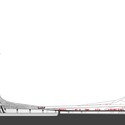
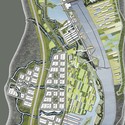
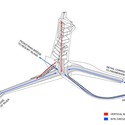
The Miyi Tower sits at the edge of the Anning River. The spot marks the transition between the newly developed areas in the North with the agricultural districts of the South. A one kilometer long promenade connects the cultural hub devoted to regional arts on one end with the Miyi Tower at the other. Along the promenade, SWA Group created an abundance of public spaces that feature photovoltaic fields and wind turbines. The promenade disperses into rising paths that converge to form a bridge over the river, affording views of reclaimed wetlands.
The Miyi Tower, designed as an educational building for residents and tourists, is meant to act as a major landmark. The temperate climate of the region allows the tower’s programmatic elements to be interspersed between enclosed and open spaces. Double height enclosed spaces, such as an auditorium, exhibition space and restaurants, alternate with open spaces, such as gardens, an observation deck, and event areas, around the vertical core of the tower. A porous, yet continuous skin, gives the various programs their unified form. The skin is designed as a patterning of objects that are mounted to a light frame, rather than a series of perforations. This enables the appropriate panels on the skin to be lined with photovoltaic cells.
The energy producing tower, along with the ecological features of the promenade, will allow Miyi County to become the region’s leader in sustainability.
Architect: Studio SHIFT
Principals: Mario Cipresso and Chris Warren (Chris has recently started his own design company, WORD – Warren Office for Research and Design – www.warrenoffice.com)
Project Assistants: Chris Hyun and Andrew Kim
Landscape Architect: SWA Group Los Angeles
Managing Principal: Gerdo Aquino
Patrick Curran and Alex Robinson
Chris Warren and Mario Cipresso formed Studio SHIFT after long tenures with Morphosis in order to further explore methodologies in various design fields including architecture and urban planning. Both currently teach architecture studios at the University of Southern California. Mario is also the founder of the competitions website Death By Architecture. http://www.deathbyarchitecture.com/
Completion: Expected early 2013








I don’t get it anymore.
when i see this kind of architecture i remember that video on youtube with peter eisenman as a critic of a graduate thesis.. he asks something like “if I put a monkey in front of the typewriter, are we going to have literature?”.. just because everybody knows how to model exquisite facades, it doesn’t mean it is architecture, and that we should go on with it… let’s focus on architecture and not on excuses anymore
This is beyond dystopic; it’s the remains of a corporate headquarters on a dead planet, draped now in dusty cobwebs.
Do not be so serious about yourself, thiago… You think you know what the real architecture is? You think it’s some kind of poetry or music? Is it a space? Is it a city? You think it’s not an object, it’s not a facade, it’s not an urban development plan and it’s not a design project? What is it then, a song? A bird flying high in the sky? And do not paste eisenman, tell me how do YOU understand the real architecture? You can name everything in this reality as an excuse even human race itself. I hear you saying that this building doesn’t have soul, I hear you saying all kinds of stuff, but these words doesnt mean nothing at all. Be wise, do not mess with reality in terms of mindless utopia that eisenman presents. Don’t hide yourself under someone’s words…Art…?
tort, dont hide yourself under waffle
tort… i think really the opposite.. architecture must have its “art” factor, but in reality it must be a technical thing, something that solve problems… but what I see when I look at these new “facades” made by computer is that is really easy to make any ‘beautiful’ drawing and find an excuse to explain it, like “The energy producing tower, along with the ecological features of the promenade, will allow Miyi County to become the region’s leader in sustainability.”
this building is not sustainable. the facade is a mere vague representation of the heritage, and so on, but the architects keep saying that….
I’m not against this building in particular, but in the act of using this ‘technology’ to explain things without a critical though… just look at AD archives, a lot of “concept facade” buildings are here, but what they represent?
and i quoted mr eisenman with this well know phrase, but I can quote the simpsons for saying exactly the same with the monkeys that write the krusty’s show, if you ever watched that…
Spider cibernetic project. Cool and new design. Inside the city i can image the visual impact.
Brazilian Architect
Well, I don’t know how through visualisations it would be possible to represent pure mathematics. And if we’re judging architecture as art I see visualisations handy enough to represent it. In my oppinion there’s not enough space in 5 min article to give all the answers about what problems did this building solved and how efficient it is. It’s an abstract form of what have been done. Engineers have calculated the energy efficiency, urban developers saw what effects would emerge to the surroundings… Sure, if we would see the calculations we could say what’s inside the facades, but as we’re proud of being artists we lack this ability to understand mathematics. My point is – let’s judge facades if there’s nothing else given…
By the way… As I look to the Master plan I see interesting spaces in headquarters of this territory. Water is being used very efficiently, main roads are isolated by trees, individual traffic is organised well and public pathways doesn’t cross main traffic arteries. There’s a lot of green public spaces by the river. I could even see the yacht club. All public interests are concentrated in beautiful nature (Miyi building also) to be part of society, not part of individuals. Living quarters has it’s hearts with some green commercial spaces. It’s our foult if we are lasy enough to see just visualisations.
I don’t see any connection of this building with Chinese heritage. Anybody? I’d guess that Studio SHIFT and SWA Group did some research to support such the claim… why it is not included in the project description? At least a summary would be helpful. As for this form being art… well everything can be art… a pile of old stinky shoes too… it’s just a question of who do you address your piece of art to… I wonder if this would be proposed to a, say, City of LA?
В А Л А С Я Ч К А ! ! !
well,in an earthquake aera……
personally… i dislike what i see here
concerning to heritage, even though i’m not at all an expert in chinese history, i live in shanghai since more than year and a half, and this project, or what i can see of it, doesn’t recall any blink of chinese culture at all
my comment is quite straight since the beginning. like/dislike is an old topyc in arts. as i see it, this problem, in architecture at least, has a way to be treated, this is, aesthetics derive from ethics, and it’s when a design, a shape, shows in its configuration a whole logic which lies behind, it’s then when i personally (at least i’d like to do it that way) when i presonally find it “good looking”, “beautiful” or “nice”, call it as you want.
besides, for sure, there are parameters in aesthetics, which don’t always get linked to this, which work separately, which come from reasons which we don’t control much, from personal inclinations. you might like this or that color, you might like this or that shape, you feel a light inclination to a certain composition… but, at the end, if a design is coherent, it gets your attention, and makes sense, and gives beauty
personally, i don’t find anything very interesting in this case, just a fancy looking rendering work
Weak equation with no sum. If you’re going to build four bridges of circulation that meet in the middle of a river, the expectations are that something will happen at this meeting place. it looks like people will just make their way up to the top of the tower and jump off?
Interesting form though. Just needs more architectural development. Try thinking like a monkey working in Eisenmann’s office. EE ee ah ah [scratch armpit].
Interesting discussion on the fundamentals of architecture: program, forma, material, use, artsmanship… None of these fundamentals are easy to read in a design like this. And, with the risk of being called “traditionalist”, i strongly belief that projects with a kind of design-language of “freeformbulpyness-and-no-worries” will be out of order sooner than we think. Sure, China and the new-world awaits… but what about the simplicity of a good “house”. A house, office or even church (program) is more than a shell, and needs the word ‘dwelling’ to complete it. That’s right, dwelling as fullfillment of architecture. Read Heidegger people, and projects like this are nothing more than a joke.
My goodness, think of the person making the drawings for this building; poor fellow-wannabe-architect trying to conceive the technical specifications; poor architecture, it made itself a joker.
мне нравится….
Я не говорю что мне не нравится В А Л А С Я Ч К А это первое что приходит на ум кода вижу этот объект…класная валасячка карочеее…
ok
these russians are pretty amusing
hi guys!
why is this facade considered fancy? it’s only angled differently than most – different than what most are used to. It probably relates to the sun more efficiently this way, but in the end, it seems just as arbitrary as a rectilinear facade. What is it about angles that disgust traditionalists so much? It does feel less rigid, more exciting, of the times.