Outpost / OSKA Architects

Uploaded by — Filed under: Houses ,Selected , , , ,
 

Architects: Olson Sundberg Kundig Allen Architects
Location: Central Idaho,
Principal in Charge: Tom Kundig
Year: 2007
Photographs: Tim Bies/Olson Sundberg Kundig Allen Architects

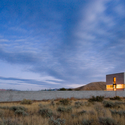
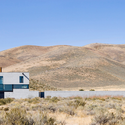
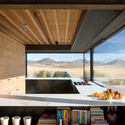
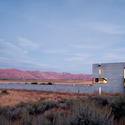
Set in the remote and harsh high desert landscape of Idaho, Outpost is a residence and studio/workshop for making and displaying art. An important aspect of the complex is the protected “paradise garden,” which is separated from the wild landscape by thick concrete walls. The materials used in the structure, including concrete block, car-decking, and plywood, require little or no maintenance, and are capable of withstanding the extreme weather that characterize the desert’s four seasons.


Thumb up Thumb down 0
jubair Sideeque says:

Nice and Neat.
I don’t think the fascination in viewing desert will last for a life time. And i think this is not a responsive way climatologically to the site.

 
# June 8, 2009 at 23:10
Thumb up Thumb down 0
idot says:

How
?

 
# June 9, 2009 at 00:04
Thumb up Thumb down 0
AMR says:

Perhaps someone with intimate knowledge of US building codes could tell me why there are fire sprinklers in a single residential house?

I do like it, there is a certain honesty about it. I don’t I would ever tire of that view……the colours would change by the hour

 
# June 9, 2009 at 03:35
Thumb up Thumb down 0
guy says:

Nice and neat – i agree.

I think it has a very appropriate balance of ‘raw’ materials and comfort.
But how did they ever get permission to build in such a beautiful landscape, thats the real achievement, assuming you like the building.

 
# June 9, 2009 at 04:38
Thumb up Thumb down 0
Terry Glenn Phipps says:

A while ago this project was featured in the New York Times and I downloaded and studied the photographs then. Somes spaces are omitted from these images that were included in the Times, and that is a pity. It is absolutely worth seeing the ground floor spaces, close up images of the exterior, and most importantly the walled garden.

I consider this a seminal work of American architecture. The concept of self-contained living on the plains is not new (think Conestoga) . However, this very American idea is here retooled using means that are appropriately simple, elegant, and complete.

The program is a live and work space for a fine artist. Everything necessary is at hand eliminating the need to focus on anything else but making art without being trapped in a studio all day and night.

Ted Kundig must have really worked through process with his client. It is so easy to imagine how a day unfolds here, broken up between sleeping, working, eating, and respite. Spaces are solitary and contemplative where they need to be, most notably in the Arab or Paradise Garden and studio, and then opening up to these unbelievable and inspirational views in the great public room.

It is fascinating his how OSKA have connected the self-contained covered wagon idea (I did not say self sufficient) to the modernist dream of “a machine for living in the garden”. This interpretation takes the idea of living in such a machine out of the abstract and puts it very squarely in terms of process. Everything here is process; how does the day unfold and how does each element contribute to the output of this -factory-.

Recently I downloaded Vincent Scully’s lecture on Philip Johnson from Yale University on iTunes U. (If you haven’t heard these lectures they are a free and an unprecedented opportunity to enjoy an experience that would otherwise be closed to most of us. You need an iPod but that costs rather less than an education at Yale.)

There is an interesting comparison to be drawn between Johnson’s glass house and this house. The reason I have referred to -living- in the abstract is that Johnson’s masterpiece is all about solitude and the contemplation of art. Not much else could really happen there. This is living a life of letters, very much the essence of the 19th century man in 20th century trappings.

Kundig has brilliantly taken many of the same ideas and fused them both to the past and present. The perimeter of the public garden is defined by the walls of the valley. Here the glass house sits raised atop another structure that just happens to be the family store. The studios have their own logic and rhythm that is connected to contemplation and working. Johnson’s guest house, the most likely place to really sleep well in New Canaan, is here moved topside and transformed into private quarters for the owner.

Unfortunately these photographs do not do justice to the feature that gives this project its real shine. The main structure viewed directly is a perfect cube, a geometric solid from which the fenestration has been very precisely incised. From the side it is a perfect rectangle. Disciples of the Golden Section will find this program relentlessly perfect in its pursuit of proportion.

Proportion and appropriateness seem to have been the twin engines of making this building. There is absolutely no ostentation or artifice in this construction. The materials are simple and honest while being used with great bravado and force. Indeed those are the values that give this structure its strong sense of place.

Terry Glenn Phipps

 
# June 9, 2009 at 06:21
Thumb up Thumb down 0
Cameron says:

I was about to communicate my own observations of this project until I read Terry Glenn Phipps’s views/critique above. As always his comments are particularly discerning and a pleasure to acknowledge.

 
# June 9, 2009 at 06:50
Thumb up Thumb down 0
salpickering says:

The building sits as one with the surroundings. I would have liked to have seen more photographs from different perspectives. I have no more to say, as Terry Glenn Phipps’s fine words have done a wonderful summary in every way.
salpickering

 
# June 9, 2009 at 07:07
Thumb up Thumb down 0
julio ramirez bruna says:

if you have this sort of site, the least you can do is to dedicate the building to the surroundings, and the inhabitation that is going to happen with it, the thickness of the glass or the wall can be definetely adjusted to mantain the heat inside the building.
I found it so simple. Beautiful insides or outsides, these architects make outsides, not insides, AWESOME PROJECT.
Any glass box cannot be compared to Johnson, or Mies , to be more accurate… but everything is different, not the 40′s not german , is just a dinner table in the dessert.
A sensitives answer to the brief, without the obvious architectural concepts or redundant speeches.

 
# June 9, 2009 at 09:01
Thumb up Thumb down 0
Fino says:

Wonderful. Just….wonderful and beautifully crafted.

that is all.

 
# June 9, 2009 at 09:37
Thumb up Thumb down 0
Gon says:

Incredible views from the inside! :O

 
# June 9, 2009 at 11:07
Thumb up Thumb down 0
angel says:

EXCELENT PROJECT!! AN PERFECT GAME MATCH OF MATERIALS…
REAL ARCHITECTURE

 
# June 9, 2009 at 12:06
Thumb up Thumb down 0
yuur says:

muy noble el espacio interior, no dialoga nada con el contexto mas si algo con la tectura del material,trata de estar ahi como una nueva referencia para un nuevo contexto del las proximas edificaciones.
muy personal si me gusta.

 
# June 10, 2009 at 12:29
Thumb up Thumb down 0
harry says:

This a really marvelous design,this is a house everbody want’s to live in.

 
# June 28, 2009 at 14:45
Thumb up Thumb down 0
J Bryar says:

Sorry but I hate it.

Aboriginal architecture in this part of the country gets what this house lacks, which is an appreciation of the reality of desert life.

The first requirement is the management of ambient light, which is INTENSE in the desert. This house would heat up like an easy bake oven in the summer. It is not enough to block direct sunlight, but in this environment reflected light would be sufficient to turn up the roasting oven in that top floor. Simply brutal.

Furthermore, one needs to deal with the wind in the high desert, particularly in the winter. The top floor will get hammered both by the direct wind coming in unimpeded at that level plus whatever is deflected by the lower wall.

This is another case of dramatic design at the expense of functionality.

 
# September 1, 2009 at 19:54
Thumb up Thumb down 0
mike says:

in about 5 years time people will start to realise how good this house is, the materials, relationship to context, scale, detailing, it’s very very good….

 
# July 27, 2010 at 01:51
Thumb up Thumb down 0

8:01 PM Oct 15th

Outpost / OSKA Architects | ArchDaily http://t.co/RUH26pK via @archdaily

Thumb up Thumb down 0

1:59 PM Nov 30th

Outpost / OSKA Architects | ArchDaily http://t.co/qQ85mKT via @archdaily

Thumb up Thumb down 0

5:29 PM Jan 21st

@idbernstein this is idaho. http://bit.ly/hcnIYr

Leave a Reply »


Latest Comments »

The interesting thing about the interior is the way the...[+]
Julius Jääskeläinen on Raakspoort Haarlem / BOLLES+WILSON
Sensitivity to context and human scale is so boring, but then again...[+]
looks like a waterproofing nightmare[+]
This is a Combat Arms Working Free VIP Hack as of February 2012. Has aimbot, godmode, rank hack, character hack, and much more! on Ferrous House / Johnsen Schmaling Architects
...[+]
As a student of Tom Fisher,...[+]

Upcoming Architecture Events »

got events? invite us! click here

Architecture Books & Magazines »

Thermally Active Surfaces in Architecture / Kiel Moe

Thermally Active Surfaces in Architecture / Kiel Moe

Departing from the simple question Why do we heat and cool buildings with air?, this book focuses on the technique of thermally active surfaces. This technique uses water in building surfaces to heat and cool bodies – a method


This is Hybrid / a+t research group

This is Hybrid / a+t research group

Following years of research, a+t publishers presents the first theoretical-practical book on hybrid buildings. Taking its inspiration from the four issues of a+t magazine’s Hybrid series, the book takes a look at the theories and projects which have had…


Review: De Stoel van Rietveld: Rietveld’s Chair, book + film by Marijke Kuper & Lex Reitsma

© Jules Gianakos

“It is hard to tell what the value of something eventually will be”
– Gerrit Rietveld, 1937.
This new insight into a classic illustrates Gerrit Rietveld’s transition from humble cabinet maker’s son to Architect and leading designer in the De…


Our partners »

AD on iPad via Pulse

Browse by date »

Browse by category »

Friends »