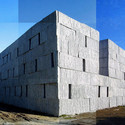
Text description provided by the architects. The project of the Musical Studies Center in Santiago de Compostela is located in the Vista Alegre plot of land, one of the most relevant green areas in the surroundings of the old quarter of Santiago. Described as a university park, the Vista Alegre plot of land hosts a group of buildings link to activities related to academic and research practices. Here it's possible to find the House of Europe, the Advanced Studies Center, the IDEGA (a university research center) and the Center for Musical Studies, dedicated to postgraduate studies for musical improvement, intended for the training of the Galician Orchestra musicians.

The proposal has its origins in a competition asking for the insertion of a pavilion which program demanded the development of classrooms for the education of music, with defined volumetry, highness, occupation and materials, in a non-symmetric exercise, as it is set against the pavilion built by Portela, made of the same materials and similar dimensions.

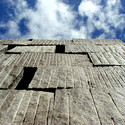
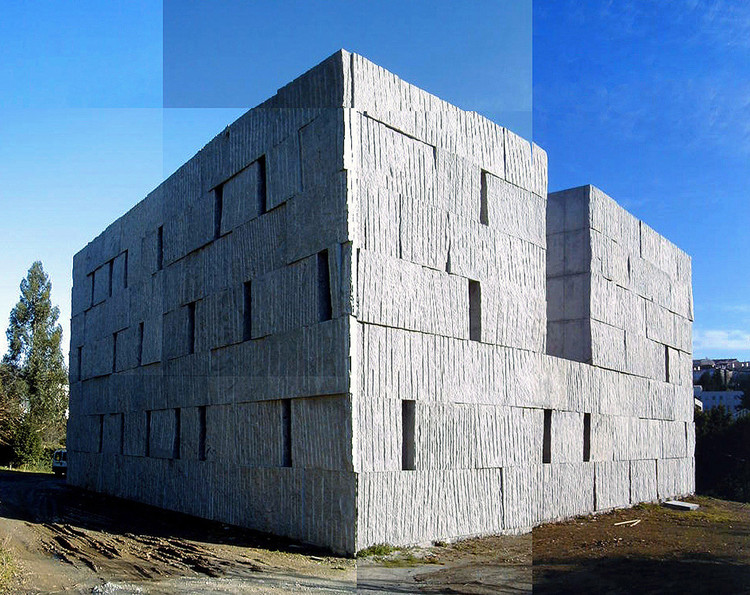
The perception of the building at different scales defines levels of comprehension. From the distance, the building lets itself fall on the land. It sticks, without any continuity, to a carpet of green grass that makes up the surface of the plot of land, cutting out its silhouette in the space of the garden in a strong definitive way, like a rock with cubic will. If we look from a middle distance point, we gaze the border, the limit that before shaped an almost perfect form, leads to the lack of definition; the trace of a broken line appears, distorting edges, and a superficial vibration of light, material and shadow fixed to a rhythm of seven parts. We move closer and the shape is broken; the pieces jump, expressing its abrasive materiality and defining holes which provide the constructive scales of the building, incisions of light that tear the facade that saw from the distance transform the hole into a shadow which talks about subtraction of mass by light in a vertical element, while the two big perforations are a direct result of the big interior volume.
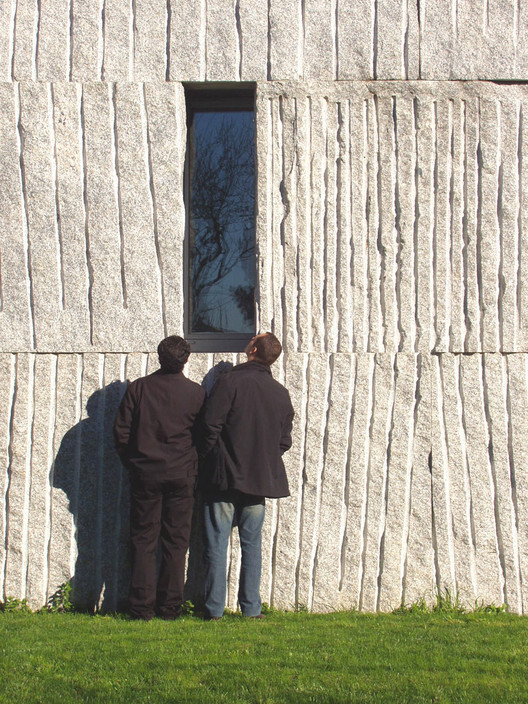
The masonry granite work of the façade it's made of stones opened "on the contrary side", searching for the spontaneous natural surface of "stereomity" which allows the granite to be ripped more easy. It's a constructive system that uses techniques of drill to break the piece of stone, using as well the border sides, but in the context of a reconsideration labor of the constructive process of opening and cut off the stone. There's a search of the constructive expression of the stone, as we've learn from the history, going back to Egypt and Rome.

From the functional point of view, the acoustic requirements of the different rooms where determinant on the design. This is the reason why the spaces which require bigger acoustic needs, are linked to a big buried concrete basement, which conforms the settling of the building, the accesses and regulates the slopes of the topography. These are the bigger classrooms (auditorium, electro acoustic, percussion rooms...), capable of hosting a large number of students and eventual audience.

The upper floors are ordered "by wheels" walkable by the inner ring and which size and public character decreases the higher they get. The upper floor is dedicated to study rooms and teachers' offices.

The expression of the project comes from the contra position and duality, that in the scale, the timbre and its materials, build the space reaching complexity. The distortion, superimposed to the harmony, evokes the purity of both spatial conditions bringing about interest both in material and spatial terms. Beyond canons, the building wants to develop architectonic concepts within a simple composition and geometry, taking in the spatial resonance from the echoes of its limits, that in the outside are represented by the carballeira, the garden, the water and the Galician light, and in the interior the stone surfaces cut from the outside (or maybe they exploit from the confrontation with it), and configure the space. The aims on the project are a deeply rooted to Galicia architecture, considering its cultural and atmosphere particularities, emphasizing the memory of the place. It seems that the building was always there.