
First Nations Garden-Pavilion / Saucier + Perrotte architectes

Uploaded by — Filed under: Public Facilities ,Selected , , ,
 

Architects: Saucier + Perrotte architectes
Location: Montreal, Quebec,
Principal in Charge: Gilles Saucier
Project Architect: André Perrotte
Project team: Sergio Morales, Anna Bendix, Maxime-Alexis Frappier, Christian Hébert
Structure: Genivar
Mechanical & Electrical engineer: Genivar
Landscape: Williams Asselin Ackaoui et associés inc.
Museum Consultants: Cultura – DES
Garden Area: 10,000 sqm
Constructed Area: 415 sqm
Project year: 2001
Photographs: Marc Cramer

The First Nations Garden is a permanent commemoration of the Great Peace of Montreal of 1701. It is a crossroads of cultures, designed to help visitors discover the culture of the first inhabitants of North America.

It also offers an opportunity for the First Nations to share their traditions, wisdom and knowledge.

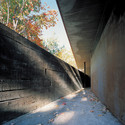
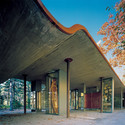
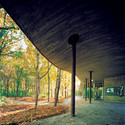
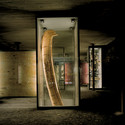
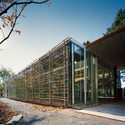
The pavilion is a museum within the garden. Sheltering less than 2% of the garden grounds, the pavilion is mostly outdoor space. Built along the garden’s main pathway, the pavilion metaphorically raises the path to reveal the cultural memory of the place. The undulating roof recalls a wisp of smoke through the trees. Outdoor displays sheltered by the roof are framed by two indoor spaces at opposite ends of the pavilion – exhibition and orientation spaces at one end, public washrooms and a meeting space at the other. The pavilion also houses a boutique and offices.

The relationship between building and site, and the environmental sensitivity needed to maintain the spirit of the garden, was critical to the design of the pavilion.

The new building acts as both a filter and a link between two garden environments: an area of spruces and a maple forest. Wherever possible, the pavilion’s exhibition was planned outdoors. These exterior spaces orient the visitor and help to reduce the apparent size of the building by integrating the exhibition with the wider environment.

Vertical surfaces are minimized so as to limit the visual impact of the building on the environment, and half of the built spaces are located underground to further reduce the influence of the new building on the existing setting. The new building was sited to retain all existing trees and maintain a relatively open terrain in an attempt to integrate the building and the site.

 
 
Thumb up Thumb down 0
aya says:

I like the design so much and I was wendering what materials will give the same effect in hot/dry climate

 
# February 28, 2009 at 16:54
Thumb up Thumb down 0
temple says:

clean line!

 
# March 2, 2009 at 05:51
Thumb up Thumb down 0
Richie says:

Nice and simple but expressive.. I like the materiality.

 
# March 2, 2009 at 09:11
Thumb up Thumb down 0
jacarch71 says:

simple plan + interesting section = good architecture

 
# March 11, 2009 at 04:34
Thumb up Thumb down 0
Montas,arch. says:

Very nice endeed, i like the site plan a lot.

 
# April 2, 2009 at 08:46
Thumb up Thumb down 0

5:25 PM May 13th

next time I'm in Montreal I'm stopping here – looks peaceful: http://bit.ly/bTm3AO

Thumb up Thumb down 0

8:43 PM May 17th

First Nations Garden-Pavilion by Saucier + Perrotte architectes http://bit.ly/9OjRXI #architecture #interiordesign #minimalism *love it!

Thumb up Thumb down 0

9:11 PM May 17th

Quite beautiful :) RT @bluevertical First Nations Garden-Pavilion by Saucier + Perrotte architectes http://bit.ly/9OjRXI *love it!

Thumb up Thumb down 0

11:44 PM Oct 25th

Arquitectura: Este es el majestuso Jardín/Pabellón de las Primeras Naciones, en Montreal http://ow.ly/2Zfzr

Leave a Reply »


Latest Comments »

The dia-grid is obviously not a structure here, just cladding pattern….....[+]
丫丫solkee on Use white, or very white
So cute~~~~!!!!!![+]
...[+]
Love it![+]
Sergio Marquez on Pier+ / AECOM and BIG
Big really likes the contour tool…[+]

Upcoming Architecture Events »

got events? invite us! click here

Architecture Books & Magazines »

Thermally Active Surfaces in Architecture / Kiel Moe

Thermally Active Surfaces in Architecture / Kiel Moe

Departing from the simple question Why do we heat and cool buildings with air?, this book focuses on the technique of thermally active surfaces. This technique uses water in building surfaces to heat and cool bodies – a method


Skidmore, Owings & Merrill International Terminal San Francisco International Airport

Skidmore, Owings & Merrill International Terminal San Francisco International Airport

Published in 2008 this book details the SOM’s design of the International Terminal at the San Francisco International Airport. The mid-rise terminal is a case study in light and lightness. It has plans, sections, elevations, models, text by Anne-Catrin…


MARK Magazine #35

MARK Magazine #35

As you well know already we love MARK Magazine, and this issue fails to disappoint. It has projects from many of the architects we have featured here on ArchDaily such as, StudioGreenBlue, Heri&Salli, Clavel Arquitectos, Kengo Kuma, Colboc Franzen, Studio Velocity, Takeshi Hosaka, Fuhrimann Hachler, Toyo Ito, Nieto Sobejano, L3P…


Our partners »

AD on iPad via Pulse

Browse by date »

Browse by category »

Friends »