Wyly Theatre / REX | OMA

By — Filed under: Featured ,In Progress , , , ,
 

The Wyly Theatre in Dallas is almost finished. This project is very interesting, and /OMA show once again how designing a building goes way beyond that working on the volumes and the skin, but to rethink the program itself.

Anyone familiar with a theatre knows the program order hasn´t changed much, as it´s pretty much the same you find on Neufert. But REX/OMA take this a step further, by re-studying the program relations and adjacencies, resulting on a unique building. Perfect for the client, as the Dallas Center (DTC) is recognized as one of the country’s few innovative companies located outside the triumvirate of New York, Chicago, and Seattle. On the top of that, an interesting aluminium skin adds to make this building unique.

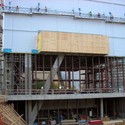
The facade is being installed this days, opening expected during 2009.

Now, the architects description:

Dallas Theater Center (DTC) is recognized as one of the country’s few innovative theater companies located outside the triumvirate of New York, Chicago, and Seattle. Ironically, the company’s artistic success can be attributed largely to its provisional accommodations in a dilapidated, galvanized metal shed. Free of the need to respect its architectural surroundings, the group regularly challenged its art’s physical conventions. The company’s makeshift residence also allowed it to be multi-form: throughout its season, DTC routinely reconfigured its stage.

Imagining a new home for DTC posed two distinct challenges. First, like a restaurant renovation which polishes out the character that made the original establishment successful, the creation of a pristine venue threatened to stultify the environment that had facilitated the company’s originality.

Second, the house’s potential flexibility had become de facto rigidity: DTC’s operational funding had grown taxed to the point that it could no longer afford the labor and materials necessary to rearrange its stage configuration.

To overcome these challenges, the Wyly Theatre repositions traditional front-of-house and back-of-house functions below-house and above-house.

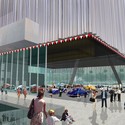
This maneuver redefines the traditional theater in two ways. First, it liberates the perimeter of the theater’s chamber; exposed on all sides, it can directly engage the city around it. No longer shielded by transitional and technical zones-lobbies, ticket counters, and backstage facilities-fantasy and reality can mix when and where desired.

Second, it turns the building into one large fly tower, a “superfly” or “theater machine” that eliminates the traditional distinction between stage and auditorium. Pristine elements can be flown; the remaining environment can be cut, drilled, painted, welded, sawed, nailed, glued, and stitched at limited cost. The new building engenders flexibility without requiring additional spending; its capital costs are relocated from architecture to infrastructure for transformation.

Each of the performance chamber’s components-seating, light control, acoustic separation, and surface-enjoys tailored flexibility without compromising any other component. At the push of a button, seating and balconies can move, rotate, tilt, and disappear completely to create proscenium, thrust, traverse, arena, flat-floor, and black-box configurations. The light control blinds can be uniformly or individually lifted. The acoustic enclosure is provided by a facade of operable glass. The stage and auditorium surface materials are deliberately not precious to encourage scenic alteration.

The Artistic Director is granted the freedom to determine the entire theater experience, from arrival to performance to departure. Suspension of disbelief can be established or ended at any point in the patron’s experience; the architect’s hand is removed.

On consecutive days, the Wyly Theatre can perform Shakespeare in a traditional, hermetic environment… or, stripped of the auditorium’s protective cocoon, Beckett through the lens of the Dallas cityscape.

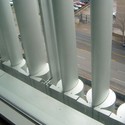
Clad in a facade composed of six different aluminum extrusions, arranged in six different combinations… the building manifests a strong presence in the Dallas Arts District despite its relatively modest size.

CLIENT Dallas Center for the Performing Arts
PROGRAM 575-seat “multi-form” theater with the ability to transform between proscenium, thrust, traverse, arena, flat floor, and black box configurations
AREA 7,700 m² (80,300 sf)
PROJECT COST $338 million, including Margot and Bill Winspear Opera House, Dee and Charles Wyly Theatre, Annette Strauss Artists Square, and Performance Park
STATUS Commenced 2004; under construction; completion expected 2008
DESIGN ARCHITECT REX | OMA
KEY PERSONNEL Joshua Prince-Ramus (Partner-in-Charge) and Rem Koolhaas, with Erez Ella, Vincent Bandy, Vanessa Kassabian, Tim Archambault
EXECUTIVE ARCHITECT Kendall Heaton
CONSULTANTS Cosentini, DHV, Donnell, Front, HKA, Magnusson Klemencic, McCarthy, McGuire, Pielow Fair, Plus Group, Quinze & Milan, Theatre Projects, Tillotson Design, Transsolar, 2×4


Thumb up Thumb down 0
martin says:

is this the REX day?

 
# February 10, 2009 at 09:14
Thumb up Thumb down 0
ray says:

the wyly theater is in my neighborhood. its been amazing watching the structure go up. the aluminum skin is almost 1/2 finished and its looking quite sexy!

 
# February 10, 2009 at 10:59
Thumb up Thumb down 0
bob says:

yes i think so..rex day…

 
# February 10, 2009 at 16:56
Thumb up Thumb down 0
dude22221 says:

guess so!

 
# February 10, 2009 at 18:30
Thumb up Thumb down 0
christos says:

beautiful building but can anybody tell me what is the purpose for the tube cladding? i can see the use for the blinds running outside the windows but why tubes??

 
# February 11, 2009 at 02:39
Thumb up Thumb down 0
Kevin says:

Oh another Rem Koolhaas project. Its just unbelievable rude
how these guys take projects off Rem and now brand them as
their own. Fakers !!

 
# February 11, 2009 at 19:01
Thumb up Thumb down 0

Kevin,

As Pausanias stated on the Museum Plaza article:

OMA has several partners who take actual and superlative responsibility in the design and development of the projects with which they are in charge. Joshua Prince Ramus was one of such partners. Being american, he was in charge with the projects OMA was developing in USA. When they ended their partnership, they came to the agreement that OMA’s office in USA, led by Prince Ramus, was going to keep the contracts for the projects “in process”. That office then was named REX.

 
# February 11, 2009 at 21:38
Thumb up Thumb down 0
Ayth1 says:

Top window looking out seems a little prison like.

 
# February 13, 2009 at 11:21
Thumb up Thumb down 0
Jim Rain says:

I work across the street from this theater, and it has been hugely interesting to watch its construction. It is an fascinating, innovative building. Sadly, I think the tubing not only hides the amazing structural elements, but it makes the facade look a bit like a giant bar code.

 
# February 18, 2009 at 00:06
Thumb up Thumb down 0
kevin says:

thanks David for the response. i have read this and i don t know rem of course but I still find all this very dodgy. even
they agreed that rex maintains contracts all the workout is based on koolhass ideas and developments during the years.
i don t care what ramus is doing or if he has the right to do this but i just don t like people who probably have worked out
the take over behind the back of the man who has created this
stunning approach to architecture. Thats why REX is getting no respect from me. I m sure this copy and paste practice will dry out in less than 1,5 years as the projects developed without OMA already look very messy.

 
# February 22, 2009 at 14:53
Thumb up Thumb down 0
zp says:

christos, you can find explanation about the tube cladding in this video from REX web page:
http://www.rex-ny.com/approach/yale-building-in-the-future-symposium

 
# March 16, 2009 at 14:27
Thumb up Thumb down 0

I wan to tell to all of you, that i just found a copy from this object in macedonia….
, construction, detail of fasade , everything.,…..
here is the link
http://vest.com.mk/?ItemID=495653ADF1CCD2418E674902E7F22EF6

 
# April 2, 2009 at 05:21
Thumb up Thumb down 0
nick says:

Say what you will about what the building looks like, but this firm is one of the only firms that are transitioning from pre-war to post-war role of architect. They’re staying relevant as the masses of architects still think they’re “artists.” Architects should solve real problems, not just accommodate the program we’re given.

 
# July 30, 2009 at 12:29
Thumb up Thumb down 0
ARCHmonster says:

Great concept, but a few things.

Most of the experience is for the patrons, which is brilliantly excecuted, but what about the people that work there day in and day out in the back of house? The people that are there every single day and to me it looks like they made a basement and threw them all in there… facing a large concrete ramp. It would have been nice if they had a little more focus.

Another… natural light in a theatre. I’ve designed a theatre, and natural light is probably the last thing you want in a main performance space. You need to control the lighting at all times.

Overall beautiful concept…

 
# August 18, 2009 at 17:17
Thumb up Thumb down 0
Jet says:

Beautiful building. Great article.

 
# January 14, 2011 at 15:41
Thumb up Thumb down 0
Tech says:

He/They built a pretty building, not much of a theater.

 
# March 30, 2011 at 13:17
Thumb up Thumb down 0
Luciano says:

Where’s the plans? D:

 
# November 3, 2011 at 22:49
Thumb up Thumb down 0

5:08 PM Aug 7th

@lorenzodiaz @alliegt se llama Wyly Theatre = Theatre Machine http://bit.ly/pkvlI4

Thumb up Thumb down 0

5:48 AM Aug 8th

“@RZVLA73: @lorenzodiaz se llama Wyly Theatre=Theatre Machine http://t.co/35b0TlV”/sí! Está dentro del AT&T performing arts center, Dallas

Leave a Reply »


Latest Comments »

ArchDaily features nice projects. But is obviously run by morons.[+]
They thought about the scale of wood. The intent is to use Trestlewood, which is wood...[+]
So creepy![+]
why is heidi montag in every swimming pool project? nice[+]
Hi, can you please correct the tag Montrea for Montreal. And it’s...[+]

Upcoming Architecture Events »

got events? invite us! click here

Architecture Books & Magazines »

A Peripheral Moment

A Peripheral Moment

This book is an account of the highly productive decade of architectural experimentation in Croatia lodged between the violent break-up of Yugoslavia and their slow integration into the EU. Ivan Rupnik guides the reader through the emergence of this


Event: Tom Kundig and Mark Rozzo – Architectural Explorations in Books, a conversation presented by New York Public Library

Photo by Tom Bies | Courtesy of OSKA Architects

[ January 25, 2012; 18:00 to 20:00. ] Tomorrow, the New York Public Library will be hosting a talk between architect Tom Kundig of Olson Kundig Architects and Town & Country Executive Editor Mark Rozzo that will discuss “the role of place, nature, materials and craft in creating Kundig’s bold and…


Made to Measure: The Architecture of Leers Weinzapfel Associates

Made to Measure: The Architecture of Leers Weinzapfel Associates

Made to Measure is a monograph showcasing the work of Leers Weinzapfel Associates, an architecture firm based out of Boston, Massachusetts. Leers Weinzapfel Associates first gained prominence by taking on infrastructure projects that are often left to engineers. Where…


Our partners »

AD on iPad via Pulse

Browse by date »

Browse by category »

Friends »