People at opentravel made a ranking on the world’s best planned cities. We surely agree on some of them, but we also think there are a lot of cities that may very well deserve a spot on the list. What do you think?
The complete ranking with photos taken from our Flickr pool after the break.
Last week, we attended a forum on urbanism held in Goldman Sach’s brand new building in downtown Manhattan. The forum specifically discussed the role of the mega project and its significance on the future of American urban development. The panel included Daniel Libeskind, Richard Kahan (the former Chairman and CEO of Battery Park City Authority) and Paul Goldberger, the architecture critic for The New Yorker.
Organized by MoMA and PS 1 Contemporary Art Center, the Rising Currents exhibit cannot be missed by architects, ecologists, or green enthusiasts…let alone any New Yorker. The exhibit is a cohesive showcase of five projects which tackle the lingering truth that within a few years, the waterfront of the New York harbor will drastically change. Dealing with large scale issues of climate change, the architects delve into a specific scale that we can recognize and relate to. The projects are not meant to be viewed as a master plan, but rather each individual zone serves as a test site for the team to experiment. The projects demonstrate the architects’ abilities to look passed the idea of climate change as a problem, and move on to see the opportunities it presents. Barry Bergdoll, the Philip Johnson Chief Curator of Architecture and Design at MoMA, explained, “Your mission is to come up with images that are so compelling they can’t be forgotten and so realistic that they can’t be dismissed.”
Their proposal primarily addresses the historical and spatial implications of building in the small city, but there are significant environmental considerations as well. The encompassing municipality of Sønderborg envisions a carbon neutral ‘Kommune’ by the year 2030, and they hope they’ll get the opportunity to contribute to that goal.
Architect’s description and more images after the break.
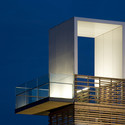
The sinuous structure is proposed to be a landmark in the middle of the old city fabric, while serving as an observation deck to discover the upper level of the compact urban context, a new view of the city. The project has been criticized by the citizens because of the contrast with the existing constructions, as you can see on the renderings.
Architecture photographer Pedro Pegenaute shared with us some photos of the current status of this impressive structure, from which we can see a preview of what the observation deck will be:
BIG, in collaboration with AKT, Tyréns and Transsolar, just won the competition for the World Village of Women Sports in Malmo, Sweden, a 100.000sqm complex for research, education and training of women’s sports.
Rather than a program organized around a sports arena disconnected from the city, the project becomes a town inside a town, offering rich public spaces as you can see on the renderings.
The central space of the village offers a large area for public gathering, which can host professional football matches, concerts, conferences, exhibitions and flea markets. Around this space we find a series of sloped buildings, which reduce the visual impact of the complex to the adjacent neighborhood.
Between these buildings we find a pedestrian network around the main sports hall which plugs into the surrounding street networks as well as the interior galleries of Kronprinsen, turning it into a complete ecosystem of urban life.
Designed by Matsys Designs, Sietch Nevada is a response to the idea of a water-poor world becoming a reality, especially in the American Southwest. With so much of the press focused on wars over oil, the world is often unaware of the slowly depleting water sources, which are indeed exponentially more valuable than oil. This futuristic urban prototype addresses the water situation as a complex underground network of tunnels and canals offers protection and the “storage, use, and collection of water essential to the form and performance of urban life.”
The future well being of cities around the globe depends on mankind’s ability to develop and integrate sustainable technology.
LAVA designed the Masdar City as the city of the future; positioned at the forefront of integrating sustainable technology into modern architectural design. Rome, Athens, Florence; most great historical cities have had the plaza, forum, or square at their epicentre – where the life, values, ideals, and vision of the population evolved. Equally, the centre of Masdar must be an iconic beacon that attracts global attention to sustainable technology.
As if it was a mix in between Huxley | Orwell story, Atelier Van Lieshout from Rotterdam is developing this project since 2005. Just like in Brave New World, future society is an embodiment of the ideals that goes beyond ethics and liberty, and the artwork it’s obviously influenced in the scripts of fiction books from the early XX century, like mentioned Huxley’s Brave New World, Orwell’s Men Like God or maybe some D. H. Lawrence novels.
Let’s hear what they have to tell us after the break
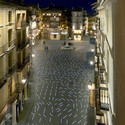
Under the direction of architect Dario Cottone, the young Italian firm recently won an international competition in the historical center of Caltanissetta, Sicily. Cottone’s project focuses on a red ribbon that aims to link the older historic parts of the 16,000 square meter site with the emerging contemporary areas.
Further project description and more images after the break.
Amidst financial buildings and high-rise apartments, Belgian architect Vincent Callebaut has redefined the conventional skyscraper. His 132 story complex for the south edge of Roosevelt Island addresses the pressing need for environmental and ecological sustainability. This conceptual design focuses on creating a completely self-sustaining organism that not only utilizes solar, wind, and water energies, but also addresses the pending food shortage problem.
However, Los Angeles is changing. The city’s Transport Authority has planned in the last years a series of measures aiming to improve quality of life through improving transit and walking and providing alternative to car commuting.