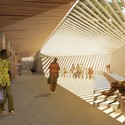
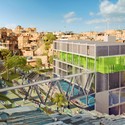
In Bangladesh, where rising sea levels are having profound effects on the landscape, one nonprofit organization called Shidhulai Swanirvar Sangstha run by architect Mohammed Rezwan is fighting back by adapting, a true quality of resilience. Rising water levels and the tumultuous climate is displacing people by the thousands; a projected 20% of Bangladesh is expected to be covered in water within twenty years. For a country that is one of the densest populated state on the planet, this figure has disastrous consequences for a population that has limited access to fresh water, food, and medicine. In response to these conditions, Shidhulai has focused on providing education, training and care against the odds of climate change by adapting to the altered landscape: moving schools and community centers onto the water – on boats.
Imagine driving down a road at night without street lights with the light-emitting road guiding your way. As the temperature outside drops the road starts to reveal images of ice crystals, signaling to you, the driver, that conditions are now icy and slippery. This futuristic concept may soon be a reality as Dutch design firm Studio Roosegaarde and the engineers at Heijmans Infrastructure team up to develop “Smart Highways” – a design agenda for interactive, sustainable and safe roads. The concept won the two firms Best Future Concept at the Dutch Design Awards 2012. Join us after the break for more.
In the wake of Hurricane Sandy, as communities band together to clean up the devastation and utility companies work tirelessly to restore the infrastructure that keeps New York City running, planners and policy makers are debating the next steps to making the city as resilient to natural disaster as we once thought it was. We have at our hands a range of options to debate and design and the political leverage to make some of these solutions a reality. The question now is, which option or combination of options is most suitable for protecting New York City and its boroughs? Follow us after the break for more.
With industrialization came unchecked suburbia and car-centric lifestyles. But now, in the rapidly approaching age of the super city, our current standards of living will not suffice. According to MIT Research Scientist Kent Larson, 21st century cities will account for 90% of global population growth, 80% of all global CO2, and 75% of all global energy use.
Understanding that the global population faces serious issues of overcrowding, affordability and overall quality of life, Larson presents new technologies that intend to make future cities function like the small village of the past. Folding cars and quick-change apartments with robotic walls are just a some of the fascinating innovations he and his colleagues are currently developing.
A wood-based nanomaterial composed of cellulose nanocrystals and cellulose nanofibrils is being evaluated at the Forest Products Laboratory, in support of a project at the Army Research Laboratory in Aberdeen, Maryland. The material, presumably stronger than Kevlar, is being produced to create clear composites as reinforced glass for clear applications. US Forest Services has opened a $1.7 million pilot plant in Wisconsin to develop the wood-based nanomaterial, whose future applications may include windshield and high performance glass.
3-D Printing technology is developing at quickening pace as both engineers and architects experiment with its technological and social potential. Consider Enrico Dini’s D-Shape printer that prints large scale stone structures out of sand and an inorganic binder or Neri Oxman’s research at MIT which involves a 3-D printing arm and nozzles that can print with a variety of different materials, from concrete to recycled plastic.
Dutch firm DUS Architects, in collaboration with Ultimaker Ltd, Fablab Protospace, and Open Coop, have added another 3-D printing machine to the list known as KamerMaker, the room builder. KamerMaker is the world’s first mobile 3d printer and has the ability to print “rooms” that are up to 11 feet high and 7 feet wide. The machine was unveiled at OFF PICNIC, a precursor to Amsterdam’s annual PICNIC technology festival.
HOK Chief Executive Officer Patrick MacLeamy, FAIA, explains why the term “BIM” doesn’t convey the real promise of building information modeling over time. In this video, MacLeamy breaks down the mega acronym “BIM-BAM-BOOM!” and addresses the real promise of this new approach across three basic phases of a building’s life.
It all begins with BIM; the architect uses 3-D modeling to investigate options and test building performance early on in order to optimize the building’s design. The design is then handed off to the contractor who streamlines the building process with BAM (Building Assembly Modeling), which allows for a significant decrease in construction costs. Once complete, BAM is turned over the owner and becomes BOOM (building owner operator model). This allows the owner to manage the building over time and ensure optimized building performance throughout its entire life cycle.
The real promise of “BIM-BAM-BOOM!” is “better design, better construction, better operation”.
The disruptive minds series is in partnership with smartwater. smartwater, simplicity is delicious. Click here to learn more.
Usually when one studies architecture, one does architecture. But that’s just not enough for some people. James Ramsey, most famous for the sci-fi-like renderings of the Low Line, an underground park which has captured the imagination of thousands, is one of those people. An architecture grad from Yale University, Ramsey went on to be a satellite engineer for NASA, before coming back to architecture and starting up his own design studio, Raad Studio. Oh yeah, and along the way he came up with a fiberoptic technology that would allow you to bring natural light (and thus grow plants) underground.
Phototropia is part of an ongoing series on the application of smart materials in an architectural context and was realized in April 2012 by the Master of Advanced Studies class at the Chair for Computer Aided Architectural Design (CAAD). The project combines self-made electro-active polymers, screen-printed electroluminescent displays, eco-friendly bioplastics and thin-film dye-sensitized solar cells into an autonomous installation that produces its required energy from sunlight and – when charged – responds to user presence through moving and illuminating elements.
The days of carrying around rolls of construction documents on site are in flux. The rapid change of both software and hardware has already dramatically changed the way architects, engineers, and general contractors communicate with each other. For those of you who do site visits on a regular basis, you are no doubt familiar with the relatively drawn out process the contractor has to take in order to get clarification on a detail or problem distillation – taking pictures of detail, scanning redlines, emailing to architect, etc. However, what if, and it is happening, you can bring out an iPad or similar device with all the drawings loaded ready to view in palm of your hand. Questions can simply be marked up right on the spot and instantly fired off for review or approval.
Remember the “Cosmic Quilt” kickstarter campaign we published a few weeks ago? Well, it was a success! With the help 20 students from the Art Institute of New York, The Principals were able to construct a reactive architectural environment just in time for the New York Design Week that took place May 19-21.
A report released by the Center for an Urban Future has positioned New York City as the fastest growing tech sector in the country, outpacing Boston to become the U.S.’s Tech Hub (only behind Silicon Valley).
Its rapid growth – a 28.7% increase of tech-related jobs in five years and a 32% increase in venture capital deals (compare that to the national average of -11%) – has been attributed to the diversification of its startup tech companies, focused not on creating new technologies, but on providing technological solutions to existing industries.
However (as we noted earlier this week in “The Next Silicon Valley(s)“) there is another “key” factor to the city’s burgeoning innovation and entrepreneur scene – the city itself.
Read More on how New York City’s Urban lay-out is encouraging its technological boom, after the break.
“Pop-Up,” “DIY,” “Kickstarter” “LQC” (That’s lighter, quicker, cheaper for the unfamiliar). Urbanisms of the People have been getting awfully catch-phrasey these days. What all these types of DIY Urbanisms share is a can-do spirit, a “Hacker” mentality: people are taking back their cities, without any “expert” help.
Unfortunately, of course, this mindset creates an anti-establishment (often, anti-architect) antagonism that would render any wide-spread change nigh impossible. Yes, the DIY movement, facilitated by the use of technology, is excellent for getting people involved, for encouraging important, innovative ideas – in the short-term.
As Alexandra Lange recently pointed out in her post “Against Kickstarter Urbanism,” technology is not a “magic wand,” and crowdsourcing initiatives often fall short in the day-to-day, nitty-gritty work of a large-scale, long-term urban project.
But while technology certainly has its limitations, its potential to facilitate connection and communication is unparalleled. What is vital, however, is that the technology enhance, not replace, our physical relationships. Instead of using online platforms as divisive or purely conceptual forums, they must becomes tools of transparency and trust-building, mediators of a conversation that invests and connects all parties on the ground.
HP, Apple, Google – they all found their success amongst the peach groves and Suburban houses of California. But why? What is it about Silicon Valley that makes it the site of technological innovation the world over?
It’s tempting to assume that the Valley’s success must be, at least in part, due to its design. But how does innovation prosper? What kind of environment does it require? In a recent interview with The Atlantic Cities, Jonah Lehrer, author of Imagine: How Creativity Works, suggests that creativity is sparked from casual exchanges, the mingling of diversity, the constant interaction with the strange and new. In short, and as a recent study corroborates, innovation flourishes in dense metropolises.
Seemingly then, Silicon Valley, a sprawl of highways and office parks, has become a hotspot of creativity in spite of its design. But let’s not write off design just yet.
As technology makes location more and more irrelevant, many are looking to distill the magic of Silicon Valley and transplant it elsewhere. The key will be to design environments that can recreate the Valley’s culture of collaboration. The future Valleys of the world will be microsystems of creativity that imitate and utilize the structure of the city.
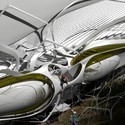
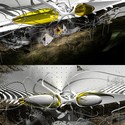
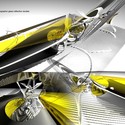
Dr. Margot Krasojevic is known for using digital parameters to explore the psychological effects of architecture – materials and spatiality – on its inhabitants. The Hanging Hotel / Suspended Campsite is one such project that was completed in October 2011 for Holden Manz Wine Estate Cape Town in Massif de L’ Esterel, (Gorges Du Vedron) South of France. The project is an investigation in the choreography of perceptions of the environment around us. In this particular project, catering to rock climbers, Dr. Krasojevic uses compound glass and a prism louver system to alter how the climbers see their environment and stimulates different psychological experiences based on these subtle shifts in vision.
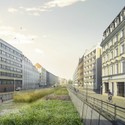
A secondary school project in Gando, Burkina Faso, a community center project in São Paulo, Brazil, and an urban renewal plan in Berlin, Germany are the winners of the Global Holcim Awards for 2012. These leading sustainable construction projects were selected from 15 finalist submissions by a jury of independent experts led by Enrique Norten. The finalists were the regional Holcim Awards 2011 winning projects that had been selected from more than 6,000 entries in 146 countries.
All 53 prize-winning projects at the regional level also competed for further prizes based on their contributions to sustainable construction through innovative building materials and construction technologies. The Global Holcim Innovation prizes conferred by a jury of materials and industry experts led by Harry Gugger went to projects in Switzerland, Germany and the United Kingdom.
Continue after the break to view the winning proposals!
Walk into the cafeteria at the Googleplex and you are nudged into the “right” choice. Sweets? Color-coded red and placed on the bottom shelf to make them just a bit harder to reach. “Instead of that chocolate bar, sir, wouldn’t you much rather consume this oh-so-conveniently-located apple? It’s good for you! Look, we labelled it green!”
Like the Google cafeteria guides you to take responsibility of your health, Google wants to transform the construction industry to take responsibility of the “health” of its buildings. They have been leveraging for transparency in the content of building materials, so that, like consumers who read what’s in a Snickers bar before eating it, they’ll know the “ingredients” of materials to choose the greenest, what they call “healthiest,” options.[2]
These examples illustrate the trend of “medicalization” in our increasingly health-obsessed society: when ordinary problems (such as construction, productivity, etc.) are defined and understood in medical terms. In their book Imperfect Health, Borasi and Zardini argue that through this process, architecture and design has been mistakenly burdened with the normalizing, moralistic function of “curing” the human body. [3]
While I find the idea that design should “force” healthiness somewhat paternalistic and ultimately limited, I don’t think this “medicalized” language is all bad – especially if we can use it in new and revitalizing ways. Allow me to prescribe two examples: the most popular and the (potentially) most ambitious urban renewal projects in New York City today, the High Line and the Delancey Underground (or the Low Line).
More on “curative” spaces after the break. (Trust me, it’s good for you.)
The announcement instigated a flurry of analyses and criticisms over the meaning of the design for the world – the Zen-like significance of the circle, the role of architecture in this technologically-driven age, the legacy and hubris of Jobs – but produced very little discussion over its meaning for the company itself.
Meanwhile, months before news of the “spaceship” landed, another internet giant was searching the California landscape for its own space to call home. Still very much under-wraps, the new Googleplex will be the first time Google builds a workplace completely from scratch. [2]
These projects will be the Magnum Opuses, the ultimate physical representations, of the two most influential Tech companies in the world, and the two share striking similarities. So let’s clash the plans of these two titans and take another look at Apple 2 – but this time in the light of Google – and see what they can tell us about these companies’ futures.