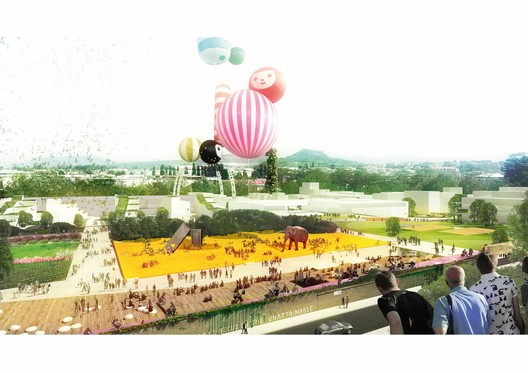
Located in the Finnish city of Turku, the Calamari Union project by LRA (Lapo Ruffi Architetto) is designed around the theme, “European urbanity | Resonance between territories and ways of life. What architectures for sustainable cities?”. The project responds to a new demand of making a city outside of the city. How must we design places to live in contexts not yet settled? Limen in Latin means limit, but also threshold, entrance. It is therefore in the etymology of this word that the premises are found for what can become a place of boundary, not to be intended as a barrier, but as an opportunity of connection. More images and architects’ description after the break.
Sasaki Associates, with RDG Planning & Design and Applied Ecological Services (AES), were recently announced as the winning team of the Water Works Parkitecture Competition. The international design competition entailed the creation of a conceptual plan for Water Works Park to form dynamic relationships between the river, the watershed, and the community. Education and the connection between the river and the community were highly stressed in Sasaki’s winning proposal. More images and architects’ description after the break.
The aim of Bike The Floating Stadium by architects Quentin Perchet & Gabriel Scerri is to design a gift to the city, a symbol of sustainability, and a 24/7 open public space gathering in an exemplary way for leisure, entertainment, and philanthropy. Their concept consists in driving bicycles and pedestrians from their homes to an exceptional viewing platform of the city, through a promenade along the water in the Noord 7 area of Amsterdam. More images and architects’ description after the break.
Designed as a learning space for the future, LAVA‘s design focuses on an environment that is sustainable, integrates with the landscape, connects with the school environment, and is suitable for prefabrication and mass customization. Relocatables are the decades old solution to changing demographics, remote community needs, and natural disasters. Unsightly, they are perceived as cheap and unpleasant spaces. This idea is upturned with spaces that are sustainable, practical, cost effective whilst making learning fun and exciting. More images and architects’ description after the break.
The Council on Tall Buildings and Urban Habitat (CTBUH) is pleased to announce a “Call for Proposals” for its 2012 International Research Seed Funding initiative – culminating with an award of US$20,000.
In their Europan 11 Proposal, titled ‘Nudge City’, RIO Agency’s main goal was to build on a critical vision of sustainability as it is often promoted today. In their approach, the urban project cannot be a goal in itself. It has to be a frame of incentives, building on the territory’s ability to attract energies, leaning on individual aspirations to create a sustainable city. Nudges are sparks: public interventions which, designing one use, open way for a tree of possibilities. More images and architects’ description after the break.
The first prize proposal in the Europan 11 competition in Hungary, Szeged by AMK+ Studio is before a functional transformation and with the cooperation of the city and the site owner, the integration of the site into the urban tissue is the main goal. Designed by Tamas Kun, Gergely Almos, and Tamas Mezey, their design suggests a kind of framing building line – an ‘intelligent wall’ – which is formed by many aspects. These aspects manage all the mutual reactions between the mainly residential environment and the rehabilited industrial – new ‘city center’ – block. A ‘bridge’ connects the place formally, in scale, by material use and with functionality. More images and architects’ description after the break.
Loïc Brenterc’h (A.B.A agency) + Ewan Marin (COT agency) shared with us their Europan 11 Proposal in Toulouse, France which won the second prize. Titled ‘META – Block: A Toulouse Urban Model’, the purpose of their design is to extend and redefine the historical city way of life. The inhabitant’s habits and living visions have changed but they still need to feel the Toulouse cultural vibes. More images and architects’ description after the break.
Interface Studio Architects shared with us their proposal for the Hong Kong Car Parc competition, which aims at romanticizing the car as an active urban object while simultaneously implementing sustainable strategies. In addition to including parking spaces in the rotational design, shopping, food and landscaping aspects are also included in the program. More images and architects’ description after the break.
The Zagreb Society of Architects(DAZ), acting as Organizer and Manager on behalf of The City of Zagreb is launching an open, on-line, one-stage, anonymous, ideas Competition for the urban-architectural conceptual design for the Zagreb Badel Site redevelopment. More information find on the official web site of the Competition. The deadline for submission of competition entries is on Thursday, 5 April 2012 at 12.00 CET. Competitors may make inquiries until Wednesday, 22 February 2012. For more information, please visit their website here. Images of the site can be viewed after the break.
This February until the first week of July, a selection of photographs and architectural drawings will be displayed at the V&A Museum of Childhood to celebrate the 140th anniversary of the Museum opening in Bethnal Green. A Museum of Art and Science was officially opened by the Prince of Wales on 24 June 1872. More information on the event after the break.
Sofia’s new Metropolitan Station 20 on line 1 connects the nearby historic city with a modern and developing city center. It creates an underground world inspired by the cities’ culture and modern day aspirations. The design strategy by ZNA (Zeybekoglu Nayman Associates, Inc.) seeks to take advantage of the overlapping relationship between Obikolna Street and the proposed station below. The design of a centralized median, which moderates traffic, becomes the glass spine of the station. Composed of high angled walls in white architectural concrete the station is formed to capture natural light. More images and architects’ description after the break.
The Europan 11 winning proposal by CUAC Arquitectura, Serrano + Baquero Arquitectos, and Luis Miguel Ruiz Aviles arises Niwu Water Garden by the ensounter of three main materials: water, city and farmland. In a scenic enclave of particular importance to the city of Leeuwarden an appropriate balance between these materials allows to think about a hybrid landscape which establishs a transition between rural and urban. The result is a new environment in which elements of the city (the traditional and the present) establish a proper dialogue with the existing agricultural plot and its associated infrastructure. More images and architects’ description after the break.
Weysen & De Baere Architects recently won a competition to design a multi-funcional hall with a daycare center and small library in Sint-Katelijne-Waver, at the outskirts of Antwerp (Belgium). The building measures around 2.100m2, and spreads over 2 stories. The program occupies a significant part of the intervention site and in order to guarantee a building as compact as possible, the multifunctional hall is centered on the site. More images and architects’ description after the break.
The best way to preserve and develop the Kiev Islands in keeping with the aim of the project would be to improve the way people access the islands. Being sensitive to the existing conditions, the proposal by Triple O Studio is not to build new bridges, but to enhance the existing ones; make them more comfortable for all means of transport but more importantly for the pedestrians, cyclists and public transit users. Through the existing access systems of elevated bridges allowing for experiencing the site from an elevated promenade, its majesty can be fully discovered. More images and architects’ description after the break.
Since the beginning, it has been very interesting to discover how, despite the fact that we have reached such an advanced state of urbanity (meaning the way we produce our more or less shared space), it is still possible to scrape the bottom of the barrel and find residual urban spaces, with enormous, unexpressed potentials. In a world where design contaminates every possible field of technical knowledge and theoretical thinking, landfills still represent and exceptional void of intentions. The strategy of the Active Edge by 2A+B embodies Grønmo’s landfill as an urban organism able to constantly re-produce its own components (soil, landscapes, trash) and the relative network of socioeconomic processes behind it. More images and architects’ description after the break.
HORIZONTE, a journal for architectural discourse just announced its latest Call for Papers for their 5th issue dealing with the topic “Fetish”. The journal is an interdisciplinary and collaborative effort of students from the School of Architecture, the School of Design and the School of Media Studies and is an independent student organization at the Bauhaus-Universität Weimar, Germany. For more information, please visit their website here.
Studio Mode / modeLab is pleased to announce the modeLab 2012 Spring Workshop Series. The series starts off with the Agent Forms, a two-day intensive design and programming workshop to be held in Brooklyn during the weekend of February 04-05.