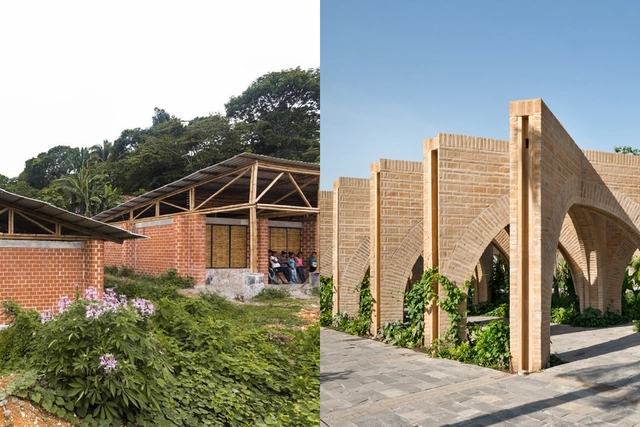
This November, REDBAAL will mark its first decade of activity, a milestone celebrated alongside four editions of the Oscar Niemeyer Award for Latin American Architecture (ON Award). Over these years, more than 350 projects have been submitted, all of which share the distinction of having been previously recognized at the most prestigious architectural biennials across Latin America.
https://www.archdaily.com/1132501/discover-the-20-finalist-projects-of-the-2022-oscar-niemeyer-award-for-latin-american-architectureDiego Vivas
Originating as protection against low temperatures around 3,500 years ago, carpets and rugs have, over time, evolved into a true art form, reaching a high level of specialization by the 16th century. Rugs, carpets, and tapestries of various shapes, colors, textures, and patterns are integrated into different areas of the home to meet users' needs and enhance spatial comfort, sometimes extending far beyond their original purpose.
Molière Street Renovation / PPAA Pérez Palacios Arquitectos Asociados. Image
Over the years, interior design has evolved in response to changing needs, and above all, to the experiences it seeks to evoke for the user. Over the last two years, we have witnessed a radical shift and a heightened interest in this field, as the pandemic forced us to pay closer attention to how we configure the spaces we inhabit. This has brought about much more holistic designs aimed at user well-being, combining colors, sensory experiences, technology, and natural elements that promote health.
As part of an initiative by LIGA, an independent space founded in Mexico City in 2011 to promote contemporary Latin American architecture through exhibitions, publications, events, lectures, and workshops, the exhibition “Registro: Museo Tamayo” opened on April 21 as part of the LIGA-ARCHIVOS initiative. This iteration presents a reinterpretation of the building designed by architect Teodoro González de León and built in 1981 in the First Section of Chapultepec Forest.
The ‘Rogelio Salmona Latin American Architecture Prize: open spaces / collective spaces’ seeks to recognize built works of architecture that create significant spaces for citizens, helping to foster more welcoming cities. Unlike previous editions, this year two categories were established: Latin America and Colombia.
From the 42 submissions, the jury—comprising Sol Camacho (Brazil/Mexico), Nicolás Campodónico (Argentina), Carlos Campuzano (Colombia), Carlos Jiménez (Spain/Colombia), and Mauricio Rocha (Mexico)—selected 26 Latin American works to be published, featured, and exhibited during this 2024 edition. The final awards ceremony will take place on October 24 of this year.
The award ceremony for the 11th edition of the Interceramic Architecture and Interior Design Award was held at the Cabañas Museum in Guadalajara. With more than 1,000 entries this year, the prize promotes and recognizes projects that reflect contemporary design and represent the state of architecture and interior design, while also honoring creativity in the use of Interceramic ceramic materials.
Marking its first hybrid (online and in-person) edition, the 3rd International Facade Forum 2023 will take place on April 26. Broadcasting from Mexico City, the event will feature 15 lectures by international speakers under the academic direction of Marshall Academia de Fachadas (Bill Marshall and Karina Tarrisse) and organized by the Sarzabal agency (Hernán Barbero Sarzabal and Maui Cittadini), alongside Daniela Ruiz de Chávez, who is managing the organization in Mexico.
The Royal Academy has honored Shane de Blacam at the 2023 Royal Academy Architecture Awards, alongside announcing the finalists for the Royal Academy Dorfman Award—an accolade that celebrates global architecture, looking toward the future of the discipline and architectural practice. The finalists are COMUNAL (Mexico), Taller Gabriela Carrillo (Mexico), H Arquitectes (Spain), and Tropical Space (Vietnam).
Educational facilities have evolved over the years in response to technological advancements and new pedagogical models, which increasingly focus on flexible methods that allow students to chart their own paths within a shared framework. The significance of these facilities lies in their role as meeting points that satisfy our social need to share physical spaces, pointing toward more horizontal and inclusive educational systems. A prime example is the Center for the Blind and Visually Impaired, designed by Taller de Arquitectura Mauricio Rocha + Gabriela Carrillo, which seeks to create diverse sensory experiences through materials, light, and temperature both inside and outside.
The Mexican state of Oaxaca is one of the most visited destinations in the country, drawing travelers from around the globe with its rich culinary, cultural, and architectural heritage. Located in the southeastern region of the country, it spans 93,757 km² and is divided into 570 municipalities, making it the fifth-largest state in Mexico.
The XI Ibero-American Biennial of Architecture and Urbanism (XI BIAU) recently announced the 210 selected projects for its upcoming edition, which will take place for the first time in Asunción this October.
The winners of the Panorama of Works Award will be chosen from this shortlist, which includes the following 18 Mexican projects:
The AR Emerging Architecture Awards have revealed their shortlist, which includes two Mexico-based practices: Estudio MMX and Comunal Taller de Arquitectura. Alongside 14 other offices, they will have the opportunity to present their projects to the judges: Anna Heringer of Anna Heringer Architecture, winner of the 2006 and 2008 AR Emerging Architecture awards; London-based Irish architect Níall McLaughlin of Níall McLaughlin Architects, who was a finalist in 2002; and Sou Fujimoto, founding director of Sou Fujimoto Architects, a previous winner in 2006 for a children's treatment center in Hokkaido, Japan.







.jpg?1555400290&format=webp&width=230&height=230&crop=true)
.jpg?1555400335&format=webp&width=230&height=230&crop=true)
.jpg?1555400496&format=webp&width=230&height=230&crop=true)
.jpg?1555400438&format=webp&width=230&height=230&crop=true)



.jpg?1643052917&format=webp&width=230&height=230&crop=true)


.jpg?1575054978&format=webp&width=230&height=230&crop=true)


.jpg?1597424114&format=webp&width=640&height=580)


.jpg?1597424114)