Gustavo Vivanco

BROWSE ALL FROM THIS PHOTOGRAPHER HERE
↓

On International Day of the World's Indigenous Peoples: Toward a Deeper Understanding of Ancestral Constructive Culture

Audio available

Every year on August 9, and since 1994, UNESCO has commemorated the International Day of the World's Indigenous Peoples. The United Nations has not yet adopted an official definition for the term 'Indigenous peoples,' but considers, for social recognition, self-identified non-dominant groups of society, with distinct language, culture, and beliefs, organized in separate social, economic, and political systems. From a territorial perspective, the UN understands the term through historical continuity with pre-colonial or pre-settler societies, and the group's strong links to territories and surrounding natural resources. The persistence in maintaining and reproducing ancestral environments and systems is also recognized as an element of identity, encompassing other designations such as first peoples/nations, aboriginals, or ethnic groups. Following the occasion's aim to raise awareness, in this article we present contemporary reflections, regional cases, and interviews about ancestral constructive knowledge and how it can build the future.

On International Day of the World's Indigenous Peoples: Toward a Deeper Understanding of Ancestral Constructive Culture - More Images+ 13

Óscar Borasino, José Canziani, Juvenal Baracco, and Frederick Cooper: Winners of the Lifetime Achievement Award at BIALIMA 2021

Following the restoration of the building originally designed by architects Óscar Borasino and Ruth Alvarado—the Mil Centro renovation by Estudio Rafael Freyre—one can quickly understand the importance of legacies.

This is precisely what the CAP-RL Lifetime Achievement Award - Casa Rosselló Award sought to celebrate. Organized by the Lima Regional Chapter of the Peruvian Association of Architects as part of the I Lima International Biennial of Architecture (BIALIMA 2021), the award aimed to recognize and highlight architects and professionals whose significant project, cultural, academic, and public service contributions have consistently demonstrated a combination of coherence, talent, vision, and commitment over time, and whose work has made a consistent and meaningful contribution to society, the profession, and the built environment.

Subscriber Access

Thatched Roofs, Plant Fibers, and Leaves: Examples in Latin American Projects

Thatched Roofs, Plant Fibers, and Leaves: Examples in Latin American Projects - Image 18 of 4
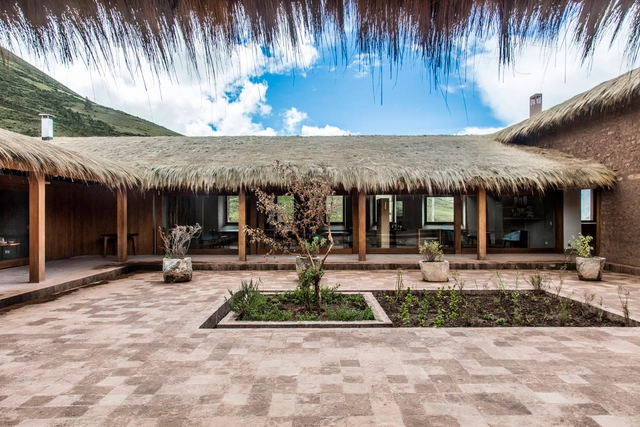
Mil Centro / Estudio Rafael Freyre. Image © Gustavo Vivanco

Thatched Roofs, Plant Fibers, and Leaves: Examples in Latin American Projects - More Images+ 16

Historically, natural elements were often the only raw materials indigenous populations used to build their temporary shelters or permanent dwellings. Today, environmental awareness and an interest in ecological construction methods have given rise to more sustainable practices that adapt these procedures to contemporary requirements. In this way, by incorporating biodegradable and low-environmental-impact materials into their projects and blending them with modern resources to enhance their physical properties, architects have successfully revived the ancestral techniques of their regions, forging a path toward green building.

Mil Centro Restaurant / Estudio Rafael Freyre

  • Area Area of this architecture project Area:  700 m²
  • Year Completion year of this architecture project Year:  2017
  • Manufacturers Brands with products used in this architecture project
    Manufacturers:  Materiales locales, Rubio Monocoat