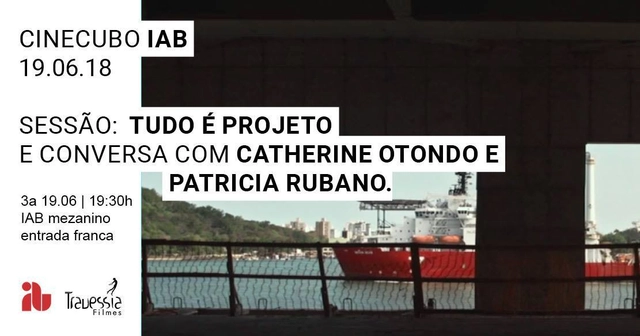
Still from the film “Tudo é projeto” by Joana Mendes da Rocha and Patrícia Rubano.
CineCubo is a film club hosted by the Institute of Architects of Brazil (IAB) designed to foster dialogue between audiovisual and architectural languages and to debate perspectives on the city. On the third Tuesday of every month at 7:30 PM, CineCubo screens films followed by a discussion at the IAB-SP headquarters. Curated and moderated by Nana Maiolini, Travessia Filmes, and guests, the sessions are free and open to the general public.
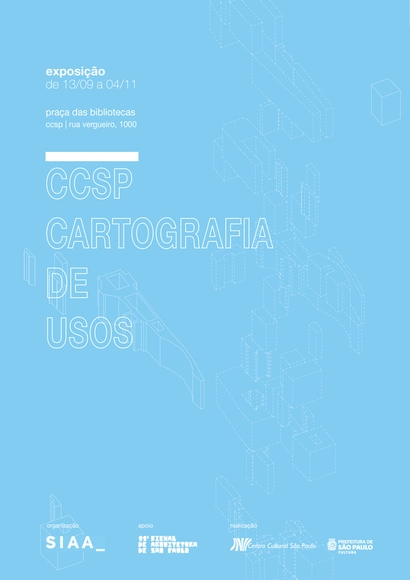
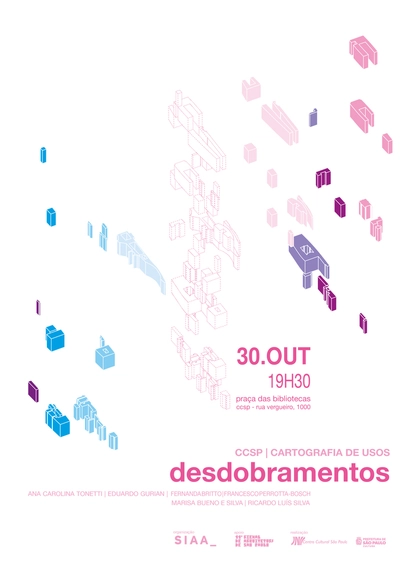
Drawing on the theme "In Project" from the 11th Architecture Biennial, the firm SIAA Arquitetos Associados reflects on the possibility of alternative relationships between architectural design, built space, and public occupation over time, whether anticipated or not. To this end, the firm uses the Centro Cultural São Paulo building—designed by architects Eurico Prado Lopes and Luiz Telles—as the foundation for its reflection, and not by chance. Following a period of immersion in the diverse uses that this space anticipates and enables, this exhibition presents a graphic record developed by the architects at SIAA. The work seeks not only to highlight what is already present in the daily life of the CCSP but also to make explicit the potential of its spaces and uses—whether programmed or appropriated—positioning the building as a powerhouse of cultural management and an architectural and urban object.
CineCubo is a film club hosted by the Institute of Architects of Brazil (IAB) designed to foster dialogue between audiovisual and architectural languages and to debate perspectives on the city. On the third Tuesday of every month at 7:30 PM, CineCubo screens films followed by a discussion at the IAB-SP headquarters. Curated and moderated by Nana Maiolini, Travessia Filmes, and guests, the sessions are free and open to the general public.
Tactical urbanism action carried out earlier this year by FADU-Udelar students
The "Corredor Sur" project, a partnership between the collectives TransLAB.URB (Porto Alegre, Brazil), Urbanismo Vivo (Buenos Aires, Argentina), and FADU (Faculty of Architecture, Design, and Urbanism at the University of the Republic, Montevideo, Uruguay), which began in November 2017, is starting to yield its first results.
Exhibition Title: Designing with Construction Sets Date: April 10, 2018 – May 4, 2018 Time: 8:00 AM – 10:00 PM (Mon–Fri) and 8:00 AM – 12:00 PM (Saturdays) Location: Main Hall of the Rectory, Federal University of Juiz de Fora (UFJF) City: Juiz de Fora, MG Organization: Laboratory for the Study of Languages and Expressions of Architecture, Urbanism, and Design (LEAUD/FAU/UFJF) Curator: Prof. Dr. Frederico Braida
Videos
29TH REGIONAL MEETING OF ARCHITECTURE STUDENTS
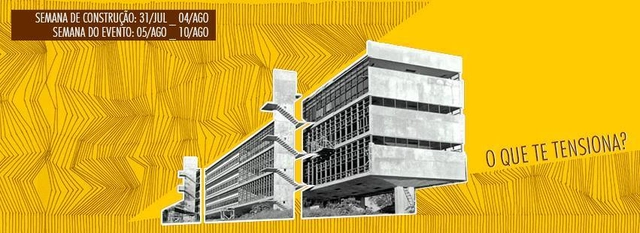
The EREA (Regional Meeting of Architecture Students) examines the extent to which the university is truly integrated into the city. Is São Carlos a university town, or is it a city with universities? It is the city with the highest number of PhDs per square meter, but who does it direct its knowledge toward? It is a technology hub, yet one where research stagnates and fails to reach the periphery; these are universities that claim to be public, yet select which segments of the population can access their spaces and knowledge. Consequently, we do not want to discuss these issues within the confines of the university; we want to burst the university bubble and integrate academic knowledge with the local context, encouraging a horizontal exchange of wisdom. To this end, the meeting will be open, with activities conducted by both participants and the community, given that Parque do Bicão is a public space located in a non-central region, outside the "university town." Thus, we position ourselves to unify and strengthen our efforts alongside social movements, local businesses, occupations, and minority groups, with the goal of deconstructing stereotypes, questioning common sense, combating oppression, and creating tension. And you, what creates tension for you?
Call for papers poster for the CATS communication sessions - Bruna Nogueira
Submissions are now open for ACADEMIC PAPERS for the Communication Sessions of the 4th CATS - CONGRESS ON ARCHITECTURE, TOURISM, AND SUSTAINABILITY - Cataguases, MG.
Applications are now open. Among them are two new postgraduate courses, one in mobility and another in technology.
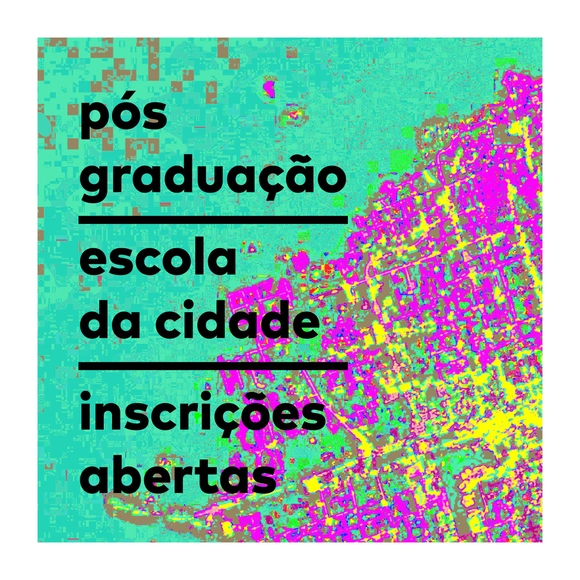
Escola da Cidade is now accepting applications for its second-semester postgraduate programs. Among the offerings are two new courses—one focused on mobility and another on technology. See the details below:
Sidewalks, also known as public walkways, can be understood as multifunctional open spaces where a range of activities occur, from pedestrian flow to social interaction. From this perspective, public walkways have great potential to host green infrastructure solutions—such as rain gardens, bioswales, and stormwater planters—capable of providing a series of environmental services for cities. These include mitigating urban pollution (water, air, and soil), providing habitats for urban fauna, contributing to the control of stormwater runoff volume and velocity, and improving local microclimatic quality and thermal comfort for adjacent buildings through shading and evapotranspiration, in addition to serving as an aesthetic element. Currently, emerging ecological sidewalk design techniques that add value and attractiveness to properties are well-known, utilized, and proven.
Drawing from the theme "In Project" of the 11th Architecture Biennial, the firm SIAA Arquitetos Associados reflects on the potential for alternative relationships between architectural design, the built environment, and its public occupation over time, whether anticipated or not. To this end, they use the Centro Cultural São Paulo building—designed by architects Eurico Prado Lopes and Luiz Telles—as the foundation for their reflection, and not by coincidence.
In this seminar, Sinaenco proposes an analysis of the challenges involved in implementing the BIM Agenda in Brazil, considering the expectation that the methodology will be widespread in public works within 10 years. Starting in 2021, certain federal government agencies are expected to require BIM for the development of architectural and engineering models.
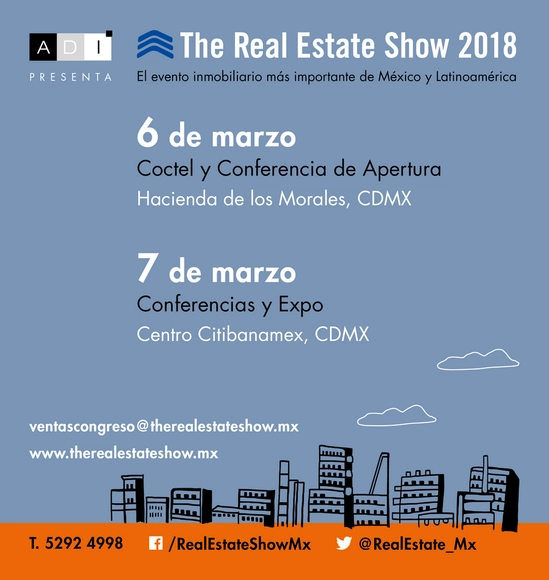
In recent years, The Real Estate Show has established itself as the most important event for the real estate industry in Mexico and Latin America. Since its first edition in 2002, the prominent participation of public officials, business leaders, and international speakers has allowed attendees to learn firsthand about the decisions shaping the nation's course across various political, economic, and social spheres.
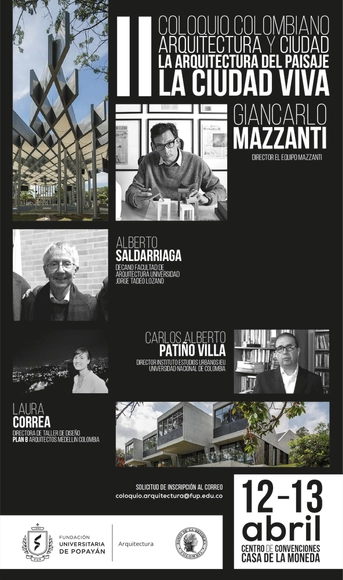
The Fundación Universitaria de Popayán, through its Faculty of Architecture, in a strategic alliance with the Banco de la República, has been working to formulate high-level academic initiatives. These efforts deserve to be shared with the academic community and the general public, which has led to the second edition of the II Colombian Colloquium on Architecture and the City: "Landscape Architecture: The LIVING CITY," to be held on Thursday and Friday, April 12–13, at the Casa de la Moneda Convention Center in Popayán.
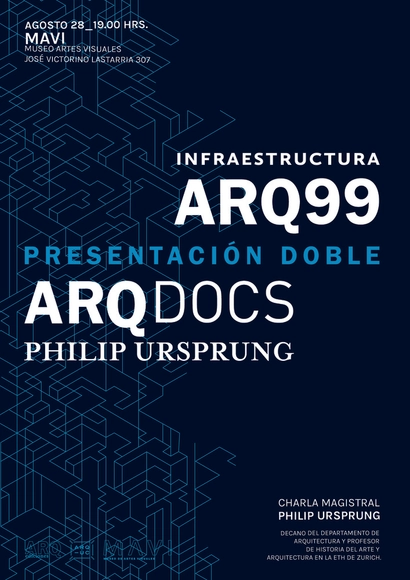
On Tuesday, August 28, the Museo de Artes Visuales (MAVI) will host the launch of ARQ magazine issue 99: Infrastructures, alongside the latest edition of the ARQDOCS series. The event will feature a keynote lecture by the author, Philip Ursprung, Chair of the Department of Architecture and Professor of the History of Art and Architecture at ETH Zurich.