The product has been saved to the folder:
My Downloaded Products

Contact manufacturer
Goppion
Contact manufacturer




Contact manufacturer
Contact manufacturer
The Jewish Museum, housed in the historic Felix M. Warburg House, holds the oldest Jewish museum collection in the United States and more than 30,000 objects—one of the largest collections of Jewish cultural heritage outside Israel.
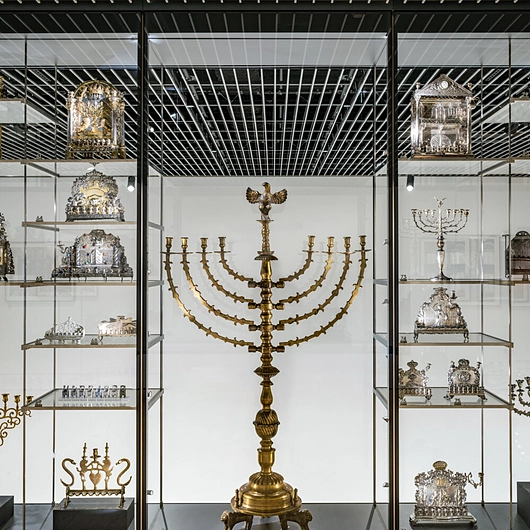
As part of a recent renovation, the Museum updated its third- and fourth-floor galleries to support new approaches to display and learning. A key element of this work is a new presentation of the Museum’s Hanukkah lamp collection, the largest of its kind. In 2024, Goppion was commissioned to design and fabricate the showcase for this installation.
Goppion’s Role: Engineering a Showcase for 130 Hanukkah Lamps
The Museum selected Goppion to design and build a single, free-standing exhibition case capable of displaying 130 lamps from the collection. Each lamp, sourced from different geographies, eras, and materials—from the Renaissance to the 21st century—represents the diversity of Jewish cultural expression, while sharing the common purpose of celebrating Hanukkah through beauty and ritual.
 |
Among the lamps is the rare piece created by Arnold Zadikow, sculptor and architect, during the Holocaust in Theresienstadt. Hidden and used secretly during the war, the lamp survived even as its maker perished. Objects like this required a display environment that expressed both reverence and clarity—qualities central to Goppion’s engineering ethos.
A Bespoke Architectural Installation
The Showcase
Goppion’s solution was a double-sided, 52-foot-long free-standing showcase, composed of 13 contiguous modules, each with its own hinged door system. The case does not simply display objects: it functions as a piece of architectural infrastructure within the Museum’s new spatial configuration.
Design Considerations
This unique blending of display and architecture required Goppion’s precise engineering expertise and sensitivity to spatial aesthetics.
Prototyping, Collaboration, and Technical Innovation
The project team—including the Museum, UNS (United Network Studio), New Affiliates Architecture, and Method Design—embraced Goppion’s engineering design assist methodology.
Prototyping Process
A full prototype was developed and then refined through two major modification phases, enabling the team to:
This iterative process ensured absolute certainty before full-scale production and installation.
A Centerpiece for the Museum’s Teaching and Learning Center
Goppion’s contribution goes beyond engineering; it supports the Museum’s mission to connect audiences with 3,500 years of Jewish culture.
A Celebration of Light and Heritage
The completed installation stands as a luminous anchor within the reimagined galleries, underscoring the significance of light—both spiritual and symbolic—in Jewish life. Goppion’s sophisticated engineering ensures each lamp, from the everyday to the extraordinary, is displayed with clarity, dignity, and narrative power.
More than a display, the project reaffirms the Museum’s role as a place of expression, learning, and exchange, and demonstrates how meticulously crafted exhibition engineering can elevate cultural storytelling.

Contact manufacturer


