The product has been saved to the folder:
My Downloaded Products

Contact manufacturer
Goppion
Contact manufacturer




Contact manufacturer
Contact manufacturer
The newly opened Princeton University Art Museum (October 2025) marks a transformative moment for one of America’s premier academic art institutions. Designed by Adjaye Associates with Cooper Robertson as executive architects, the 146,000-square-foot building doubles the museum’s gallery space and elevates its capacity for conservation, research, and public engagement. Home to world-renowned works by Picasso, Rothko, Mitchell, and Moore, alongside extensive collections of photography, Greek and Roman antiquities, medieval art, Chinese calligraphy, bronzes, and 19th-century paintings, the museum required a display infrastructure equal to the significance and diversity of its holdings.
To meet this ambitious vision, Goppion was commissioned as the primary technical partner for exhibition casework—delivering engineering solutions tailored for both curatorial needs and architectural integration.
Goppion’s Role: Technical Partnership from Concept to Installation
Goppion collaborated closely with Adjaye Associates throughout the exhibit design process, contributing early-stage engineering analysis, iterative prototyping, and full fabrication. This partnership ensured every display case met the museum’s stringent standards for conservation, accessibility, long-term durability, and visitor experience.
Engineering Design Assistance
22 Custom Display Cases Designed for a New Architectural Landmark
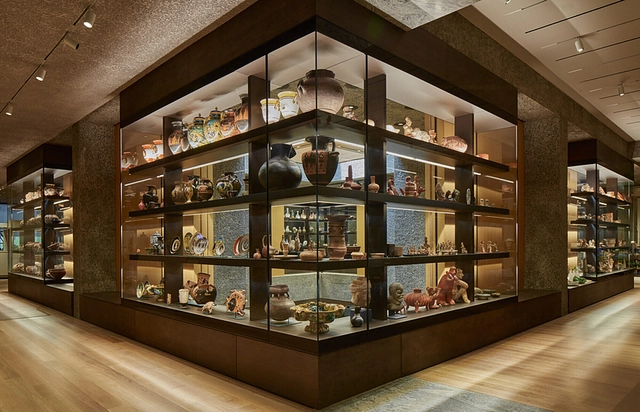
Goppion engineered 22 bespoke display cases, predominantly wall-standing units, designed for both public presentation and behind-the-scenes functionality.
 |
Key Features
This casework supports the museum’s ambition to exhibit its world-class collection with the highest standards of conservation and accessibility.
Innovative Corner Case: A Landmark in Display Engineering
A highlight of the project is Goppion’s special corner display case, an L-shaped pull-and-slide system with a suspended door, engineered to open 70% to both the left and right.
Innovation at Scale
Precision Logistics: Engineering Beyond the Gallery
Goppion’s involvement extended beyond fabrication and installation. Due to the building’s evolving construction, careful advance logistical planning was essential.
Such coordination reflects Goppion’s hallmark approach: engineering solutions not only for objects and cases, but for the entire lifecycle of a museum project.
Signature Case: 6-Meter Bespoke Display with Electric Actuators
Among the project’s standout achievements is a 6-meter-long B-class display case equipped with electric actuators—a custom engineering solution for one of the museum’s antique stained-glass masterpieces.
Key Features
A Museum for the Future—Built on Precision and Collaboration
The new Princeton University Art Museum represents a bold vision: a place where art, architecture, education, and community converge. Resonating with Princeton’s long-standing belief in the power of museums, the building sets a new benchmark for accessible, inclusive, and inspiring cultural spaces.


Contact manufacturer


