The product has been saved to the folder:
My Downloaded Products

Contact manufacturer
Goppion
Contact manufacturer




Contact manufacturer
Contact manufacturer
The Fenix Art Museum about Migration, opened on May 16, 2025, in Rotterdam’s historic Fenix warehouse, represents a bold intersection of adaptive reuse, cultural memory, and architectural storytelling. Situated on the Katendrecht Peninsula, the museum occupies a site that once served as a major hub for the Holland-America Line, facilitating the migration of millions from Europe to the Americas. Built in 1923, the Fenix warehouse was then the largest of its kind globally, making it a highly resonant setting for a museum centered on the theme of human movement.
The museum is the first European commission for MAD Architects, the Beijing-based practice led by Ma Yansong. Their design preserves the historic industrial identity of the warehouse while injecting it with a dynamic contemporary intervention: The Tornado. This 30-meter spiraling tower of polished stainless steel rises dramatically from the heart of the building and acts as both an architectural and narrative anchor, drawing visitors physically and emotionally through the museum.
Exhibition Design and Integration
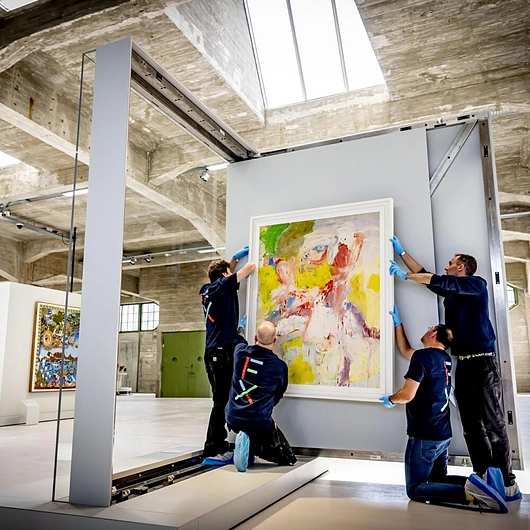
The spatial and curatorial brief—led by curator Roland Buschmann—called for display solutions that could adapt to a wide range of media, from delicate archival materials and sculpture to immersive installations. These solutions had to support modular layouts within the vast open-plan galleries while preserving visual coherence and narrative flow.
Goppion delivered a full suite of custom-engineered museum display systems, including:
These elements were not only functional but integral to maintaining architectural coherence, contributing to an experience that is both immersive and legible.
Material Culture as Spatial Expression
 |
Architectural Ethos
The Fenix Art Museum exemplifies a layered architectural approach, wherein adaptive reuse, contemporary intervention, and narrative integration converge. MAD’s Tornado acts as both sculpture and infrastructure, while the overall design by Goppion and curatorial team respects the spatial DNA of the original warehouse without compromising accessibility or clarity.
Learn more: fenix.nl


Contact manufacturer


