The East River Park Museum Competition in Brooklyn, New York have just announced it’s winner. We really love it’s simplicity and good use of materials. We couldn’t find out who designed it, so if you know, please do tell us!
“In the profession of Architecture today women currently make up about 50% of Graduate students. However, in the profession itself, licensed women practitioners make up only about 15%. Why do you think we see such drastic percentage drops? Why don’t we, women, make it to the end?”
Architect Abre Etteh shared with us this proposal that received an Honorable Mention for the Fashion Museum Competition in Omotesando Street in Tokyo, Japan. The challenge consisted in designing a 100 meters high tower-museum, containing exhibition areas of 20th century fashion history and becoming a landmark for Tokyo.
More images and architect’s description after the break.
In a week where millions will celebrate Passover and Easter, we think it would be good to remember some great religious architecture we’ve been featuring in the past. After the break, our third selection of religious architecture.
Farewell Chapel / OFIS Arhitekti A farewell chapel is located in a village close to Ljubljana. The site plot is next to the existing cemetery. The chapel is cut into the rising landscape. The shape is following the lines of the landscape trajectories around the graveyard. Three curved walls are embracing and dividing the programs. External curve is dividing the surrounding hill from chapel plateau and also reinstates main supporting wall (read more…)
We’ve told you before what Hometta is. This summer Hometta presents a virtual neighborhood modeled after its collection of small, modern house plans. H-Town will help Hometta fans further experience the Hometta designs in an interactive way. Through avatars, visitors will be able to explore, socialize with others through chat, and participate in self-guided tours of the Hometta houses.
Portugal-based architects Spaceworkers shared with us their proposal for a competition sponsored by the city of Maribor in Slovenia within the European Capital of Culture.
The challenge was to create a footpath and cycling bridge in a place where the first bridge in this city once existed.
More images and architect’s description after the break.
Have you been on a vacation for the past week? Turned off your computer and coming back today? Either way, there may be some great posts we featured last week we don’t want you to miss. Check them all after the break.
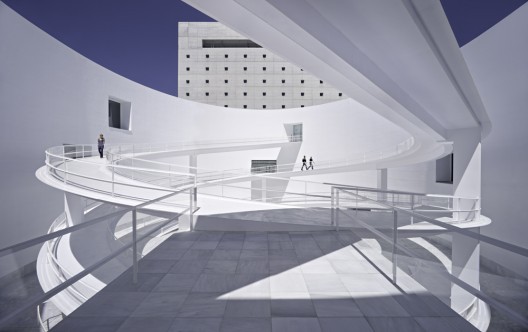
The MA: Andalucia’s Museum of Memory / Alberto Campo Baeza We would like to make “the most beautiful building” for the Museo de al Memoria de Andalucía (Andalusia’s Museum of Memory) in Granada. The MA. A museum that wishes to transmit the entire history of Andalusia. As early as Roman times, Strabo described the inhabitants of Andalusia as “the most cultivated of the Iberians, who have laws in verse.” (read more…)
Wai Think Tank have shared with us their proposal for the Fashion Museum Competition in Omotesando Street in Tokyo, Japan. The challenge consisted in designing a 100 meters high tower-museum, containing exhibition areas of 20th century fashion history and becoming a landmark for Tokyo.
See more images and architect’s description after the break.
Exploration of natural systems from the microscopic to the universal unearths vast design potential for overlaying cultural, ecological, and life cycle flows toward determining new architectonic strategies.
Iceland Pavilion for Shanghai World Expo 2010 was designed by Plús Arkitektar. The concept for the Icelandic Pavilion is to create the image of an ice cube made of backlit printed fabric on the exterior that captures the complex ice patterns that are only visible within a glacier.
More images and architect’s description after the break.
From Portugal, Germany, Canada, UK and Sweden, here’s our third selection of previously featured museum on AD. Remember to check them all after the break!
Santa Marta Lighthouse Museum / Aires Mateus Aires Mateus is an office that has been working on minimal projects, blending the new with the old in a subtle way. More fresh portuguese architecture, thanks to photographer Joao Morgado for sharing this with us! (read more…)
A new concept of the city has emerged among contemporary urbanists. Architects and planners now frame the city not as a set of independently regulated functions but as a mesh of landscapes, spaces, and policies. Streets, paths, parks, and infrastructure are elements of a constantly shifting system that joins the particularities of place and overarching social goals.
The AIA Young Architects Forum (YAF) and the AIA Committee on Design (COD) invite architects, students, and allied design professionals to submit sketches to the international 2010 YAF/COD Ideas Competition: Temporary/Permanent Relief Housing. In this year’s unique sketch competition, submitters are asked to explore the issue of temporary relief housing that could have a permanent function, through a concept design problem.
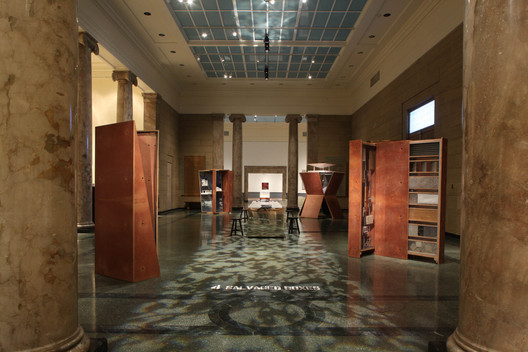
The 4 Salvaged Boxes document the design approach and process wHY Architectureapplied toward quality design and creative environmental sustainability, with focus on the Grand Rapids Art Museum, the first new art museum building in the world to receive the LEED Gold certification, and other current projects from wHY Architecture and Design.
Almost a year ago, we featured the Austrian Pavilion designed by Vienna based firms SPAN and Zeytinoglu Architects for Shanghai World Expo 2010. Now, the pavilion is almost complete. See more images of the construction after the break.
From old stores to new residences, this is our second part (see the first one here) of our selection of previously featured refurbishment projects in AD. Check all of them after the break.
H&M Store in Barcelona / Estudio Mariscal A design project aimed at creating excitement among the customers that go into the shop. Excitement at buying clothes and also to be shopping in a pleasant, comfortable, unique place. To make sure that the area is the setting for a pleasant, fun-filled experience. Second objective: that the clothes should find their own place, that the distribution of the shop should order the exhibition of the clothes and the routes (read more…)