Our friend Mattias Karlsson from karlsson wachenfeldt arkitekter sent us this info on their latest project. Dalslandsring is a new center for all kinds of motorsport in the small community of Färgelanda in Dalsland, Sweden. It will accomodate over 30 000 spectators and includes 5 different race tracks, exhibition area, driver education, fire station, motel, camping and restaurants.
Dalslandsring is situated in the car-crazy west sweden and it´s one piece of a puzzle to draw interested visitors to the area. This is to be a facility who stands for a new generation of enviromentally friendly racing. Cars runs on eco-fuels, Dalslandsring produces its own energy and spectators arrive by train.
The Project is based around a central complex with spectator stands, service and the racecontrol tower.
The Wolfe Center for the Arts will be the first completed American project for the Norwegian architectural firm Snøhetta. The new structure is located on the campus of Bowling Green State University in Bowling Green, Ohio. The building design was led by Snøhetta architect Craig Dykers and will feature 93,000 square-feet of space.
Project was recently launched with a unique groundbreaking celebration that featured a 60-piece wind symphony and a architectural model created by the school’s ceramic students. The building is designed to unite a diverse range of art studies into a social facility that encourages interaction between the students and faculty. The architects also wanted to make it a space for the whole school, breaking barriers between people’s different interests.
Our friend Péter Archibald Bodola sent us their design of a temporary art pavillion for a competition called TOGS (Temporary Outdoor Gallery Space) in March of this year, where 200 entries from all over the world were received by the organizers. The temporary architecture installation is an outdoor exhibit which provides prestigious gallery space.
More images and architect’s description after the break.
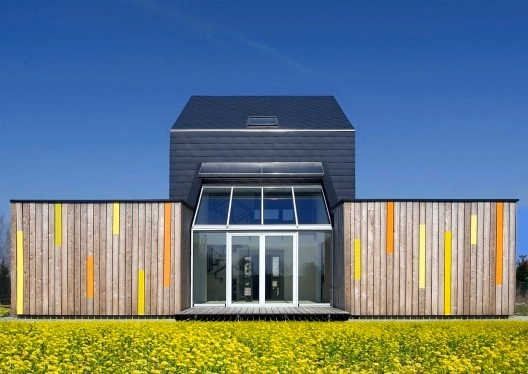
Wood can be a very good material when designing your future house. It can be cheap, energy efficient, and of course, look good. So to finish this week’s Round Up, we bring you previously featured wooden houses.
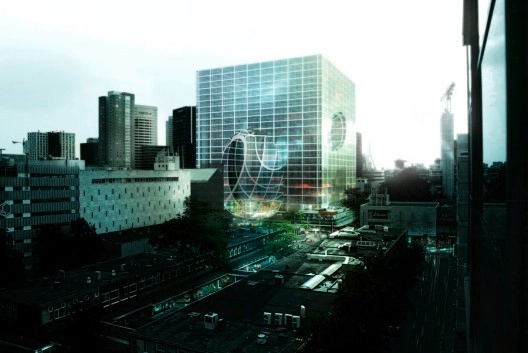
Schmidt Hammer Lassen Architects was recently announced as the winner to design ‘Urban Mediaspace’, the largest public library in Scandinavia. The 228 million euro project is located in Aarhus, Denmark and is only the latest in the studio’s history of library designs. Other finalist in the competition included Mecanoo, GPP architects and A-team, a collaboration between two danish studios, Aart and Arkitema.
Schmidt Hammer Lassen’s deisgn aims to re-examine the traditional concept of library design. Rather than focusing on books, the building is envisioned as a hub for social interaction that includes indoor and outdoor recreation spaces, as well as studying, socialising and relaxing areas. Measuring 30,000 square metres, ‘Urban Mediaspace’ is located in Aarhus’s old cargo docks area. The building is heptagonal in shape and features a glazed-facade.
Our friends from MVRDV sent us their latest project with Living Architecture, the Balancing Barn, a cantilevered holiday home near the village of Thorington in Suffolk, England. Living Architecture, a British organization devoted to architecture as experience, has commissioned a series of outstanding holiday homes in the UK. MVRDV and co-architect Mole Architects from Cambridge will create a house sympathetic in spirit and materials to the exceptional natural site, which will be available for holiday rental from 2010.
More images and architect’s description, after the break.
The ‘Harvest Green Project’ by Romses Architects was a winning entry in a recent competition held by the city of Vancouver: ‘The 2030 Challenge’ to address climate change plans and to guide greener and denser development, reducing carbon emissions for the future.
The concept of ‘harvest’ is explored in the project through the vertical farming of vegetables, herbs, fruits, fish, egg laying chickens, and a boutique goat and sheep dairy facility. In addition, renewable energy will be harvested via green building design elements harnessing geothermal, wind and solar power. The buildings have photovoltaic glazing and incorporate small and large-scale wind turbines to turn the structure into solar and wind-farm infrastructure. In addition, vertical farming potentially adds energy back to the grid via methane generation from composting non-edible parts of plants and animals. Furthermore, a large rainwater cistern terminates the top of the ‘harvest tower’ providing on-site irrigation for the numerous indoor and outdoor crops and roof gardens.
Our friend Djordje Pejkovic from Serbia sent us this interesting project, currently in development. The Ski Jumping Hill is located in the Kopaonik Ski Resort in central Serbia, close to the border with Kosovo. The 120 meter structure is made from cross steel tubes and every detail in the column is visible. The top is horizontally cut to accomodate a viewing platform with a coffee shop in the top deck.
Our friends from Minimalismi shared with us this info. This October, Zaha Hadid will exhibit her best works in an exhibition at the Salone of the Palazzo della Ragione in the Italian city of Padova.
The Palazzo has presented itself as a vigorous design challenge for Zaha Hadid due to the historical quality of the space. The aim has been both to respect the spatial / contextual characteristics and to intervene in the space at the same time. The undulating blocks, whose forms are defined by the rules of breaking and continuity, generate 6 distinct islands within themselves. Each of these islands define the Conceptual Morphologies of the ZHA exhibition concept, namely: (1) Lines/Bundles/Networks, (2) Waves/Shells/Cocoons, (3) Aggregations/Clusters/Jigsaws, (4) Fields, (5)Landscape & Topography, and (6) Parametricism.
The project was designed for a competition called TOGS (Temporary Outdoor Gallery Space) in March of this year, where 200 entries from all over the world were received by the organizers. The temporary architecture installation is an outdoor exhibit which provides prestigious gallery space.
More images and architect’s description after the break.
Rem Koolhas founded the Office for Metropolitan Architecture in 1975 together with Elia and Zoe Zenghelis and Madelon Vriesendorp. Winners of the Pritzker Prize in 2000, OMA employs a staff of almost 300 of more than 35 nationalities. So for today’s Round Up, we bring you previously featured projects by OMA.
Eric Owen Moss Architects created a mixed use tower that neighbours the capitol building in Almaty, Kazakhstan. The republic square is part of a large-scale development across the city of Almaty.
The tower itself is 126,000 square feet that will be divided up between retail, office, hotel and residential spaces. The building is a long tower which is anchored to the ground by a 38 meter diameter spiral. This feature will enclose an indoor plaza or ‘winter garden’ connecting the two sides. The spiral provides major support for the structure and encapsulates the five public venues near the ground level. In between these five spaces, four courtyards let natural let in and are each shaped to represent the four seasons of the year.
The five human senses are the main theme of the space in which materials and vegetation are related to them. The equipped green area and urban garden is due to be completed this month.
Our friend Marcello Silvestre, from Iodice Architettisent us their design por the Italian Pavillion for the Shanghai World Expo 2010. Silvestre, along with Francesco Iodice and Giuseppe Iodice from Iodice Architetti worked with Giampaolo Imbrighi, Teresa Crescenzi, Antonello De Bonis, and Cosimo Dominelli in the design of the pavillion. The project proposes a building which integrates a typical model of the Italian urban building, with the architectural structure of the Chinese construction game called Shanghai. More images and architect’s description after the break.
A narrative slideshow that depicts a day in the life of a Berkeley architecture student (played by Chris Torres). Photography and editing by Peter Hess. Music by Nine Inch Nails.
The Docks de Paris project by Paris based architecture studio Jakob + MacFarlane is nearing completion. The building was first designed in 2004 for a competition held by the city of Paris. Jakob + MacFarlane’s entry eventually won the competition and has been underway since 2007.
The project is actually a renovation of a concrete shipping depot originally built in 1907, which the architects chose to keep for the base of their new design. The architects are calling their design a ‘plug-over’ as the new structure is a new external skin that enveloped the existing site on the sides and on top. The river facing façade features a glass covered steel tube structure that is inspired by the flow of the river and its pedestrian promendades. The roof has also been developed using wooden decks and grassed areas. The front façade addition serves as the buildings circulation system allowing visitors to move between levels. Inside the new building will feature a variety of programming including galleries, retail shops, the french fashion institute, and cafes.