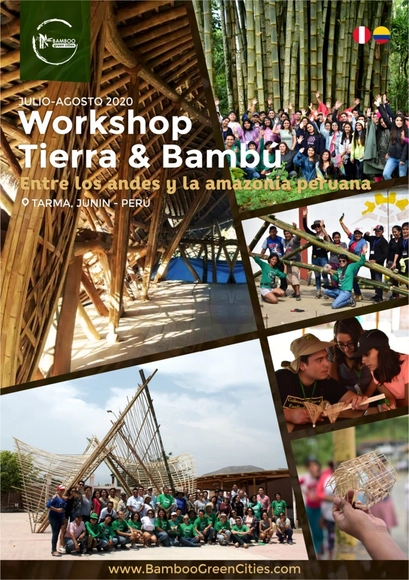
We are officially launching the 3rd edition of the Bamboo Experience Camp - Peru 2020, an international training workshop where we will construct a module using earth and local, native, and introduced bamboo species—Chusquea dombeyana and Dendrocalamus asper—in the city of Tarma, Peru.
Earthen architecture is an important part of Chile's construction heritage. It declined during the height of the Industrial Revolution but has seen a strong resurgence in recent decades, driven by the need to make construction more sustainable for our planet. In this context, innovation in construction systems that incorporate earth and natural fibers as building materials offers an appropriate expression of local identity and an understanding of the territory as pillars of the new human habitat.
The IV ENEEEA aims to discuss the teaching of structures in architecture schools, addressing traditional structural systems and innovations, as well as their integration with architectural design courses and other didactic activities outlined in the programs' pedagogical curricula.
This Forum aims to bring together, over four days in Belo Horizonte, various stakeholders involved in housing issues—architects, planners, public officials, members of municipal housing councils, grassroots movements, government representatives, organizations, and other professionals working in the field, as well as researchers and students. In doing so, it aims to provide a space for multidisciplinary discussion, addressing both theoretical and practical issues related to urban living.
The course—organized into three monthly modules (April, May, and June), each consisting of four classes—will examine central issues in modern art history through the works of: Paul Cézanne, Aleksander Rodchenko, Hannes Meyer, and Le Corbusier (Module 1, April); Federico Fellini, Giuseppe Terragni, Arnold Schoenberg, and Rem Koolhaas (Module 2, May); Kazimir Malevich, Marguerite Duras, Louise Bourgeois, and Toyo Ito (Module 3, June). Modules may be taken individually or sequentially.
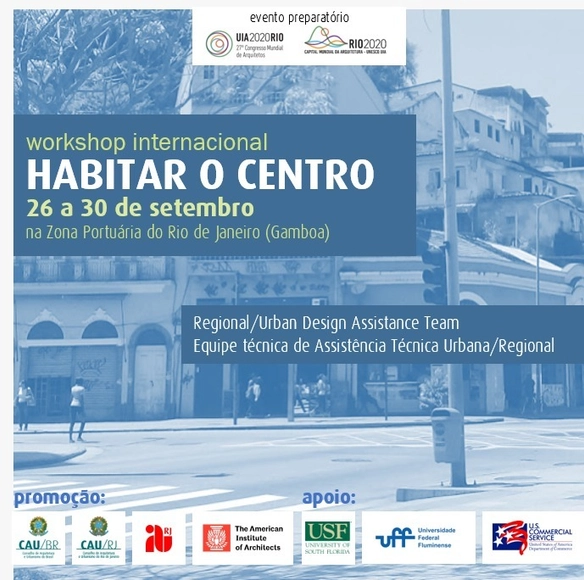
The event's objective is to discuss alternatives for the Gamboa area, in Rio's Port Zone, to once again be inhabited by the population with quality of life.
The International Workshop "Habitar o Centro" (Living in the Center) begins this Thursday and runs through September 30th, as part of the American Institute of Architects (AIA) Regional/Urban Design Assistance Team (R/UDAT) program. The event aims to discuss alternatives for revitalizing the Gamboa area in Rio's Port Zone, ensuring it becomes a high-quality residential neighborhood once again. The opening ceremony will take place this Thursday, the 26th, at 7:30 PM at the IAB-RJ headquarters (Beco do Pinheiro, 10, Flamengo) and is open to the public.
Castro Abierto is a festival of architecture, landscape, and heritage that invites the public to rediscover the commune by visiting spaces of high architectural, environmental, urban, social, and cultural value free of charge on March 30 and 31. This event will take place for the first time in both urban and rural Castro during the last weekend of March. Seventeen spaces will open their doors to the public, offering guided tours led by architects, community leaders, carpenters, managers, neighbors, and the property owners themselves. This inaugural edition of Castro Abierto aims to create a space for exchange among the various members of the island community to reflect on its cultural landscape and how the processes of territorial transformation affect us all. Accordingly, on March 30 and 31, visitors will be able to explore the following spaces:
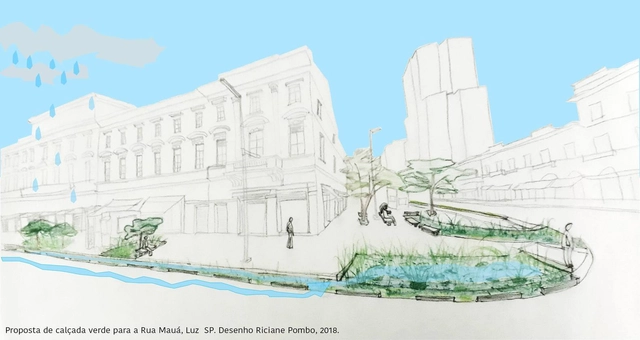
Green sidewalk proposal for Rua Mauá, 512 - Luz, SP. Architect and urban planner Riciane Pombo, 2018.
Sidewalks, also known as public walkways, can be understood as multifunctional open spaces where a range of activities occur, from pedestrian flow to social interaction. In this context, public walkways have significant potential to house green infrastructure solutions—such as rain gardens, bioswales, and stormwater planters—capable of providing a range of environmental services for cities. These include mitigating urban pollution (water, air, and soil), providing habitats for urban fauna, contributing to the control of stormwater runoff volume and velocity, and offering improved local microclimatic quality and thermal comfort for adjacent buildings through shading and evapotranspiration, in addition to serving as an aesthetic element. Emerging ecological sidewalk design techniques that add value and appeal to properties are currently well-known, utilized, and proven.
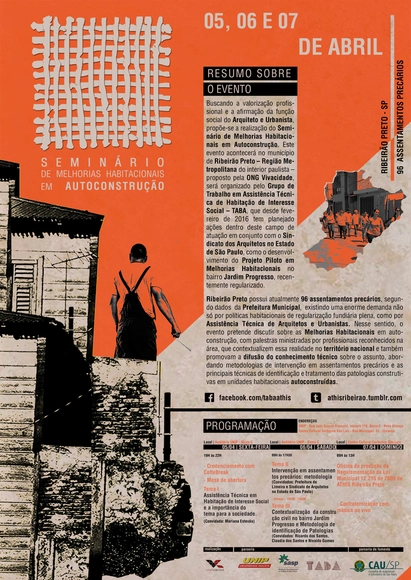
In April, the NGO Vivacidade is hosting the Seminar on Housing Improvements in Self-Construction, a free event organized by the TABA group for Technical Assistance in Social Interest Housing, with funding support from the Council of Architecture and Urbanism of São Paulo (CAU/SP), under public notice no. 001/2018 and funding agreement no. 007/2018.
This is a space for discovery and discussion regarding the present and future of the country's cities. The event aims to share approaches, evidence, and proposals concerning Peru's cities, and to facilitate the exchange of multi-stakeholder efforts aimed at improving urban areas nationwide, with the goal of accelerating Peru's transformation into a country of high-quality cities for all citizens.
Launch of the second ARQ Docs of 2019, The Architectures of Prediction: Truth is in the Tower, by Francesca Hughes, Director of the School of Architecture at the University of Technology Sydney, Australia. During her visit, she will deliver the keynote lecture, "The Architecture of Error."
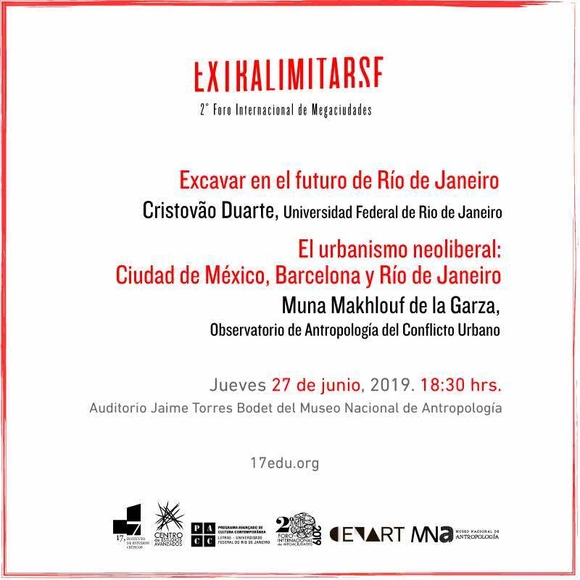
Pushing Boundaries, 2nd International Megacities Forum. How can we end ongoing violence? Improvisation in atrocious times. Dialogue and reflection on territories, migrations, cultures in resistance, feminisms, and art. June 25–29. National Museum of Anthropology. Mexico City. Register at 17edu.org. Free admission.
DIAGRAMA TEAM (14th Bolivian Architecture Biennial)
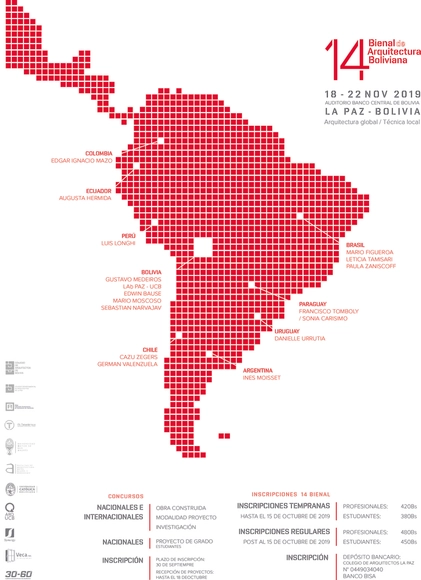
The 14th Bolivian Architecture Biennial will be held in the city of La Paz from November 18 to 22, 2019. The event will feature architectural exhibitions highlighting the trajectory and contributions to Bolivian architecture, keynote lectures by renowned national and international guests, and architectural production competitions.
20th International Conference on Heritage Intervention
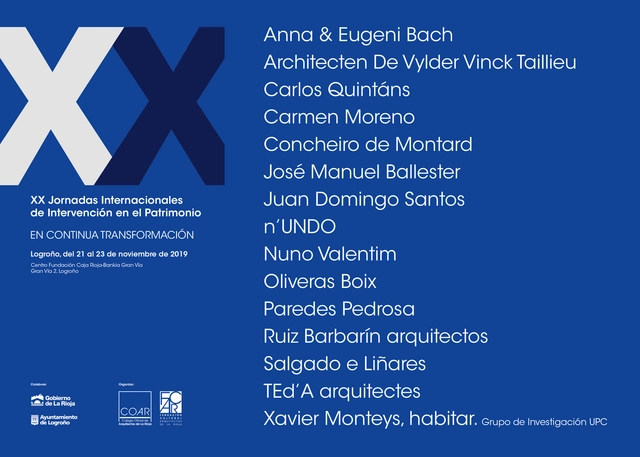
The 20th edition of the International Conference on Heritage Intervention, titled "In Continuous Transformation," will take place in Logroño from November 21 to 23. The event is organized by the La Rioja Architects' Association, with support from the Government of La Rioja and the Logroño City Council. Speakers will include Jan de Vylder, Carlos Quintáns, Antonio Ruiz Barbarín, Ignacio García Pedrosa, Juan Domingo Santos, Nuno Valentim, Isabel Concheiro, Núria Oliveras, and Xavier Monteys, among others.